
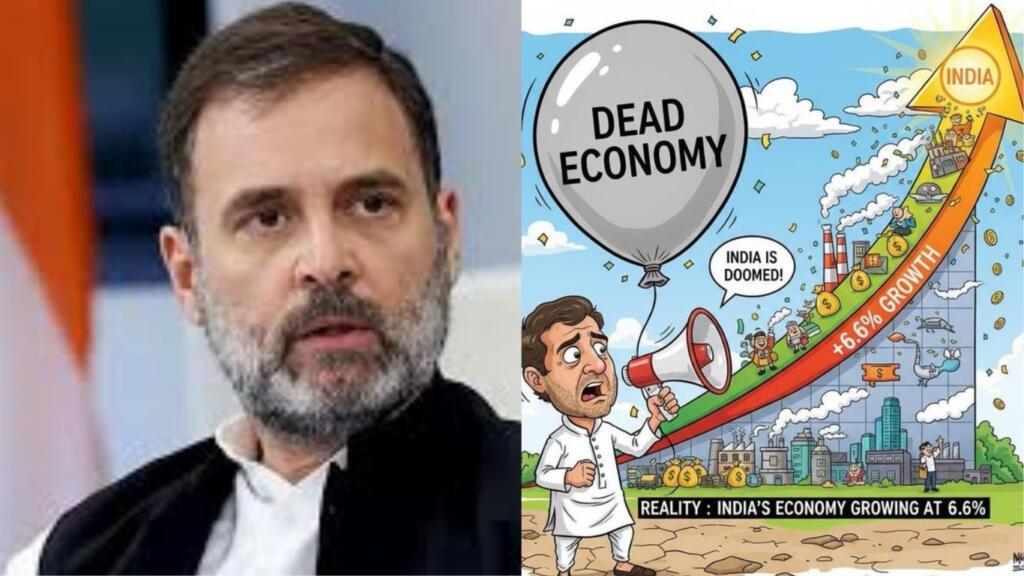
The International Monetary Fund (IMF), in its World Economic Outlook released on October 14, 2025, has once again reaffirmed India’s position as the world’s fastest-growing major economy, projecting a strong 6.6% GDP growth for 2025-26. This is a 0.2 percentage point increase from its July forecast, a remarkable feat amid global trade disruptions and tariff pressures. India’s projected growth stands far ahead of other leading economies the United States at 2.0%, China at 4.8%, Japan at 1.1%, and Germany at a mere 0.2%. This latest IMF projection completely shatters the Congress propaganda that India’s economy is “dead.” Just a month ago, Rahul Gandhi irresponsibly echoed U.S. President Donald Trump’s insult, calling India a “dead economy.” Now, the IMF’s figures have proved that India’s economy is not just alive but thriving a global growth engine powering through adversity.
Rahul Gandhi’s Anti-India Narrative Exposed Yet Again
At a time when the entire world is battling inflation, slow growth, and trade disruptions, the IMF’s recognition of India’s resilience is a matter of national pride. But instead of supporting India’s economic success, Rahul Gandhi chose to side with a foreign leader who insulted India, agreeing with Trump’s remarks that the Indian economy was “dead.”
Rather than standing with the people of India, Rahul Gandhi chose to mock his own nation on the global stage a move that has now spectacularly backfired. His remarks reveal what has long been evident: for Congress, politics always comes before patriotism.
Trump had announced a 25% tariff on Indian imports, along with an additional 25% penalty for India’s Russian crude and defence purchases, claiming, “They can take their dead economies down together.” Instead of condemning this insult to India’s sovereignty, Rahul Gandhi applauded it, declaring that he was “glad” Trump spoke the “truth.” Ironically, the very institution that Rahul Gandhi and his allies frequently cite for data the IMF has now delivered a clear verdict that exposes their deceit.
India’s Economic Momentum Defies Global Headwinds
According to the IMF’s October 2025 report, India’s economic performance is driven by “strong Q1 momentum and robust domestic demand”. The country’s growth is powered by structural reforms, a young workforce, and resilient consumption patterns that continue to offset global uncertainties. The IMF also notes that India’s inflation trajectory has “surprised on the downside,” indicating macroeconomic stability and effective policy management.
The IMF expects India’s GDP to grow 6.6% in FY2025-26, followed by a slightly moderated 6.2% in FY2026-27, still keeping India well ahead of every major global economy. In contrast, developed nations such as Germany (0.2%), Japan (1.1%), and the United Kingdom (1.3%) are witnessing stagnation. Even China, once touted as India’s economic rival, trails significantly behind.
BJP National General Secretary Tarun Chugh rightly summed up the sentiment, saying, “At a time when the whole world is witnessing recession, the IMF projecting India to grow at 6.6% is proof that PM Modi’s policies are strong and self-reliant. Today, India has become an engine of progress and development for the world. The IMF’s projection for India is a tight slap for Rahul Gandhi.”
India’s Rise Amid Trade Tensions and Tariff Challenges
The IMF report also factored in the impact of President Trump’s 50% tariffs on U.S. imports, including those from India. Yet, despite the heavy trade restrictions and global supply chain disruptions, India’s economy continues to outshine its peers. The IMF explicitly mentions that “carryover from a strong first quarter more than offset the increase in U.S. effective tariff rates on imports from India since July.”
The report further highlighted that India’s exports now face an average 35.8% effective tariff rate the second highest among major economies after China. Even so, India’s economic fundamentals have remained solid. Domestic consumption, manufacturing expansion under Make in India, and digital transformation under Digital India have insulated the economy from external shocks.
Meanwhile, the IMF’s global analysis warns that an escalating U.S.-China trade war could drag global GDP by up to 1.8% by 2027, but India’s diversified economy and internal demand buffer it from the full impact of such global slowdowns. The organisation also credits India’s younger demographic and technological advancements for sustaining high growth levels.
Congress Chooses Politics Over Nation
Rahul Gandhi’s misjudgment and his alignment with Trump’s disparaging comments have once again exposed the Congress Party’s anti-India mindset. Instead of defending India’s economic sovereignty, he mocked it, echoing the words of a foreign leader imposing punitive tariffs on Indian goods. Now, the IMF has delivered the final verdict India is the fastest-growing major economy in the world, while Congress remains the slowest-learning opposition in Indian history.
The IMF’s upward revision of India’s growth forecast even amidst tariff hikes and global uncertainties is a testament to Prime Minister Narendra Modi’s economic vision, strong governance, and the resilience of the Indian people. It sends a clear message to the world: India’s growth story is not a narrative of chance, but of conscious policy, innovation, and national will.
For Rahul Gandhi and the Congress, this should serve as a wake-up call. But as history shows, when India rises, they only complain because their politics thrives not on progress, but on pessimism. The IMF report has not just validated India’s economic strength; it has exposed how hollow and politically motivated Congress’s anti-national rhetoric truly is.