



















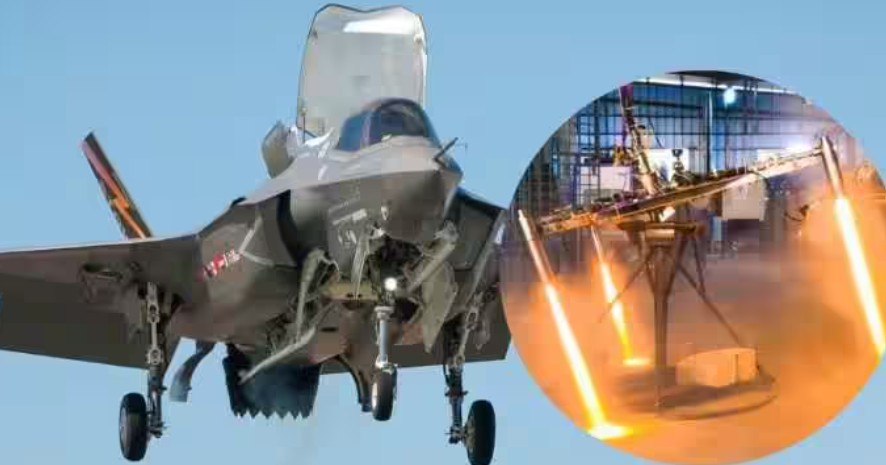
In a significant breakthrough, researchers at the Indian Institute of Technology (IIT) Madras have successfully developed a vertical take-off and landing (VTOL) aircraft and an unmanned aerial vehicle (UAV) powered by hybrid rocket thrusters.
In an advanced experiment that integrated a real-time hybrid rocket thruster with virtual simulation, the team achieved the required velocity for a “soft landing” — a critical capability for both planetary exploration modules and terrestrial VTOL aircraft.
The researchers noted that touchdown velocity is a key factor in ensuring safe vertical landings. Their findings, published in the International Journal of Aeronautical and Space Sciences, explore the feasibility of using hybrid rocket motors for vertical landing systems.
These motors are not only simpler and safer than traditional liquid engines but also offer enhanced throttling and control. Hybrid rocket systems are increasingly popular as they combine the advantages of both liquid and solid propulsion technologies.
Currently, most VTOL systems are highly complex and demand extensive maintenance. To address this challenge, the IIT Madras team conceptualised a hybrid rocket thruster-powered platform as part of an initiative to develop an efficient propulsion unit for VTOL applications in aircraft and UAVs.
According to PA Ramakrishna, Professor at the Department of Aerospace Engineering, IIT Madras, “VTOL enables an aircraft to take off and land vertically, eliminating the need for infrastructure like long runways. VTOL capability will enable access to remote locations and rugged terrains where long runways and large airports are difficult to establish. Currently, helicopters are the system operating on those terrains; however, they face limitations in terms of speed, range and efficiency compared to a fixed-wing aircraft.”
He further added, “Once the VTOL system reaches the Technology Readiness Level (TRL) for commercial application, it will be a game-changer in both civil and military aviation. VTOL will help to decentralise air transport to multiple locations rather than a single big airport or an airbase.”
Such decentralisation, he explained, offers significant strategic and operational advantages. The current study marks an important step toward the development and demonstration of a proof-of-concept for a hybrid rocket-powered VTOL platform.
Ramakrishna also noted that the positive outcomes from the study open avenues for further experimental work on landing platforms with multiple degrees of freedom.
“Once attitude stabilisation (maintaining orientation in a desired direction) of the platform is achieved, a hardware-in-the-loop simulation for landing without the assumption of an attitude-stabilised system could be carried out. This would be a step closer to realising a VTOL platform with hybrid rocket thrusters,” he said.
Attitude stabilisation is essential for maintaining the desired orientation of a VTOL platform during hovering, take-off, and landing. The developed technology, he added, could initially be applied to fixed-wing UAVs, serving as a proof-of-concept for broader aerospace applications.
“This not only serves as a proof-of-concept for broader aerospace applications but could also attract attention from industries interested in next-generation air mobility solutions,” Ramakrishna said.