




















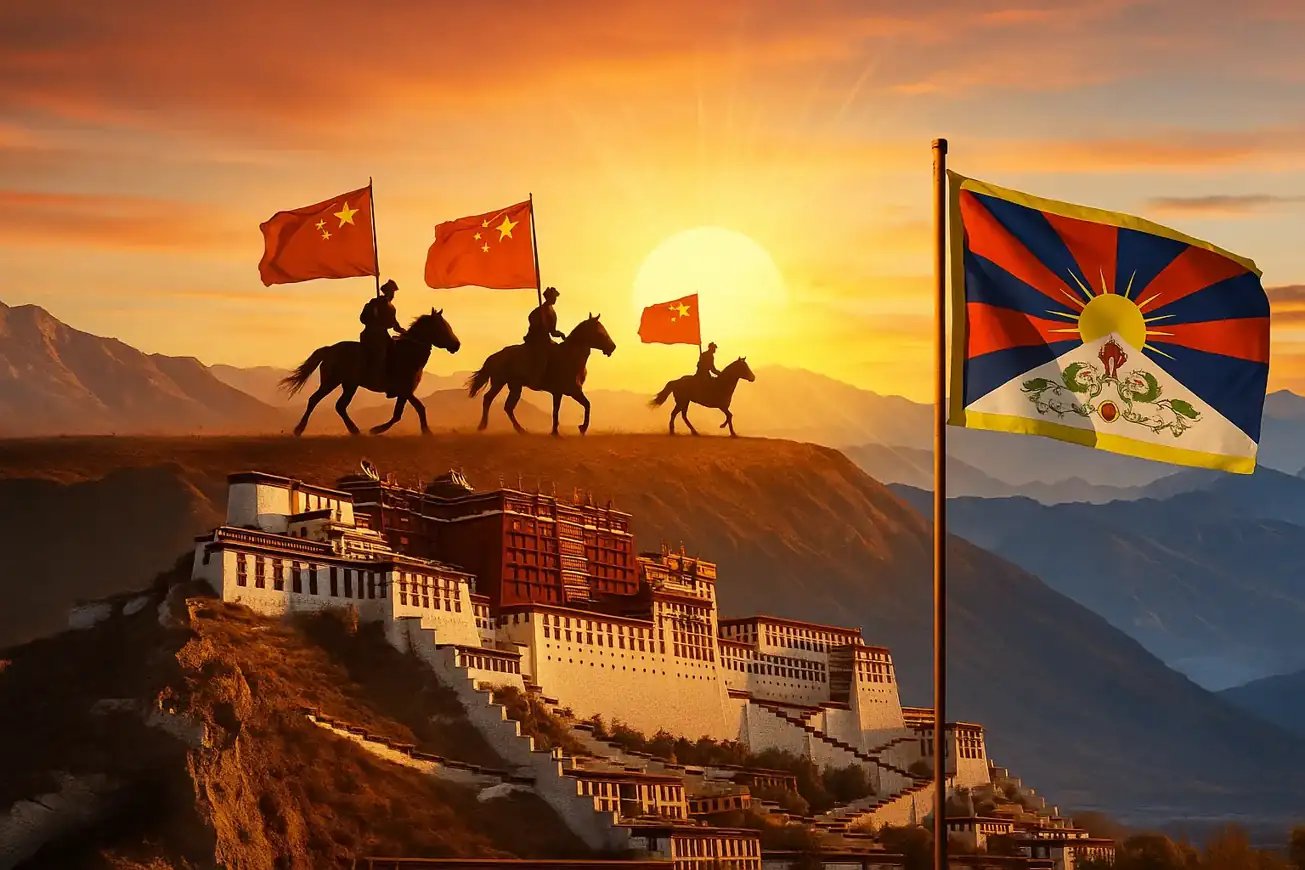
In 1950, the Chinese Communist Party (CCP) launched an invasion of Tibet. From Tibet’s perspective, this invasion interrupted centuries of independent nationhood. The Chinese, meanwhile, believed they were simply re-establishing control of part of their sovereign territory, which had been wrested from them during the past century of foreign imperialism and precipitating civil war.
Exile and Resistance: 1959 — The Year Tibet Rose and Fell
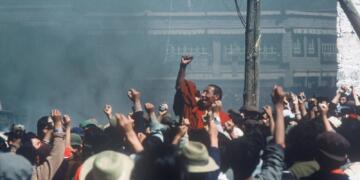
Following the uprising against Chinese occupation in March 1959, thousands of Tibetans, including the Dalai Lama, were forced into exile. The Dalai Lama referred the matter of Tibet to the UN Secretary-General in September 1959, seeking an international response to the situation in Tibet.
The United Nations General Assembly (UNGA) adopted three resolutions concerning Tibet between 1959 and 1965, specifically in 1959 (Res. 1353), 1961 (Res. 1723), and 1965 (Res. 2079), calling for the respect of the Tibetan people’s human rights and cultural heritage, which remain unheeded today.
These resolutions emphasised the principles of the UN Charter and the Universal Declaration of Human Rights, with Resolution 1723 also calling for respect for the right to self-determination, as reported by the Tibet Advocacy Coalition and Wikipedia. However, the resolutions have been largely ignored by China, leading to a continued violation of the fundamental rights and freedoms of the Tibetan people, according to the Central Tibetan Administration and the International Campaign for Tibet.
The 1959 Resolution 1353 (XIV) deplored the continued violation of fundamental rights and freedoms in Tibet and called for respect for human rights and the distinct culture of the Tibetan people. The 1961 Resolution 1723 (XVI) reaffirmed the importance of the UN Charter and the Universal Declaration of Human Rights, and specifically called for respect for the Tibetan people’s right to self-determination. Lastly, the 1965 Resolution 2079 (XX): The third resolution that further called for the respect of Tibetan rights and culture.
The UN’s Crisis of Conscience
The problem is UN resolutions are recommendations, not binding laws, and the UN has no authority to enforce them on sovereign nations. Moreover, China, a permanent member of the UN Security Council, continues to ignore the resolutions, viewing them as an interference in its internal affairs and upholding its claim over Tibet, according to the International Campaign for Tibet. The international community’s concerns are often overshadowed by geopolitical and economic interests, making it difficult for the UN to act decisively against powerful nations like China.
But, Tibet is not the only region facing Chinese repression. The People’s Republic of China (PRC) has maintained its systematic suppression of human rights across the country in 2024, Human Rights Watch has said in its World Report 2025. Apart from Tibet, PRC is repressing the Uyghurs in Xinjiang, and the authorities have further dismantled Hong Kong’s basic freedoms.
For the 546-page world report, in its 35th edition, Human Rights Watch reviewed human rights practices in more than 100 countries. In much of the world, Executive Director Tirana Hassan writes in her introductory essay, governments cracked down and wrongfully arrested and imprisoned political opponents, activists, and journalists. Armed groups and government forces unlawfully killed civilians, drove many from their homes, and blocked access to humanitarian aid. In many of the more than 70 national elections in 2024, authoritarian leaders gained ground with their discriminatory rhetoric and policies.
Beijing’s Playbook: Power Over Principles
The Chinese government revised the State Secrets Law and published the implementing regulations, expanding the law’s already overly broad scope. Previously tolerated topics, such as criticisms of the economy, have become off limits.
The Chinese government continued to imprison human rights defenders, including human rights lawyer Yu Wensheng and his wife, rights activist Xu Yan, who were taken into custody while going to meet European Union representatives visiting China. Courts sentenced the feminist journalist Huang Xueqin and the labor rights activist Wang Jianbing to prison.
In March, the Hong Kong government introduced a new national security law, the Safeguarding National Security Ordinance, which criminalizes peaceful activities, expands police powers, and weakens due process rights. In November, a Hong Kong court handed down baseless and harsh sentences against 45 democracy advocates.
Hundreds of thousands of Uyghurs are still arbitrarily detained and imprisoned, with abuses against them among the Chinese government’s crimes against humanity in Xinjiang. In August, the Office of the United Nations High Commissioner for Human Rights reported that “many problematic laws and policies” that the UN’s 2022 report on Xinjiang documented, remain in place.
Tibet was an early test Beijing failed and the UN’s silence echoes now. But can the world body choose to remain silent forever? Can it afford to turn a blind eye towards the blatant abuse of rights in Tibet, Xinjiang and Hong Kong?
Ashu Mann is an Associate Fellow at the Centre for Land Warfare Studies. He was awarded the Vice Chief of the Army Staff Commendation card on Army Day 2025. He is pursuing a PhD from Amity University, Noida, in Defence and Strategic Studies. His research focuses include the India-China territorial dispute, great power rivalry, and Chinese foreign policy.





