















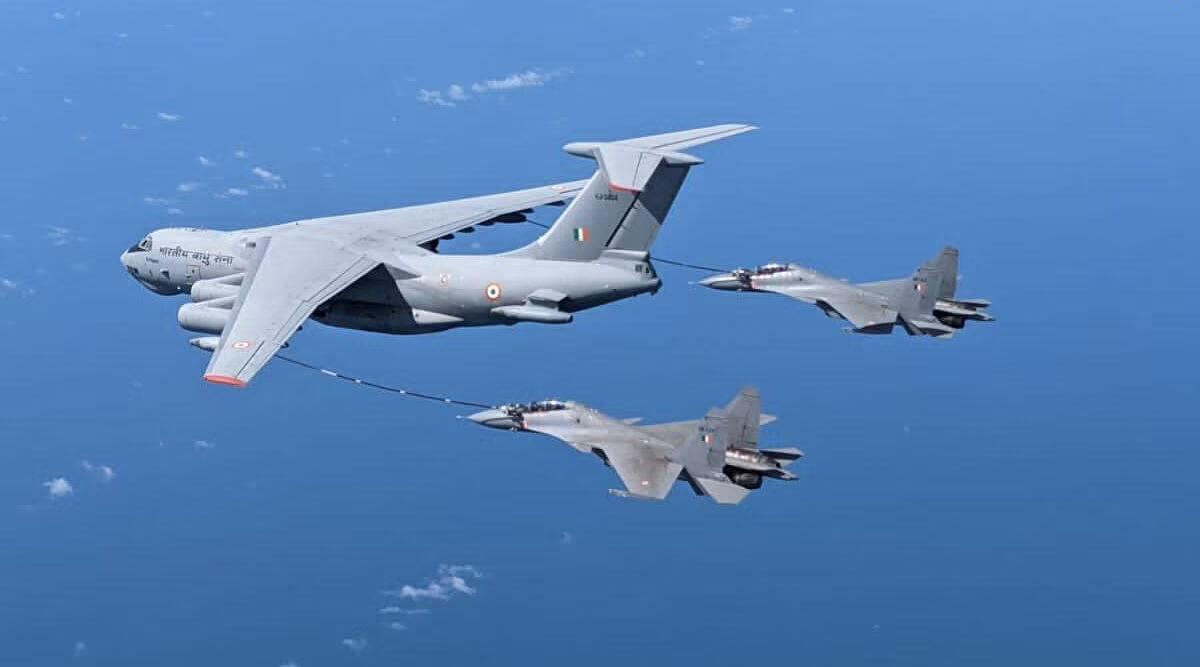
The Indian Air Force (IAF) is set to get six new mid-air refueling aircraft, which will give major boost to its air power. These planes will be built by Israel Aerospace Industries (IAI) as part of a new India-Israel partnership. The deal is expected to cost around Rs. 8,000 crore. For the past 15 years, the IAF has been trying to replace its old refueling aircraft. Currently, the Air Force operates six IL-78MKI tanker planes that were bought from Russia in 2003–04. These aircraft have become outdated and are difficult to maintain. The Russia-Ukraine war has also made it harder to get spare parts. Because of these challenges, India decided to move ahead with a new deal with Israel.
IAI’s Bedek Aviation Group will purchase six old Boeing 767 passenger planes and convert them into Multi-Mission Tanker Transport (MMTT) aircraft. These upgraded planes will be able to perform several roles i.e. refuelling other aircraft in mid-air, carrying troops and equipment, and even taking part in surveillance missions when needed.
IAI has nearly 40 years of experience in building and converting such aircraft and has completed similar projects for 12 different countries. The company recently signed a partnership with India’s Hindustan Aeronautics Limited (HAL), which means that in the future, parts of these aircraft could be built or maintained in India itself.
About 30 per cent of this deal will come under the Made in India program, meaning Indian companies, including Hindustan Aeronautics Limited (HAL) and several private firms, will play a major role in the project. This will help create new jobs in India and promote advanced technology development in the country’s aviation sector.
The addition of these new refuelling aircraft will nearly double the strength of the Indian Air Force. Fighter jets like the Rafale and Sukhoi-30 will be able to fly much longer missions without needing to land for refuelling. This means Indian jets could operate from the Indian Ocean all the way to China’s borders without interruption.
This deal is more than just a purchase, it marks a new level of defence cooperation between India and Israel. The agreement will significantly enhance India’s air strike capability, logistics support, and long-range mission power. The deal is expected to be finalised by the end of 2025, giving the Indian Air Force an even greater edge in the skies.
IAI brings over four decades of expertise to the table, having converted more than a dozen aircraft types for 12 international customers, including the Colombian Air Force’s KC-767 in 2010. The firm’s recent ventures include a 2025 partnership with India’s Hindustan Aeronautics Limited (HAL) for similar conversions, underscoring deepening Indo-Israeli collaboration. IAI’s MMTT platform, first flight-tested in 2010, offers reduced operating costs and high performance, with fuel efficiency improvements over legacy tankers.
Mid-air refuellers empower the IAF with responsiveness, reach, and mobility-key enablers for expeditionary operations, a sentiment echoed in recent IAF briefings. The addition aligns with broader modernization drives, including wet-leased KC-135 tankers from U.S. firm Metrea since March 2025 for training and interim surge capacity. The single-vendor outcome, while streamlining procurement, reflects IAF’s pragmatic pivot toward reliable partners. Russia’s II-78 woes and Europe’s hesitance on offsets left IAl as the frontrunner, building on successes like the Barak-8 missile and Heron drones. This deal, expected to be inked by year-end, could pave the way for future co-developments, including IAl’s proposed 767-based firefighting variants adaptable for humanitarian aid
In an era of contested skies, aerial refuelling is the linchpin of power projection. For the IAF, doubling its tanker fleet from six to 12 will dramatically extend the combat radius of its fighters, enabling strikes deep into adversarial territory without forward basing vulnerabilities. Analysts highlight its role in scenarios ranging from rapid response in the Indian Ocean to sustained patrols along the Line of Actual Control (LAC) with China.