
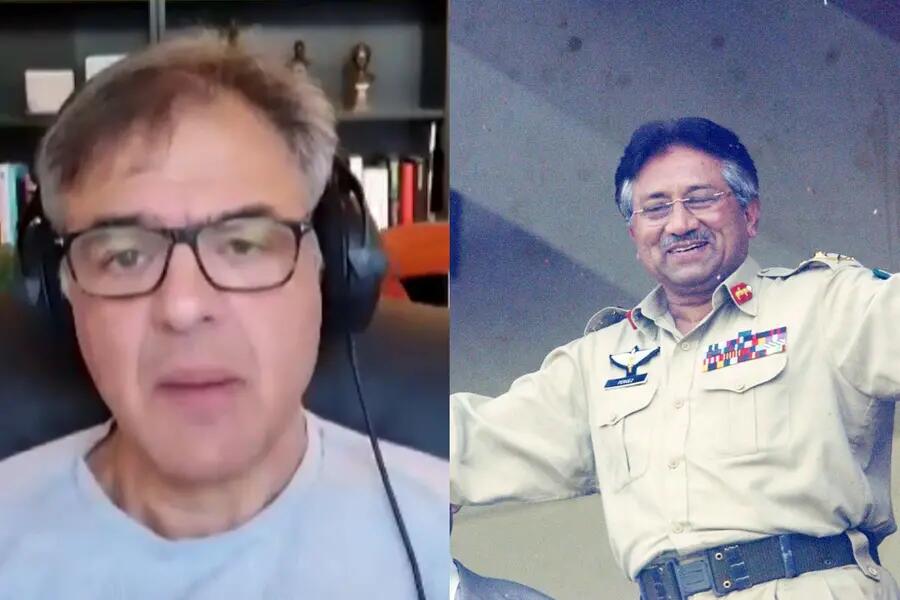
In a startling disclosure that exposes the murky underbelly of global power politics, former CIA officer John Kiriakou has revealed how the United States “bought” Pakistan’s loyalty during General Pervez Musharraf’s regime through massive financial aid even gaining temporary control over Islamabad’s nuclear arsenal. Speaking in an interview with ANI, Kiriakou, who once headed counterterrorism operations in Pakistan, accused Washington of hypocrisy and said the U.S. often manipulates dictatorships in the name of democracy and security. His comments have reignited debate on how far America went to safeguard its interests in South Asia, often at India’s expense.
The U.S. “Bought” Musharraf And Pakistan’s Compliance
According to Kiriakou, the Pentagon had indirect control over Pakistan’s nuclear weapons in the early 2000s after Musharraf handed over operational oversight to Washington. “When I was stationed in Pakistan in 2002, I was told unofficially that the Pentagon controlled the Pakistani nuclear arsenal. Musharraf turned control over to the United States because he feared nuclear weapons might fall into terrorist hands,” he said.
The former CIA officer explained that Washington found Musharraf’s autocratic rule ideal for pursuing its post-9/11 strategy. “The United States loves working with dictators. You don’t have to deal with public opinion or a free press. We basically bought Musharraf,” he said, describing how millions in military and economic aid allowed the U.S. to access Pakistan’s military and intelligence networks without resistance.
However, Kiriakou emphasized that Musharraf’s cooperation came with duplicity. While publicly backing the U.S. “war on terror,” the Pakistani establishment continued supporting anti-India terror networks under the radar. “The Pakistani army didn’t care about Al-Qaeda. Their main concern was India. Musharraf pretended to be on our side while actually sponsoring terror against India,” Kiriakou added, highlighting Pakistan’s double game that persisted for decades.
India’s Strategic Patience Surprised the White House
Kiriakou revealed that American intelligence had anticipated India’s retaliation after both the 2001 Parliament attack and the 2008 Mumbai terror strikes. However, New Delhi’s restraint caught the CIA and White House by surprise. “At the CIA, we called it strategic patience. India would have been within its rights to strike Pakistan but didn’t. At the White House, officials were astonished and said India was showing a mature foreign policy,” he said.
He admitted that this restraint likely prevented an escalation that could have led to a nuclear confrontation. However, Kiriakou cautioned that India’s patience should not be mistaken for weakness. “India has reached a point where it can’t risk strategic patience being misunderstood. When provoked again, they had to respond,” he added — indirectly referencing New Delhi’s decisive actions in later years, such as the Balakot airstrikes in 2019.
Saudi Arabia Shielded Pakistan’s Nuclear Scientist A.Q. Khan
Perhaps the most shocking revelation from Kiriakou’s interview concerns the role of Saudi Arabia in blocking American action against Abdul Qadeer Khan, the architect of Pakistan’s nuclear program who was accused of running a global proliferation network.
Kiriakou said the CIA had concrete plans to “take out” A.Q. Khan, but the operation was halted after Riyadh’s direct intervention. “If we had taken the Israeli approach, we would have killed him. But the Saudis told us, ‘Please leave him alone. We like A.Q. Khan. We’re working with him,’” he said. According to Kiriakou, the White House ordered the CIA and the International Atomic Energy Agency (IAEA) not to touch Khan a move that, he claims, was a “big mistake.”
He hinted that Saudi Arabia’s protective stance stemmed from its own nuclear ambitions, suggesting that Riyadh might have viewed Pakistan as a partner in future atomic cooperation. “We always suspected the Saudis wanted a nuclear program. Looking at the current Saudi-Pakistan defence ties, they may be calling in that investment now,” Kiriakou noted.
A Changing World Order: Rise of India
Kiriakou was equally scathing in his criticism of Washington’s foreign policy, accusing it of double standards and opportunism. “We like to claim that we stand for democracy and human rights, but that’s not true. The U.S. does whatever benefits it at that moment,” he said.
He described the U.S.-Saudi relationship as purely transactional, saying: “Our entire policy with Saudi Arabia is simple we buy their oil, and they buy our weapons.” Recalling an incident from his field experience, Kiriakou said a Saudi guard once told him bluntly, “You’re the hired help. We paid for you to come here and defend us.”
According to Kiriakou, the global power balance is shifting rapidly, with countries like India, China, and Saudi Arabia asserting greater independence in international affairs. “The U.S. doesn’t need Saudi oil anymore, and the Saudis know it. They’re hedging by improving ties with China and India. The world is changing, and we’re watching that transformation unfold,” he concluded.
Lessons from an Unequal Alliance
Kiriakou’s revelations offer a rare insider’s account of the transactional relationship between Washington and Islamabad one built on money, fear, and manipulation. The alleged control over Pakistan’s nukes and tolerance of its terror links expose how the U.S. compromised principles for short-term gains. At the same time, India’s measured restraint and growing diplomatic clout underscore its emergence as a responsible power in a volatile region. As the geopolitical order tilts toward multipolarity, Kiriakou’s words remind the world that alliances based on convenience not conviction are always temporary.