





















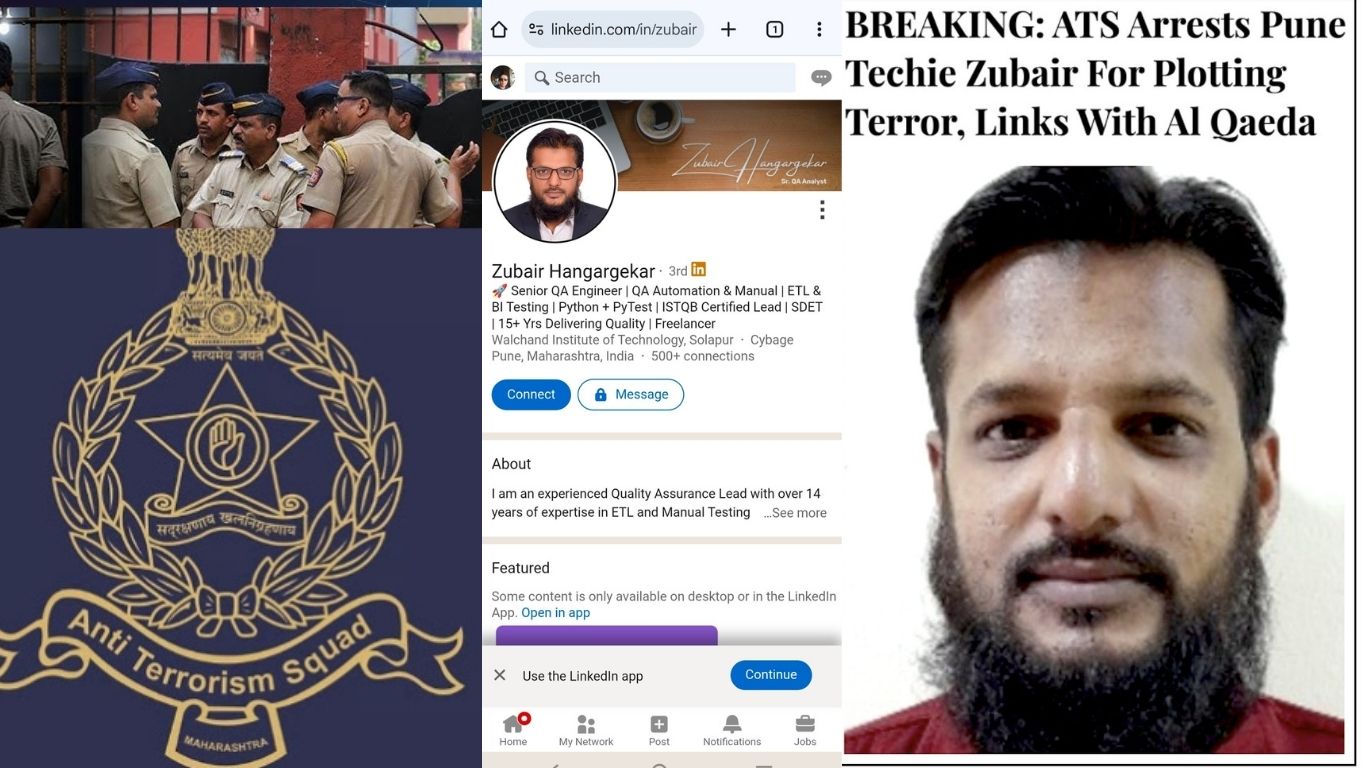
For years, liberals have claimed that terrorism is born out of poverty and illiteracy. But the arrest of Zubair Hangargekar a highly educated, well-paid IT professional from Pune has once again exposed how flawed that narrative truly is. Here was a man born into an affluent family in Solapur, a BTech graduate, a college topper, captain of the cricket team, and a man earning seven digit salary at a reputed software firm. Yet, behind this picture of success lay a dark secret he was allegedly consuming and spreading Al-Qaeda propaganda, and plotting large-scale terror attacks across Maharashtra.
Zubair, 35, was arrested on October 27 by the Maharashtra Anti-Terrorism Squad (ATS) from Pune’s Kondhwa area under the Unlawful Activities (Prevention) Act (UAPA). His arrest, officials say, followed weeks of surveillance and electronic analysis, revealing disturbing evidence that he was deeply involved in activities linked to radical Islamist networks.
He was living the dream life of an Indian tech professional a stable job, and a comfortable income. But that illusion shattered the moment investigators found Al-Qaeda literature, terror videos, and extremist training material stored in his personal laptop.
From Database Developer to Dangerous Radical
The arrest of Zubair is part of a broader ATS crackdown that began on October 9, when raids were conducted at 19 locations in Pune linked to a terror funding and robbery case that had connections to the Islamic State (ISIS) and Al-Qaeda modules. During these raids, authorities seized 19 laptops, 40 mobile phones, hard drives, and books many containing extremist content.
An ATS officer told The Times of India, “We arrested Hangargekar because his laptop, among those seized during the searches, was found containing downloaded Al-Qaeda literature. Downloading such material itself constitutes an offence.” Investigators discovered incriminating videos, propaganda manuals, and digital evidence suggesting attempts to reach out to other radical networks.
Zubair’s friend, who travelled with him to Chennai for a private function, was also detained at the Pune Railway Station when the two returned. Both were under close ATS monitoring for weeks, as intelligence inputs hinted at possible coordination with other terror operatives.
Officials suspect that Zubair was part of a larger recruitment and indoctrination chain, possibly using his technical expertise to encrypt communication, hide data, or aid in terror logistics. “We are probing if he had any direct contact with Al-Qaeda handlers and what his exact role was in their operations,” a senior police officer said.
The Broader Terror Web: From ISIS Modules to Al-Qaeda Links
To understand Zubair’s arrest, it’s crucial to trace the background of the ongoing “Pune ISIS Module” investigation. The case dates back to July 2023, when Pune Police arrested Mohammed Shahnawaz Alam, Mohammed Yusuf Khan, and Mohammed Yunus Saki all suspected ISIS operatives for stealing a car in Kothrud. Their “petty crime” soon unraveled a much deeper terror network.
The three were allegedly planning bomb-making experiments in Pune’s Ghat area, Satara, and Kolhapur forests. When Delhi Police later recaptured Alam (who had escaped custody), it became clear the group was connected to the 2022 Rajasthan explosives case. The National Investigation Agency (NIA) soon stepped in, identifying the Pune group as an active ISIS module responsible for funding, training, and testing explosive devices.
Subsequent arrests including Zulfikar Barodawala, S.N. Kazi, and Abdul Kadir Pathan revealed that the module had even robbed a businessman in Satara to fund terror activities. They allegedly used part of the stolen ₹1 lakh to purchase components for bomb assembly.
It was during this multi-layered probe that investigators came across Zubair’s digital footprint. His devices showed downloads, communications, and literature consistent with Al-Qaeda ideology suggesting that while ISIS and Al-Qaeda may differ in names and geographies, their toxic influence continues to spread among radicalised individuals across India’s urban spaces.
India’s Educated Radicals: A Dangerous New Trend
Zubair’s arrest brings to light a disturbing shift in the profile of India’s terror suspects. Unlike traditional extremist recruits from poor or conflict-ridden regions, many new-age radicals come from educated, tech-savvy, and financially stable backgrounds.
These individuals are often exposed to online extremist content, which uses sophisticated psychological techniques to prey on their emotions portraying global jihad as a “moral duty” or an “intellectual rebellion.” In Zubair’s case, his deep knowledge of coding and data systems could have been exploited to support terror operations digitally.
It’s not the first such case. In recent years, several well-educated individuals — from Kerala’s ISIS-linked youth to Hyderabad’s tech recruits have fallen prey to extremist indoctrination online. But Zubair’s story stands out because he had everything to lose and nothing to gain. He wasn’t desperate. He wasn’t poor. He wasn’t unemployed. He was simply brainwashed by ideology, showing that terrorism today isn’t born in madrasas or slums alone — it can germinate in air-conditioned offices too.
India’s War Is No Longer Against Poverty, But Against Perverted Ideology
The arrest of Zubair Hangargekar is more than just another counter-terror operation it’s a wake-up call. It shows how radicalisation has evolved beyond borders, beyond class, and beyond stereotypes.
While the world still debates poverty and inequality as root causes of terror, India is facing a far more insidious enemy educated radicals who willingly trade logic for lunacy and morality for murder.
The fact that a Pune techie with a seven digit salary, an engineering degree, and a loving family could still fall prey to terrorist propaganda underlines a chilling truth: terrorism thrives not because of deprivation, but because of distortion of faith, facts, and freedom.
As investigations continue, Zubair’s arrest should remind India that the war on terror is not just fought in the jungles or at the borders it must also be fought in the digital corridors, classrooms, and minds of those who confuse education with enlightenment.
Because the real roadblocks to India’s growth aren’t external enemies alone they are the misguided insiders who turn their privilege into a weapon against their own nation.





