
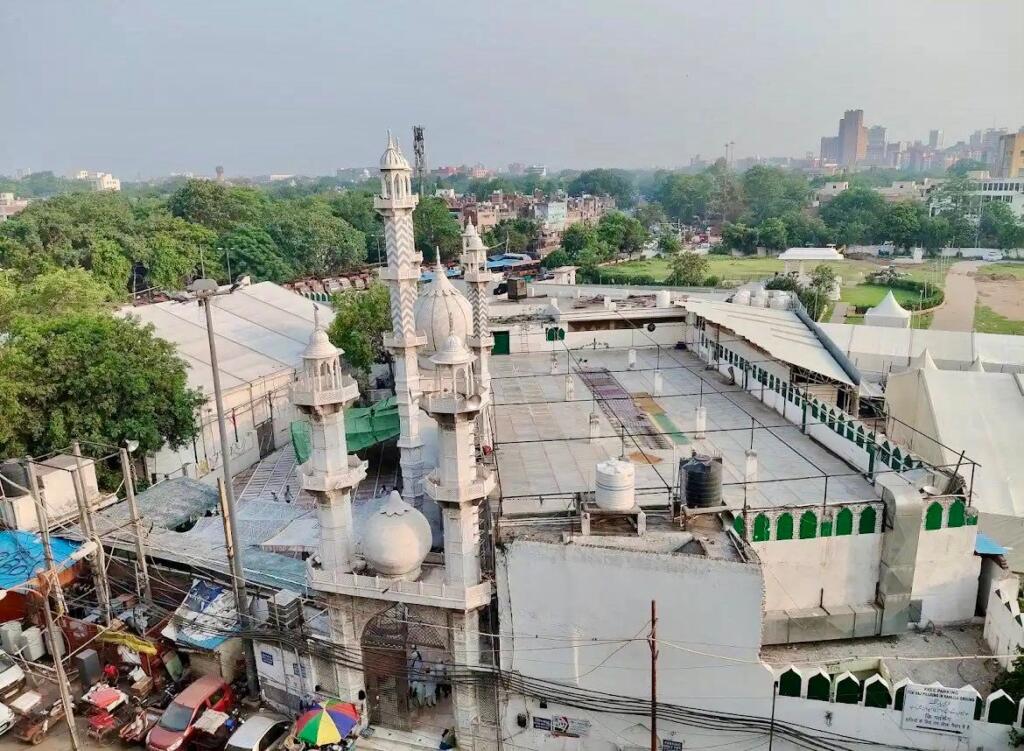
It is a disturbing sight: one of New Delhi’s most emblematic public grounds, the vast expanse of Ramlila Maidan, is reportedly under siege—not from protesters or traffic—but from creeping encroachment by a religious-structure complex. According to recent surveys, more than 45,000 sq ft of land belonging to Ramlila Maidan has been taken over by a complex that includes a mosque, graveyard, banquet hall and commercial activity.
Here is the horror in simple terms: a space meant for the people, for festivals, gatherings, democracy and culture, is being quietly transformed into a privately occupied terrain. A ground built on the promise of public life is now being choked by walls, private business interests and religious shelter.
From decades the Ramlila Maidan has been the stage for massive cultural events, democratic assemblies, and public celebration. But now, a joint inspection by civic officials discovered that what was allotted for public-use has been hijacked—first by a banquet infrastructure, then a private diagnostic centre, vehicle parking, and a “mosque + graveyard” parcel—accounting for around 7,400 sq ft of the encroachment.
It is not only the sheer scale that chills; it is the mechanism. The land had been transferred by the state agencies decades ago for public purposes, but is now under the control of private interests using religion as the shield. According to civic activist documentation, “the land mafia network has used religion as a shield to deter authorities from acting against illegal occupations.”
Public space is among the most precious resources in a democracy—especially one as densely populated and culturally charged as Delhi. To see it being whittled away in this manner is an affront not only to civic norms but to the basic promise of shared life. The fact that the encroachment lies right next to one of Delhi’s most communally sensitive zones makes it scarier still.
The urgency is further underscored by the jurisprudence: the Supreme Court of India has affirmed that no religious structure can be allowed to obstruct public roads, waterways or other civic assets.
Yet despite that rule, the takeover of these large public plots continues.
What is the effect? Imagine Ramlila scenes with thousands of people—now imagine large sections fenced off for private functions, graveyards and parking lots—spaces intended to be accessible to all, now fenced and controlled. Imagine politics and mass culture and religious festivals shrinking because the ground that once hosted them is reduced.
What should happen? The civic survey results demand action: the full report must be made public; the areas need to be reclaimed; and the law applied evenhandedly, regardless of religion or identity. The authorities must ask: Was the land of Ramlila Maidan ever legally converted into a waqf or religious endowment? If not, why has eviction been delayed? As one activist put it: “This selective classification of encroached land as religious property would set a dangerous precedent for communal land capture in the heart of the capital.”
The horror of this situation is not just the physical takeover of land; it’s the erosion of what civic life depends on: open space, collective gatherings, marginalised voices finding voice. When that ground is lost, the capacity for public dissent, drama, culture—and even democracy—is compromised.
In the end, Ramlila Maidan is not just a patch of earth. It is the heart of public memory, of festivals, of rallies—the very mechanism by which ordinary people claim space in the city. Its partial conversion into a religious-commercial enclave is a warning. If we permit this quietly, other spaces will follow. The ground may be lost slowly, but what is at stake is not just soil—it is the public soul of the city.