
Navratri a festival symbolizing the triumph of good over evil turned into a night of terror in Bahiyal village of Gujarat’s Gandhinagar district. What began as joyous Garba celebrations on September 24 soon descended into chaos after violent clashes broke out between two communities. Stones were hurled, vehicles were vandalized, and shops were set ablaze. The immediate spark was a controversial social media post yet the unrest quickly revealed deeper fault lines of communal provocation, ideological intolerance, and premeditated violence.
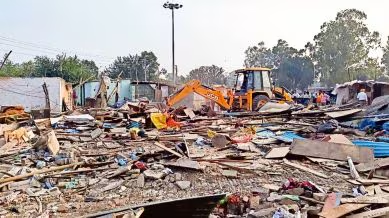
The Gujarat government, led by Chief Minister Bhupendra Patel, responded with a firm message: peace must prevail, and lawbreakers will face strict consequences. Within days of the riots, authorities launched a sweeping demolition drive, targeting illegal constructions belonging to the accused involved in the violence. By the end of the week, 186 shops and 50 houses were demolished in Bahiyal village a show of zero tolerance against rioters and encroachers alike.
The ‘I Love Muhammad’ Controversy Spreads Unrest Across States
The Bahiyal violence did not occur in isolation. Over the past month, several regions across India from Uttar Pradesh to Uttarakhand have witnessed unrest tied to the “I Love Muhammad” campaign. Initially projected as a “social awareness initiative,” the campaign has repeatedly devolved into confrontations, threats, and riots. Gujarat, a state long praised for maintaining communal peace, became the latest victim of this disturbing pattern.
In Bahiyal, tensions escalated after a youth’s social media post celebrating Lord Shiva captioned “I Love Mahadev” triggered outrage among another community. What began as online abuse soon spilled onto the streets. A mob gathered outside the youth’s shop, leading to assaults, arson, and organized destruction. Multiple eyewitnesses confirmed that the attackers used pre-collected glass bottles and stones, suggesting the violence was not spontaneous but carefully orchestrated.
The Gujarat Police acted swiftly, registering cases against nearly 200 individuals. As of now, around 60 people have been arrested, and more are being identified through CCTV footage and viral videos.
Garba Night Turns Into a Scene of Horror
According to eyewitnesses, the Garba celebration in Bahiyal started peacefully. Families, children, and devotees gathered at the venue to offer prayers and dance in devotion to Goddess Durga. But as the night progressed, the atmosphere suddenly turned sinister. Stones were thrown from nearby rooftops, plunging the festive gathering into panic. The lights went out moments before the attack, making it impossible for people to identify the culprits or flee safely.
Several participants, including women and children, suffered injuries. Two police vehicles were damaged in the ensuing chaos. Houses and shops near the venue were also vandalized, and by midnight, parts of the village had turned into a war zone.
Police responded with tear gas and large-scale deployment to regain control. Gandhinagar Superintendent of Police Ravi Teja Vasamsetty confirmed the scale of the operation. “A total of 186 commercial establishments are being vacated. You must recall that riots had erupted here. Hence, the houses and establishments of the culprits were sealed,” he said.
By morning, two companies of the State Reserve Police (SRP) and more than 200 officers were stationed in and around Bahiyal. Patrolling was intensified, and checkpoints were set up to prevent further escalation.
Shops Torched and Property Reduced to Ashes
The most severe phase of violence erupted earlier that evening when a mob targeted shops linked to the youth behind the Lord Shiva post. The assailants reportedly set fire to several commercial properties, including an electronics store and a Xerox shop. Vehicles parked nearby were torched, and even fire engines responding to the scene were attacked with stones.
Dahegam Assistant Superintendent of Police Ayush Jain said, “At least four shops were set ablaze and several cars vandalized during the rampage. Police launched an immediate operation that continued till 4 a.m., resulting in the arrest of 60 accused.”
By dawn, the damage was extensive — charred vehicles, destroyed shops, and shattered glass littered the streets. The loss of property ran into lakhs, with many families left without their livelihoods. FIRs have been filed against 83 identified individuals and around 1,500 unidentified persons based on evidence gathered from surveillance footage.
Premeditated Attack: Locals Speak of Orchestrated Violence
While officials worked to restore calm, residents of Bahiyal voiced frustration and fear. Many insisted that the violence had been pre-planned. “No way someone could gather so many bottles and stones at the last minute,” said a local woman, her home damaged in the attack. “It looked like they had been stockpiled for days.”
Another resident claimed that his small family temple had been desecrated. “The spire of our goddess’s shrine was broken. This was not just an attack on people but an attack on faith,” he said. Several villagers also reported that members of a provocative procession — linked to the “I Love Muhammad” campaign — had been spotted in the area days before the incident, raising tensions.
One shopkeeper, who lost his business to the fire, estimated his losses at ₹25 lakh. “My shop stood here for 25 years. It’s gone in one night,” he said, visibly shaken.
The residents’ testimonies have strengthened the government’s view that the riots were premeditated acts aimed at disrupting communal harmony and intimidating the Hindu population during a religious festival.
The Gujarat Government’s Strong Response: 186 Demolitions Ordered
In a decisive move, the Gujarat government launched a demolition drive targeting illegal encroachments belonging to the accused. Nearly 186 unauthorized establishments — including makeshift shops and houses — were razed in Bahiyal as part of the state’s crackdown on rioters. The drive mirrors the “bulldozer justice” model seen in other states, where illegal structures owned by those accused of communal violence are demolished to deter future offenders.
Officials clarified that the demolition was not arbitrary but conducted after verification of ownership and municipal permissions. “The action sends a clear message — law and order will not be held hostage by mob mentality,” a senior officer remarked.
The move has earned widespread public support in Gujarat, where the administration has often taken pride in maintaining harmony during festivals. It also aligns with the state’s broader zero-tolerance policy against communal violence.
Law, Order, and a Warning for the Future
With enhanced security, continuous patrolling, and strict administrative action, Bahiyal has gradually returned to normalcy. The police have maintained a strong presence to ensure no further flare-ups occur. Community leaders are also being engaged to rebuild trust and communication among residents.
However, the incident has left an indelible mark — not just as a night of chaos but as a reminder that peace in a diverse society demands vigilance, not complacency. The Gujarat government’s crackdown stands as both punishment and prevention — a message to those who believe they can hide behind religious slogans or political propaganda to justify violence.
Gujarat Sends a Message Faith Can’t Be Hijacked by Fanaticism
The Bahiyal incident is a sobering reminder that intolerance wears many disguises — sometimes in the form of slogans, sometimes in the guise of faith. The Gujarat government’s demolition drive and swift arrests have reaffirmed that the state will not bend before communal intimidation. Festivals like Navratri must remain symbols of devotion and unity, not occasions for hate.
As bulldozers clear illegal structures, the administration’s action carries a symbolic undertone — cleansing not just encroachments but the mindset that fuels division. The government’s approach — firm, lawful, and immediate — has restored confidence among citizens that Gujarat will protect its peace, its people, and its sacred right to celebrate without fear.
In Bahiyal, the echoes of Garba may have been momentarily silenced by stones and fire — but the resolve of Gujarat stands stronger than ever: violence will be crushed, and Sanatan harmony will prevail.