
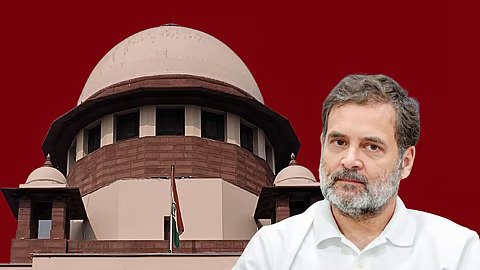
Rahul Gandhi’s long-running tirade of “vote chori” (vote theft) allegations finally met a judicial wall, as the Supreme Court refused to entertain a plea seeking an SIT probe into his claims. The apex court’s sharp rejection not only exposed the hollowness of the charges but also reflected the Congress party’s consistent strategy of undermining institutions when faced with electoral rejection. For a leader who has been repeatedly dismissed by voters across states, Gandhi’s attempts to discredit the Election Commission come as yet another episode in the Congress’s politics of deflection where blame replaces introspection and rhetoric replaces responsibility.
On October 13, the Supreme Court dismissed a petition demanding the formation of a Special Investigation Team (SIT) to probe allegations of “vote theft” charges that Congress leader Rahul Gandhi had aggressively propagated against the central government and the Election Commission of India (ECI).
The petition, filed by advocate Rohit Pandey, sought an inquiry into alleged manipulation of the voter list in Bengaluru Central during the 2024 Lok Sabha elections. Gandhi had claimed irregularities in the Mahadevapura assembly segment, but the ECI had already examined and dismissed these allegations as baseless.
A two-judge bench comprising Justices Surya Kant and Joymala Bagchi firmly declined to entertain the plea, directing the petitioner to approach the Election Commission instead. The bench observed, “Only the Election Commission possesses the power to investigate such issues. The petitioner is encouraged to submit his complaint there.” The court made it clear that judicial intervention in matters concerning the election process or outcomes was inappropriate and constitutionally untenable.
In his submission, advocate Pandey referenced Rahul Gandhi’s press conference held on August 7, where the Congress leader accused the ECI of facilitating vote manipulation. Pandey claimed he had verified the accusations and discovered prima facie evidence of a conspiracy to dilute genuine votes. However, the court found the plea lacking in substance and categorically stated that it did not qualify as a matter of public interest litigation.
The bench noted that Pandey had already submitted a complaint to the Election Commission but expressed impatience over the ECI’s response. The Supreme Court refused to set any deadline for the poll body’s action, reiterating that such administrative matters lie within the Commission’s purview. “We are not inclined to review this petition. If the petitioner wishes, he may bring his case before the Election Commission,” Justice Kant said, drawing the matter to a close.
The “vote chori” allegations have been a recurring theme in Congress’s narrative particularly after repeated electoral setbacks under Rahul Gandhi’s leadership. Rather than introspecting on corruption, dynastic politics, and policy paralysis that have alienated voters, the party has often chosen to attack independent institutions like the Election Commission.
Gandhi’s accusations were examined and debunked by multiple fact-checkers and by the ECI itself. Yet, the Congress leader has refused to retract his statements or submit concrete evidence. The Commission even issued formal notices, asking Gandhi to substantiate his claims under oath and reminding him that false submissions would attract penalties under Section 227 of the Bharatiya Nyaya Sanhita (BNS).
Chief Electoral Officers (CEOs) from Karnataka, Maharashtra, and Haryana further revealed that the Congress had not filed a single formal objection or appeal against the published voter lists in any of these states. This exposed the party’s allegations as politically motivated theatrics rather than legitimate electoral grievances.
The Supreme Court’s ruling is not the first instance where Rahul Gandhi’s rhetoric has backfired. Similar baseless claims from the Rafale deal to the Pegasus spyware narrative have repeatedly been discredited, exposing the Congress’s desperation to stay politically relevant.
Observers point out that instead of confronting the reasons for its electoral decline, the Congress leadership has chosen a confrontational path, questioning the credibility of constitutional institutions. This not only damages public faith in the democratic framework but also reflects the party’s inability to evolve beyond outdated grievance politics.
The Supreme Court’s firm stand marks a moment of reckoning. By rejecting the plea outright and reaffirming the authority of the Election Commission, the apex court has reinforced institutional integrity against political theatrics. Rahul Gandhi’s “vote chori” campaign, lacking evidence and substance, now stands legally and morally defeated.
Yet, the Congress leader’s persistence in spreading misinformation underscores a larger problem the party’s refusal to accept electoral verdicts and introspect on its failures. At a time when India’s democracy thrives on transparency and trust, such reckless allegations only isolate the Congress further. The message from the Supreme Court is unmistakable: truth and evidence, not slogans and slander, define the sanctity of elections.