
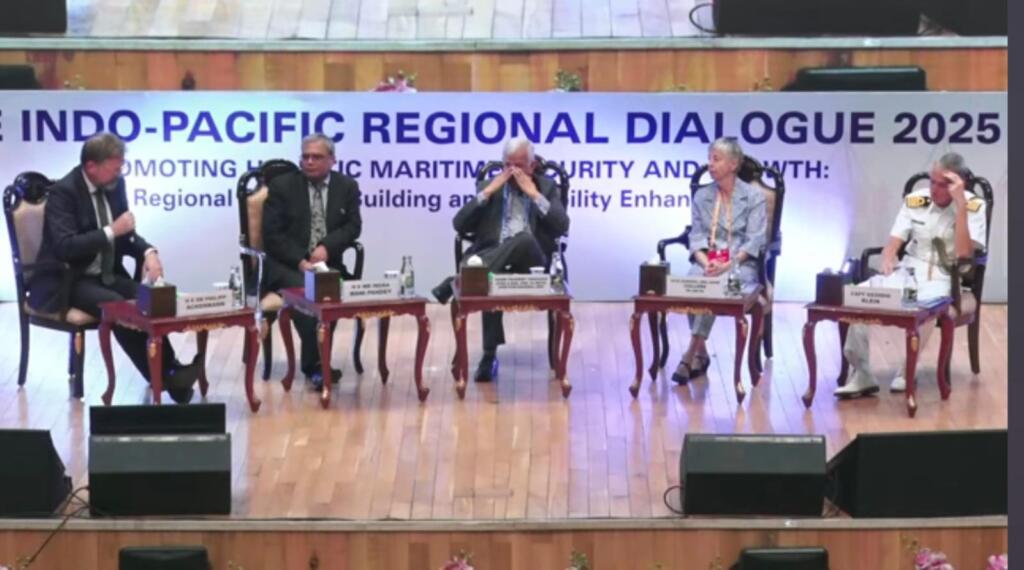
Germany signalled deeper alignment with India’s maritime ambitions on Monday as senior diplomats and naval leaders convened for the opening of the Indo-Pacific Regional Dialogue (IPRD) 2025 in New Delhi.
Speaking at a packed session titled Chaupal ki Charcha, German Ambassador Philipp Ackermann described India and Germany as “on a very good path” and hinted that the two sides were “in the process of doing something — very soon, very good.” The envoy’s remark, delivered alongside senior representatives from France, the Netherlands and BIMSTEC, suggested that a new phase of Indo-German maritime cooperation may be imminent.
Ackermann said the partnership rests on “shared values, mutual trust and a common commitment to open seas,” pointing to the Indo-Pacific’s growing centrality to global supply chains and cyber-security frameworks. Analysts interpreted his comments as a sign of Berlin’s willingness to translate its 2020 Indo-Pacific Guidelines into practical naval and industrial collaboration with India.
The three-day Dialogue, organised by the Indian Navy in association with the National Maritime Foundation, opened under the theme “Promoting Holistic Maritime Security and Growth: Regional Capacity-Building and Capability-Enhancement.” Former Navy Chief Admiral Karambir Singh delivered the inaugural address, warning that great-power competition and non-traditional threats were reshaping the maritime order and calling for a “cooperative architecture” to manage the turbulence.
In a commemorative keynote, Admiral Dinesh K Tripathi, the current Chief of Naval Staff, highlighted that India’s maritime policy of MAHASAGAR — Mutual and Holistic Advancement for Security and Growth Across Regions — seeks prosperity through collaboration. “Oceanic spaces are central to India’s economic growth and security,” he said, urging like-minded nations to enhance interoperability and build collective capacity. Tripathi also unveiled a new book, Future Maritime Warfare, authored by Captain K.S. Vikramaditya of the Indian Navy.
Forty speakers from 19 countries are participating in IPRD 2025, which has become a fixture in India’s maritime diplomacy calendar. Day one concluded with a special address by Professor Christian Bueger of the University of Copenhagen, who launched a dedicated edition of Maritime Affairs, the NMF’s flagship journal.
As Germany deepens its Indo-Pacific footprint and India positions itself as a regional net-security provider, the signals from IPRD 2025 suggest a convergence of interests stretching from Kiel to Kochi — a partnership anchored not only in naval strategy but also in the shared conviction that the sea lanes of the Indo-Pacific must remain open, resilient and inclusive.