
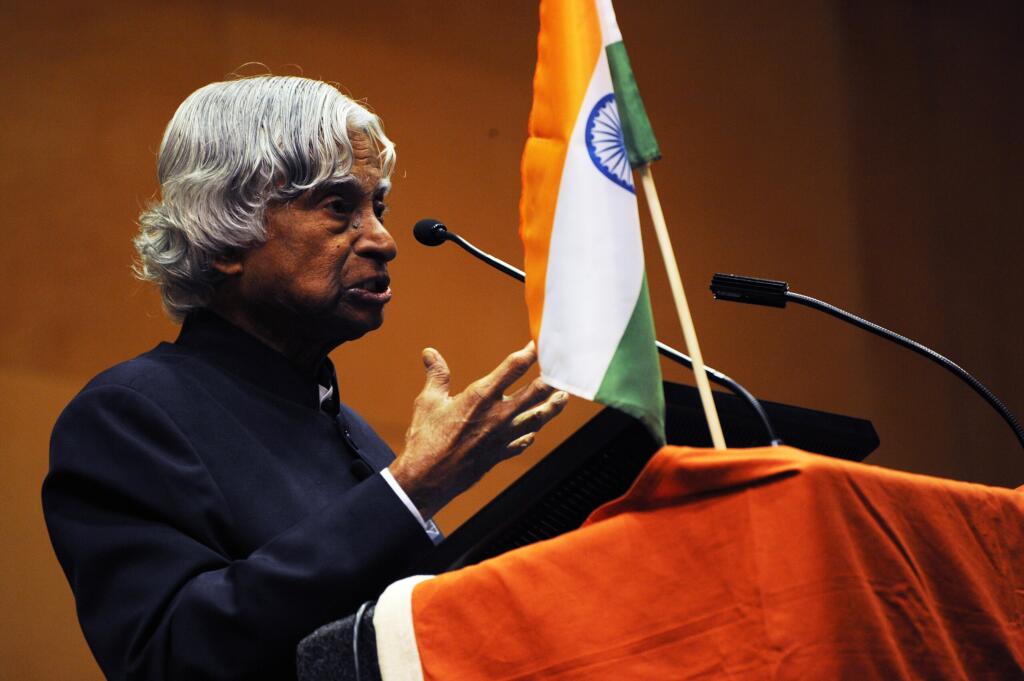
On October 15, 1931, in the serene island town of Rameswaram, Tamil Nadu, a boy was born who would one day transform India’s destiny. Dr. Avul Pakir Jainulabdeen Abdul Kalam, who passed away on July 27, 2015, was not just the 11th President of India he was the architect of India’s strategic autonomy and the symbol of self-reliance in science and defence. As we remember him on his birth anniversary, we also remember how this humble scientist redefined the meaning of patriotism through technology, vision, and relentless dedication.
When Kalam joined the Defence Research and Development Organisation (DRDO) in 1958, India was a struggling nation trying to find its place in a Cold War world dominated by superpowers. Dependent on foreign nations for defence hardware, India’s sovereignty was constantly at risk. Kalam saw early on that true freedom lay in technological independence. This belief became the foundation of a movement that would take India from dependency to deterrence.
Architect of India’s Missile Power
Dr. Kalam’s most remarkable contribution came through his leadership of the Integrated Guided Missile Development Programme (IGMDP) in the 1980s. At a time when India faced international technology embargoes and regional threats, Kalam’s visionary leadership gave India the ability to defend itself with indigenous strength. Under his direction, India developed five missile systems Prithvi, Agni, Akash, Trishul, and Nag.
Each missile served a distinct strategic role: Prithvi as a battlefield weapon, Agni as an intermediate-range ballistic missile capable of carrying nuclear warheads, Akash as a surface-to-air defence system, Trishul as a quick-reaction missile, and Nag as an anti-tank missile. Among them, the Agni series became the cornerstone of India’s nuclear deterrence. It was Kalam’s vision that gave India the confidence to stand tall among global powers.
Today, the Agni-V with a range exceeding 5,000 kilometres carries forward the same technological lineage that Kalam initiated. Every successful missile test, every display of India’s strategic might, is a tribute to the man who once dreamt of an Atmanirbhar Bharat in defence long before the term became a national slogan.
The Nuclear Tests That Changed India’s Status
Dr. Kalam’s role extended beyond missiles to the Pokhran-II nuclear tests in 1998 a defining moment that established India as a declared nuclear power. As the Chief Scientific Adviser to the Prime Minister and the head of DRDO, Kalam played a central role in the planning and execution of these tests. Despite intense global scrutiny and technological sanctions, India succeeded, demonstrating to the world that its scientific community could achieve the impossible through sheer determination.
Pokhran-II was not just a technological success; it was a psychological victory. It proved that India could no longer be coerced by external powers. The image of Dr. Kalam standing beside Prime Minister Atal Bihari Vajpayee, both smiling after the successful detonation, remains one of the most iconic moments in India’s modern history. Kalam had helped ensure that India’s future would be secured not through borrowed technology, but through indigenous brilliance.
The Visionary Who United Science and Spirit
What made Kalam extraordinary was not only his scientific acumen but his belief that science must serve society. He transformed India’s defence sector into a hub of innovation and self-belief. To him, every missile was not a weapon of war, but a symbol of national pride and human achievement.
He often reminded young scientists that their work was not just about machinery and metal but about nation-building. His leadership nurtured an entire generation of engineers and researchers who now lead India’s space and defence programmes. The BrahMos missile, developed through Indo-Russian collaboration, and India’s 2019 anti-satellite weapon test, both bear the imprint of Kalam’s integrated vision of aerospace and defence.
Beyond laboratories, he inspired students, engineers, and citizens through his books like India 2020, where he outlined a roadmap for transforming India into a developed, technologically advanced nation. He envisioned an India driven by innovation, entrepreneurship, and a spirit of service an India that believed in its own potential.
Legacy That Lives in Every Rocket and Dream
The India we see today a nation launching satellites for other countries, exporting defence systems, and leading in aerospace research is the realization of Kalam’s dreams. Our indigenous aircraft carrier INS Vikrant, hypersonic missile programmes, and space exploration missions all stand on the foundation he helped lay.
Yet, his most profound contribution lies beyond science. He made Indians believe that a poor boy from Rameswaram could rise to the highest office in the land and still remain grounded in humility and service. His life was a message that education, integrity, and perseverance could transform both individuals and nations.
On the day he passed away July 27, 2015 Kalam was doing what he loved most: teaching students at IIM Shillong. His last moments reflected his lifelong devotion to knowledge and youth. For millions of Indians, he remains the “People’s President,” not because of his title, but because of his simplicity, accessibility, and unshakable faith in the next generation.
Dr. A.P.J. Abdul Kalam’s life continues to inspire every Indian who dreams of a stronger, self-reliant nation. His vision transformed India’s defence and space landscape from dependency to dominance, from aspiration to achievement. Every launch at ISRO, every innovation at DRDO, every young mind entering the field of science carries forward his mission.
He proved that patriotism can be expressed through a test tube as much as through a tricolour, that humility can coexist with greatness, and that true leadership lies in empowering others.
On his birth anniversary, we remember him not just as a scientist or a president, but as a nation-builder who turned dreams into rockets and vision into reality. Dr. Kalam lives on in every missile that guards our skies, in every student who dares to dream, and in every heartbeat that believes in an Atmanirbhar Bharat.