
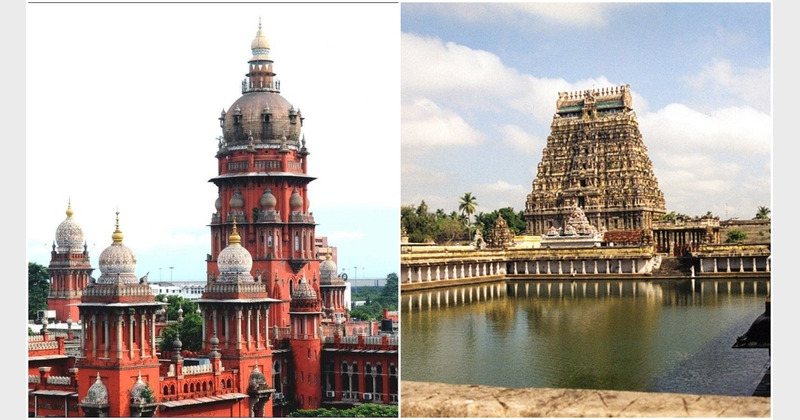
In a major blow to the DMK government, the Madras High Court has directed the Tamil Nadu administration to form a Heritage Commission within four weeks a move that exposes how temple heritage and sacred structures have been recklessly handled under the so-called Dravidian model. For years, ancient Hindu temples have been tampered with, their sanctity compromised by civil works handed out to unqualified contractors under the control of the HR&CE Department. The court’s order is not just a legal directive it’s a wake-up call to a government that has long treated Hindu temples as state property, not as divine institutions.
The Madras High Court’s latest order has once again put the spotlight on the Tamil Nadu government’s controversial handling of temple heritage. On Thursday, a special division bench comprising Justices R Suresh Kumar and S Sounthar directed the state government to constitute the Tamil Nadu Heritage Commission within four weeks as mandated under the Tamil Nadu Heritage Act. This comes after petitions, including one filed by temple activist T.R. Ramesh, challenged illegal constructions being carried out inside and around the sacred Tiruvannamalai Arunachaleswarar Temple.
The court made a strong observation that despite the Act coming into force on March 1, 2024, the government has failed to set up the statutory body responsible for protecting heritage sites. The bench reminded the state that such a commission is vital for identifying, restoring, and preserving heritage buildings especially temples that have suffered severe structural and cultural damage due to unscientific civil works carried out by the HR&CE Department. The judges questioned the government’s delay, pointing out that more than a year and a half had passed without action. The order further restrained the HR&CE from continuing with certain controversial constructions like the elephant memorial, Thirukalyana Mandapam, and Annadhana Koodam inside the temple complex, while permitting only essential works like façade lighting and queue line sheds.
This judgment has significant implications. It exposes the growing pattern of negligence, greed, and political control over temple management under the DMK regime. For decades, the Hindu Religious and Charitable Endowments Department, a government body that controls over 45,000 temples, has been accused of functioning without transparency or accountability. Ironically, while churches and mosques operate freely under their respective trusts, only Hindu temples remain under government control a clear constitutional anomaly and a violation of religious freedom guaranteed under Articles 25 and 26.
The HR&CE’s past moves including melting more than 1,074 kilograms of gold from 21 temples and depositing them in banks under the Gold Monetisation Scheme has added insult to injury. The department claims that the ₹17.81 crore annual interest earned from this gold is being used for temple development. But questions remain: Who gave the state the right to melt sacred offerings made by devotees to the deities? Was there any consent taken from the temple trustees or worshippers? And most importantly, where is the audit trail showing that this money is actually being spent on the temples themselves?
This is not financial management it’s cultural misappropriation. It’s the systematic erosion of temple independence under the pretext of modernization. Despite repeated interventions by the courts, the DMK government continues to treat temples as revenue-generating assets rather than spiritual centers of Hindu faith. The Supreme Court has already raised concerns about the HR&CE’s indefinite appointment of Executive Officers (EOs) in temples, often in clear violation of legal norms. According to the 2015 rules, such appointments cannot exceed five years. Yet, in Tamil Nadu, these EOs have been holding positions indefinitely, even in small temples, effectively sidelining hereditary trustees and traditional management systems.
In the past 70 years, not a single temple taken over by the HR&CE has been returned to its original trustees. Once under government control, these temples never see freedom again. The state’s interference has gone far beyond administration it has entered the sanctum of faith itself. From unauthorized construction to looting temple wealth, the HR&CE’s record stands as a reminder of how the Dravidian model has systematically undermined Hindu institutions while projecting itself as a model of social justice.
Temple activists have repeatedly warned that allowing political appointees and unqualified contractors to handle ancient structures has caused irreversible damage. From crumbling gopurams to defaced murals, Tamil Nadu’s ancient temples symbols of our dharmic heritage have become victims of bureaucratic arrogance and ideological hostility. The recent court order for setting up a Heritage Commission is thus not just administrative it’s moral. It’s a call to protect India’s civilizational heritage from political exploitation.
The question now is whether the Tamil Nadu government will comply with the High Court’s directive or continue its defiance. Given its track record, many fear the order might be delayed or diluted. But the larger issue remains should the government have control over Hindu temples at all? If churches and mosques are allowed autonomy, why should temples be treated differently?
The Madras High Court’s order marks a defining moment. It challenges the DMK’s decades-long monopoly over temple administration and reinforces the demand for freeing Hindu temples from state control. The devotees of Tamil Nadu are watching closely. This is not just about one temple or one commission it’s about reclaiming the spiritual independence that has been systematically stolen from Hindu society.