
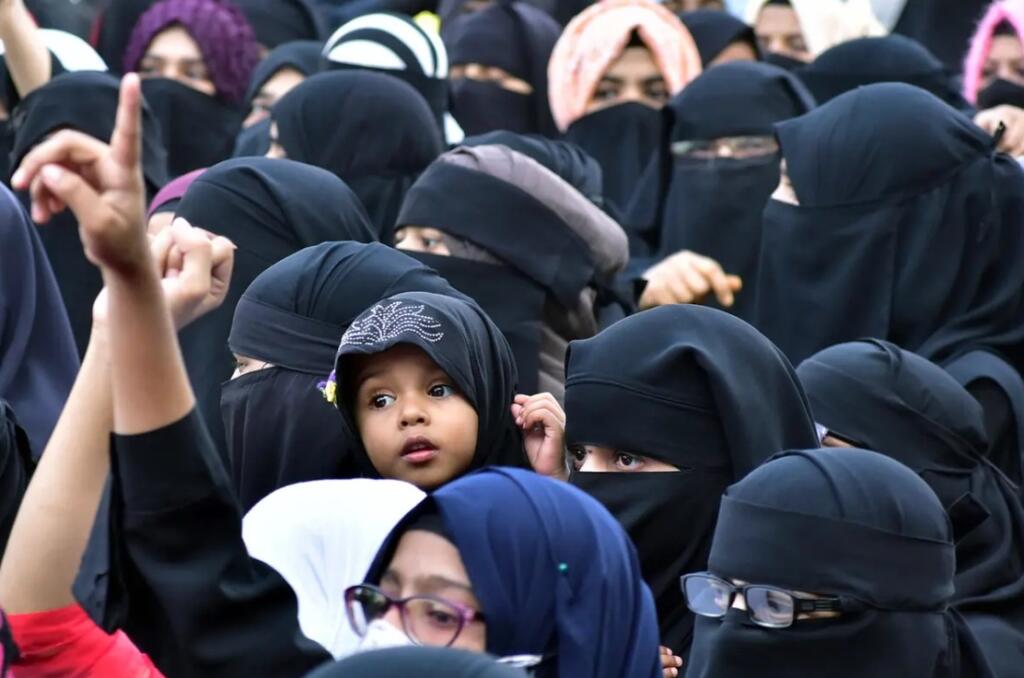
The Kerala hijab controversy at St Rita Public School in Kochi has laid bare the Communist Party of India (Marxist)’s brand of selective secularism—one that appeases Muslim vote banks, placates Christian institutions, and sidelines Hindu voices.
At the heart of the dispute is a Catholic-run school that sought to enforce a uniform dress code, only to be thrust into political crossfire when a Muslim student’s demand to wear a hijab was met with government intervention.
A Muslim student’s family insisted on allowing her to wear the hijab. The school declined, citing discipline and uniformity. Instead of backing institutional autonomy, Kerala’s Education Minister V Sivankutty intervened, directing the school to permit the hijab—a clear act of political signalling ahead of local polls.
But the move backfired. The Syro-Malabar Church pushed back, accusing the government of “rekindling communal trouble.” The Church-owned Deepika Daily issued a strong editorial warning the state against yielding to “fundamentalist” pressure.
Within 24 hours, Sivankutty reversed course. The minister, who had invoked “religious rights,” now declared the issue “settled” after the student’s father agreed to follow the dress code.
This U-turn exposed the CPI(M)’s selective application of secular values, flexible for one community, firm with another. Had it been a Hindu-run institution, the political response may have been very different—accusations of discrimination, public protests, and no retreat.
A Pattern, Not an Exception
This is not an isolated incident in Kerala. In February 2024, CPI(M) workers disrupted a Ganapati Homam at a school in Kozhikode, calling it communal—even though it had official approval. Organisers were assaulted and arrested.
Yet in August 2025, a CPI(M) office in Kollam was turned into a prayer space for a Muslim hawker offering namaz. Party leaders hailed the moment as “an expression of brotherhood.”
This hypocrisy runs deep. In 2017, party minister Kadakampally Surendran was reprimanded for visiting a Hindu temple with his family.
Party leadership said it went against “Marxist principles.” But when Islamic rituals are observed in party offices, they’re celebrated as progressive.
Institutionalised Bias
The CPI(M)’s 2025 political resolution confirms this bias. It described the Ram Mandir as “Hindutva aggression,” dismissed Hindu festivals as “provocations,” and offered sympathetic reasoning for Islamist radicalisation blaming it on Hindu assertiveness.
Hindu demands for temple restoration are labelled “communal,” while calls for religious exemptions by minorities are welcomed.
From temples being state-controlled, to festivals being policed, the Hindu community is treated as a problem to be managed, while minority identities are carefully courted.
Appeasement is Not Secularism
The St Rita episode wasn’t about a uniform. It was about Kerala government choosing politics over principle, and selectively applying “secular” values based on religious identity.
This is not secular governance—it’s religious brokerage, where faith becomes a political currency. Kerala’s CPI(M) has replaced ideology with identity management, and conviction with vote arithmetic.
Kerala deserves better—a government that treats all communities equally, not one that practices minority-majoritarianism in the name of secularism.