
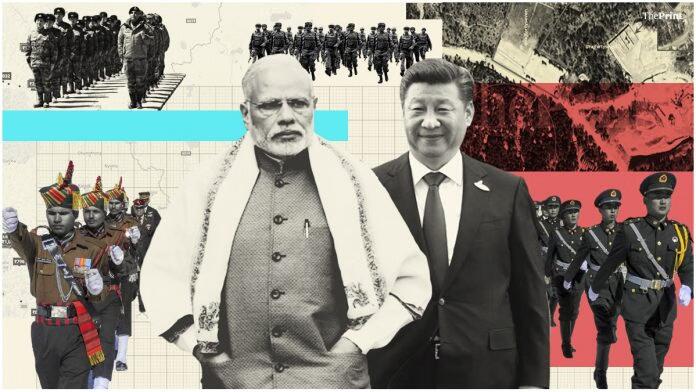
The Himalayan frontier has turned into Beijing’s most persistent testing ground. Since Xi Jinping consolidated power in 2012, India has faced a steady rhythm of border confrontations that reveal not chaos, but a method. What emerges is a deliberate playbook of incremental encroachment—what strategists call “salami slicing”—designed to probe, press, and pocket gains unless firmly resisted. From Depsang in 2013 to Galwan in 2020, the pattern has hardened into policy: China advances until it meets Indian steel.
Xi’s Era of Assertiveness
The contrast with the past is stark. Before Xi, skirmishes along the Line of Actual Control (LAC) were sporadic. Under his watch, five major face-offs have erupted in less than a decade. Each carried the same imprint: sudden PLA incursions, forward positions reinforced with tents and equipment, and an attempt to normalise the fait accompli through negotiation.
Depsang in April 2013 set the tone. A PLA platoon pitched camp 19 kilometres inside Indian-claimed territory. For 21 days, Chinese soldiers held their ground until a negotiated pullback. It was not a dramatic clash, but it established the basic script that would repeat—with greater intensity—in later confrontations.
Doklam: The Template on Display
By 2017, at Bhutan’s Doklam plateau, the template had matured. When PLA engineers pushed a road towards the strategically sensitive Siliguri Corridor, India intervened under its treaty obligations to Thimphu. Nearly 270 troops crossed into the area under Operation Juniper, halting construction and triggering a 73-day standoff.
Doklam exposed the mechanics of Chinese coercion: creep forward under the guise of “different perceptions of the LAC,” fortify the advance, and then use prolonged tension to shift facts on the ground. Beijing’s surprise at India’s firmness revealed the other side of the equation—when checked early and decisively, PLA moves lose momentum.
Galwan: Escalation by Design
The clash in Galwan Valley on June 15, 2020, was the most violent test yet. For the first time in 45 years, blood was spilled on the high Himalayas: 20 Indian soldiers and at least four Chinese personnel lost their lives.
Galwan followed the same template but with a critical twist. Instead of a single incursion, the PLA opened multiple pressure points—Hot Springs, Gogra, Pangong Tso—seeking to overwhelm Indian responses. Infrastructure was the trigger; Chinese objections to Indian road-building in undisputed territory masked a larger push to enforce a new status quo.
If Doklam was the rehearsal, Galwan was the attempt at a full performance. Yet it also marked the point where China’s assumptions faltered. India’s counter-deployments, rapid reinforcement, and willingness to absorb costs signalled that salami-slicing had met its limit.
Red Lines and the ‘Salami Slicing’ Strategy
From Depsang to Galwan, the continuity is undeniable. The PLA advances incrementally, calculating that India—despite its military capacity—will manage tensions rather than escalate. Beijing relies on the ambiguity of the LAC, on protocols meant for conflict prevention, and on India’s instinct for restraint.
But every incident has also sharpened India’s resolve. Border infrastructure has accelerated, surveillance has improved, and force levels in Ladakh have been permanently strengthened. Post-Galwan, India has shown that negotiations will not mean withdrawals without reciprocity—a shift Beijing cannot ignore.
The Road Ahead
The December 2022 Yangtse clash and continuing frictions in Depsang and Demchok show the pattern is far from over. Xi’s China has turned border management into a tool of military competition. Each provocation tests how much India will concede in the name of stability.
The burden, then, is clear: peace in the Himalayas will not rest on protocols or confidence-building measures alone. It will depend on deterrence. As Doklam and Galwan have proved, only credible opposition—military preparedness matched with political will—halts Chinese expansion.
Until Beijing recalculates that the costs outweigh the benefits, the PLA will keep pressing. India’s task is to ensure every probe meets resistance swift enough, and firm enough, to make aggression a losing game.
(Ashu Maan is an Associate Fellow at the Centre for Land Warfare Studies. He was awarded the Vice Chief of the Army Staff Commendation card on Army Day 2025. He is pursuing a PhD in Defence and Strategic Studies at Amity University, Noida. His research focuses on the India-China territorial dispute, great power rivalry, and Chinese foreign policy.)