
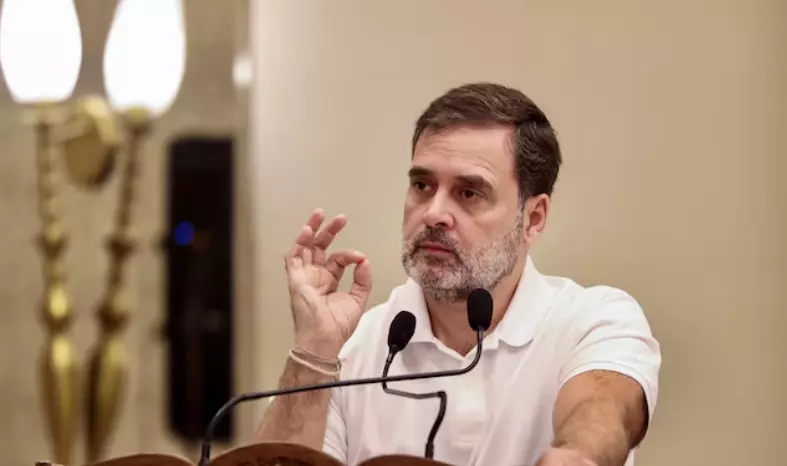
As the NDA in India prepares to announce its candidates for the crucial Bihar elections, Congress leader Rahul Gandhi has returned from a two-week tour of South America not with solutions, but with fresh controversy. Speaking in Peru, Gandhi once again chose to malign India’s image abroad, this time alleging that the country’s education system only benefits the “upper castes.” His comments, made on foreign soil, are being seen as part of a familiar pattern: divide India’s social fabric, denigrate national institutions, and deflect attention from the Congress party’s own legacy of caste politics and policy failures at home.
Rahul Gandhi’s Latest Controversy in Peru
While addressing students in Peru, Rahul Gandhi claimed that India’s education system “favours upper castes” and excludes the traditions of “middle and lower castes.” He added that the “scientific temper” of the education system had been destroyed by the current BJP government, and promised to “repair” it by restoring logic and open thinking.
Gandhi stated, “Approximately 90% of India’s population is middle castes and lower castes. Their thought systems and traditions are not included in our education system. It is an education system of the top tier of society.”
However, political observers point out the irony: Gandhi belongs to a party that has ruled India for over six decades and had every opportunity to make the system more inclusive. Instead, the Congress is remembered for institutionalising vote-bank politics through selective policies and appeasement, rather than genuine social reform.
Congress’ Contradictory Caste Politics
Rahul Gandhi’s statements on caste discrimination appear hollow in light of the Congress’s track record. The same party has repeatedly attempted to extend reservations meant for Scheduled Castes and Scheduled Tribes to Muslims a move seen as both unconstitutional and opportunistic.
His slogan, “Jitni abadi utna haq” (rights based on population), has been criticised as an open endorsement of proportional representation, a dangerous idea that divides the Hindu community while consolidating the Muslim vote bank. The Congress manifesto for 2024 further pledged to lift the 50% ceiling on reservations, opening the door to a system where caste and religion not merit determine opportunity.
Political analysts warn that such measures could turn India’s democracy into a numbers game, where religion-based quotas and sectional demands replace national unity. In the long run, this could resemble the disastrous Lebanese-style proportional representation model, which fractured their society beyond repair.
Anti-Business and Anti-India Narratives Abroad
Rahul Gandhi’s recent foreign tours including visits to Brazil, Colombia, Peru, and Chile have attracted criticism for their political undertones. Observers note that most of these countries currently have left-leaning governments that came to power on “anti-businessmen” and “redistribution of wealth” narratives. Gandhi’s choice of destinations, many believe, aligns with his ideological positioning and his attempts to reinvent Congress as a global socialist force, disconnected from India’s economic realities.
Social media users mocked his visit to Bogotá, Colombia, with sarcastic posts saying he had gone there “to solve Bihar’s problems.” Others questioned his priorities, pointing out that while he was lecturing foreign students about caste, the Congress-led opposition in India was struggling to finalise its seat-sharing arrangements ahead of the Bihar polls.
BJP spokesperson Amit Malviya summed it up sharply: “Rahul Gandhi spent nearly fifteen days in South America and participated in only a few public events. With just weeks left for the crucial Bihar elections, he chose a foreign vacation over finalising alliances. His priorities are clear.”
NDA Finalises Candidates While Congress Wobbles
Back home, the National Democratic Alliance (NDA) led by the BJP has displayed strategic discipline and unity. Bihar BJP president Dilip Jaiswal confirmed that the NDA will announce its full list of candidates, saying, “The NDA has already finalised its seat-sharing formula. All constituents will contest unitedly.”
Under the arrangement, the BJP and JD(U) share the lion’s portion of seats, while smaller allies have been allotted constituencies based on regional strength. The alliance has also signalled readiness with a cohesive manifesto focused on development and governance.
In stark contrast, the Mahagathbandhan (Grand Alliance) comprising the RJD, Congress, and Left parties remains entangled in internal confusion. Senior Congress leaders have yet to agree with Lalu Prasad Yadav and Tejashwi Yadav on seat allocation. Reports suggest Congress might contest fewer seats than in 2020, when it managed to win only 19 of the 70 it contested.
Political observers say Rahul Gandhi’s absence during this critical negotiation period underscores his disinterest in serious political strategy. Even as the NDA readies for a strong electoral campaign, Congress remains directionless bogged down by indecision, infighting, and a leader seemingly more comfortable criticising India abroad than leading his party at home.
Rahul Gandhi’s Priorities Speak Louder Than His Speeches
Rahul Gandhi’s pattern is now familiar travel abroad, question India’s institutions, divide society by caste, and return home to a confused opposition. His comments in Peru are not just ignorant; they are irresponsible. By portraying India as a nation that discriminates against its own citizens, he damages the country’s global image while attempting to score domestic political points.
At a time when India is being globally recognised for its economic resilience and technological innovation, Rahul Gandhi continues to cling to outdated Marxist ideas of “class struggle” and “redistribution.” Worse, he does so while his party fails to get its own electoral act together.
As the NDA moves confidently ahead in Bihar with a united front, the contrast could not be clearer. Leadership is about priorities and Rahul Gandhi’s latest foreign lecture tour shows that for him, politics comes before patriotism, and self-promotion before service.