
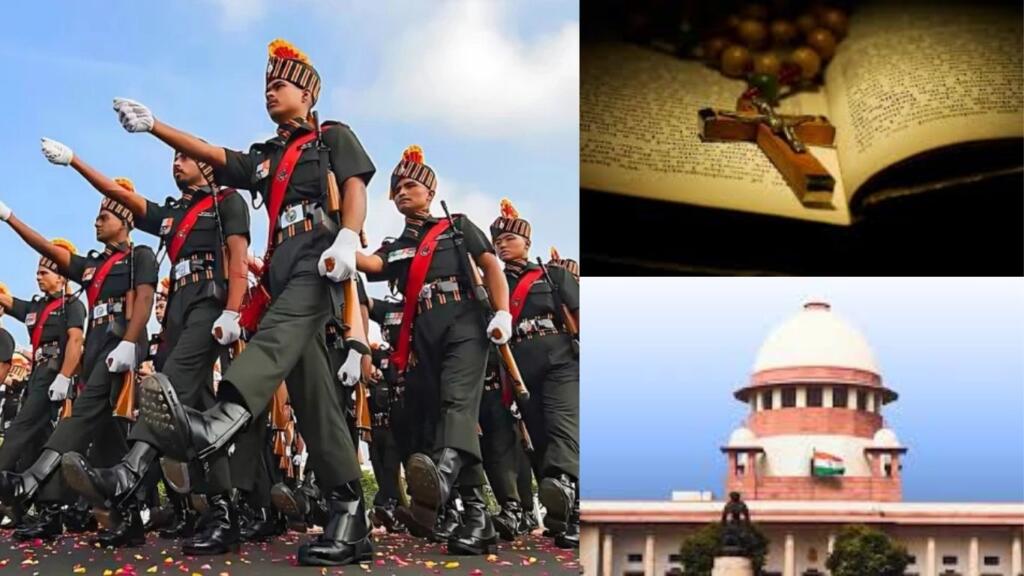
A controversy that cuts to the very heart of military ethics has reached the Supreme Court. Lieutenant Samuel Kamalesan, a Christian officer in the Indian Army, was dismissed from service after refusing to enter the sanctum of his regiment’s temple, citing a conflict with his religious beliefs. His case now before the apex court has reignited the timeless debate between personal faith and professional duty. Can religion take precedence over discipline in a force that defines itself by absolute obedience? Or is command the only true Dharma of a soldier?
The Delhi High Court had earlier upheld Kamalesan’s dismissal, observing that “placing personal religion above lawful command amounts to indiscipline.” For the court, the principle was simple: in the Army, faith is private, but discipline is institutional. And in the barracks, the tricolour not any deity is the highest symbol of reverence.
Lt. Samuel Kamalesan served with the 3rd Cavalry Regiment, a proud unit composed of Sikh, Jat, and Rajput troops. Like many regiments, it maintained both a temple and a gurdwara within its lines symbols of unity and shared tradition rather than theological devotion. Kamalesan participated in Diwali, Gurpurab, and Holi festivities alongside his men. By all accounts, he was sincere, disciplined, and respectful of others’ faiths.
The conflict arose during a regimental ritual when Kamalesan was ordered to enter the temple sanctum and perform aarti. He declined, citing that such an act would violate his Christian belief in worshipping only one God. His refusal, though polite, was seen as defiance of a lawful command.
This moment seemingly minor to a civilian was monumental in the Army’s eyes. In a structure built entirely on obedience, even a symbolic hesitation is a breach in the chain of command. As military officials later argued, when one officer chooses which orders to obey, it opens the door for others to question, delay, or defy.
Why Faith Cannot Dictate Command
The Army’s stance before the High Court was unequivocal: regimental rituals, even those rooted in religion, serve a secular military purpose. They are not worship, but expressions of unity and morale. When a commanding officer leads his men through rituals, it strengthens the bond between faith and fearlessness—a vital psychological anchor in combat.
In the 3rd Cavalry, the deity’s aarti was not about theology but tradition. A refusal, however principled, risked alienating the officer from his troops, who see shared participation as brotherhood. When soldiers march into battle shouting “Bajrang Bali ki Jai” or “Bole So Nihal,” they are not proclaiming religious supremacy; they are expressing collective courage.
The Army’s ethos has always been clear: “The religion of the troops is the religion of the unit.” For a regiment to function as a single body, its members must rise above individuality. Once uniformed, soldiers are bound by a sacred chain of command that transcends caste, creed, and faith.
Why the Army Is Not a Democracy
Civil society thrives on debate, dissent, and diversity of opinion. The Army, however, cannot afford such luxuries. It functions on precision, hierarchy, and instantaneous obedience. Every order whether it concerns cleaning a rifle or executing a mission—is sacred.
If soldiers start interpreting orders based on personal belief, chaos ensues. Imagine a scenario where a soldier refuses to fire because his religion forbids killing, or another declines to hoist the national flag because his sect rejects symbolism. Such exceptions could paralyse an entire unit in combat.
That is why the Army’s oath is not to God, but to the Constitution and the Republic. When a soldier salutes, he salutes the idea of India not a faith. Personal spirituality is respected, but it remains secondary to operational discipline. In this ecosystem, the highest virtue is obedience, not devotion.
The Danger of Personal Exceptions
Lt. Kamalesan’s supporters argue that he maintained decorum he removed his shoes, stood respectfully outside the sanctum, and observed the ritual without participating. But discipline, the Army insists, is not about intention but execution.
His refusal was not seen as disrespect, but as disobedience. And in military life, that distinction is critical. A single act of defiance, however courteous, can erode the sanctity of command. Today, if an officer refuses a ceremonial order, tomorrow a soldier might hesitate in a firefight. The Army’s insistence on absolute obedience is therefore not authoritarian it is existential.
During operations in insurgency zones like Kashmir or Manipur, there is no room for theological interpretation. Soldiers act on command, not conviction. That’s why even minor breaches in peace time are treated severely—to set a precedent that prevents fatal hesitation in war.
Religion as Strength, Not Division
No one denies that Indian soldiers are deeply religious. In fact, faith is often their greatest source of courage. Before battle, Sikh soldiers recite the Ardas, Rajputs invoke Lord Ram, Gurkhas worship Goddess Kali, and Muslim soldiers offer silent prayers. Religion unites, motivates, and sanctifies sacrifice.
But the line is clear: religion in the Army exists as emotional strength, not ideological assertion. Festivals are celebrated across faiths—Hindus join in Eid, Muslims partake in Holi, and Christians light lamps on Diwali. Yet none of these gestures can ever override the primacy of command.
Lt. Kamalesan’s case, therefore, is not a conflict between Hindu and Christian traditions. It is about defining the boundary where personal conviction ends and institutional discipline begins. The Army is, in its own way, a temple—but its deity is the tricolour, and its prayer is service.
Supreme Court’s Task: Balancing Freedom and Duty
The Supreme Court, led by Justice Surya Kant, has now taken up this sensitive case. The core question is whether an officer’s right to religious freedom can override military discipline. Article 33 of the Constitution explicitly allows Parliament to restrict fundamental rights of Armed Forces personnel to maintain order and discipline.
Thus, while religious freedom is a cornerstone of Indian democracy, it cannot be absolute in uniform. A soldier, by oath, surrenders a portion of his personal liberty in exchange for the honour of defending national liberty.
The Delhi High Court had rightly stated that “things work differently in the Army.” It was not a dismissal of faith, but a recognition that the Army’s sanctity lies in its command structure. Just as a doctor must detach emotion to perform surgery, or a judge must detach bias to deliver justice, a soldier must detach belief to obey an order.
The Only Dharma of a Soldier
Lt. Kamalesan’s faith deserves respect, but his refusal cannot be condoned. Because when duty and religion collide, the soldier must always choose duty. The Indian Army is not Hindu, Muslim, Christian, or Sikh it is a brotherhood forged in sacrifice, a living embodiment of national unity.
The regiment’s temple is not a religious site but a memorial of continuity where generations have prayed before battle, where martyrs’ names are enshrined, and where camaraderie transcends creed. To deny participation, even symbolically, is to distance oneself from that sacred lineage of shared service.
In the end, the Supreme Court’s verdict will not merely decide one man’s fate. It will reaffirm an eternal truth: that in the Indian Army, the only God is Bharat Mata, the only scripture is the Constitution, and the only Dharma is discipline.