
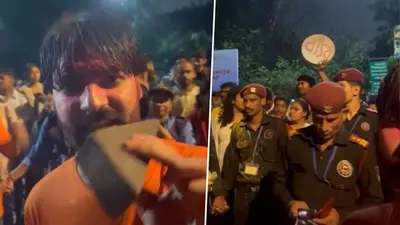
Tensions gripped the Jawaharlal Nehru University (JNU) campus on Thursday evening after a Durga Puja idol immersion procession was allegedly attacked, triggering violent clashes between rival student groups. The incident occurred around 7 PM near the Sabarmati T-Point, where members of the Akhil Bharatiya Vidyarthi Parishad (ABVP) were leading the immersion procession. According to eyewitness accounts, members of Left-leaning student groups — including AISA, SFI, and DSF — intercepted the procession and resorted to violence. Stones and wooden blocks were hurled, and even idols were targeted, leaving the atmosphere on campus deeply polarized.
Flashpoint at JNU: From Effigy Burning to Clashes
The immediate trigger for Thursday’s violence can be traced back to an earlier symbolic protest. ABVP members from the Barak hostel had organized a Ravan effigy burning on Dussehra, but instead of using traditional imagery, they placed the faces of controversial figures like Sharjeel Imam and Umar Khalid on the effigy. Both individuals, accused in anti-CAA protests and conspiracy cases, have long been defended by Leftist student groups on campus. This symbolic act enraged the Left-aligned organizations, who accused the ABVP of communal provocation. In retaliation, Leftist groups shifted their protest venue towards the Sabarmati T-Point, which was also the route of the Durga idol immersion. What began as verbal altercations soon escalated into stone-pelting, with wooden blocks reportedly hurled at the procession.
ABVP Accuses JNUSU President of Orchestrating Violence
Following the incident, ABVP members accused the Leftist organizations of deliberately orchestrating the violence. They alleged that the protest was relocated with the explicit intent to provoke and clash with the Durga Puja immersion. Serious allegations were also leveled against JNUSU president Nitish Kumar, with ABVP claiming that the violence happened at his behest. One ABVP member said, “They attacked us with stones and wooden blocks. Even idols were targeted. This was a pre-planned assault.” Reports also suggest that a female participant in the procession was assaulted during the chaos. The JNU administration has since stepped in to restore order, with campus security monitoring the situation to prevent further escalation.
A Pattern of Mocking Hindu Traditions
This is not the first time Hindu festivals and rituals have come under attack within JNU’s charged ideological atmosphere. The university has a long history of Left-aligned student groups mocking Hindu traditions. One of the most controversial examples was the observance of “Mahishasur Martyrdom Day,” an event that painted a demon from Hindu mythology as a heroic figure and insulted Goddess Durga. Such events sparked outrage across the country, with critics accusing JNU’s Leftist groups of systematically undermining Hindu beliefs under the guise of academic freedom and political expression. Thursday’s violence has now added another chapter to this history, once again raising questions about whether the campus is becoming a breeding ground for anti-Hindu provocations disguised as student activism.
Violence Beyond JNU: Attacks on Navaratri Celebrations Nationwide
The clashes at JNU are part of a larger pattern of disturbing incidents during this year’s Navaratri festivities across India. From Gujarat to Maharashtra and Rajasthan, Hindu religious events were disrupted by Islamist groups. In Gujarat’s Gandhinagar, stone-pelting and arson followed a social media post that read “I Love Muhammad,” with 70 people arrested. In Maharashtra, leaked WhatsApp chats revealed Muslim students plotting to target Hindu girls at Garba venues, with comments like “Not a single Hindu girl should be spared.” Similar infiltration attempts were reported in Rajasthan, Kanpur, Chhattisgarh, and Vadodara, where mobs indulged in vandalism and attacks. In Mumbai’s Mankhurd, a Durga statue was desecrated near a mosque, sparking communal tension. These incidents underline a worrying trend: Hindu festivals are increasingly being targeted, either by Islamist groups or by Leftist student organizations that openly ridicule Hindu faith and practices.
JNU Violence Reflects a Larger Ideological Battle
The violent disruption of the Durga Puja idol immersion at JNU is not an isolated incident but part of a larger ideological battle that has long gripped the campus. For decades, Left-aligned student groups have mocked and undermined Hindu traditions, creating an atmosphere where faith-based celebrations are routinely politicized and attacked. This year’s violence, coinciding with wider disruptions of Navaratri celebrations across the country, signals a dangerous convergence of ideological extremism and religious hostility. While ABVP has accused Leftist organizations of orchestrating the clashes under the guidance of the JNUSU president, the broader issue remains: Hindu festivals are being deliberately targeted, whether in universities or on the streets. The JNU administration and law enforcement agencies must act firmly, not only to restore order on campus but also to ensure that Hindu festivals can be celebrated without fear of provocation or attack.