
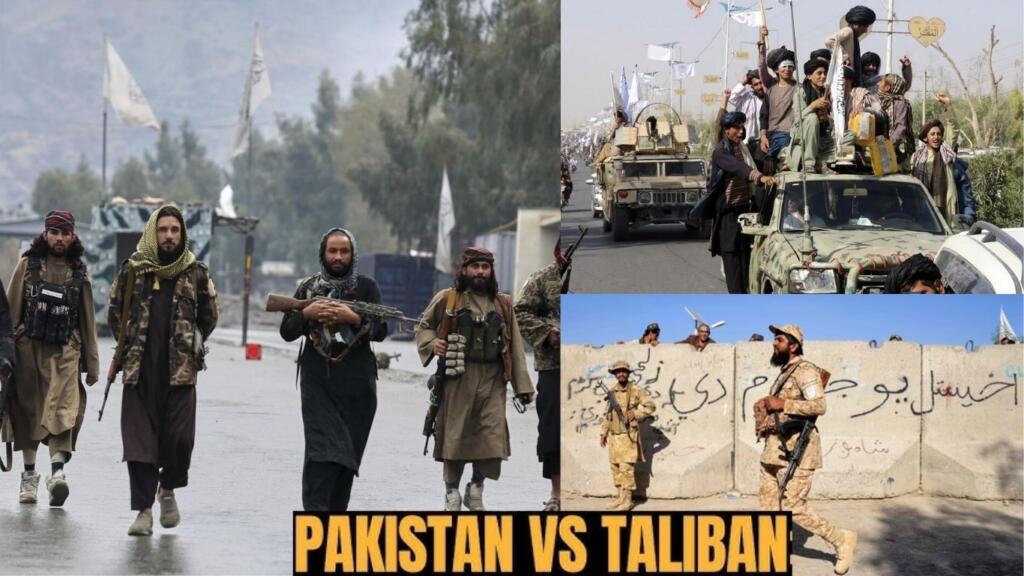
In a major policy reversal, Pakistan has stated that the Afghan Taliban regime is not legitimate, a stark contrast to its earlier stance in 2021 when Islamabad was among the first to endorse the Taliban government following the fall of Kabul. The shift, described by sources as a forced decision rather than a principled change, marks a clear rupture in the once-close relationship between the two neighbours.
Pakistan’s decades-long policy of nurturing terror groups for strategic purposes is now proving to be a dangerous miscalculation. The situation has unfolded exactly as Hillary Clinton famously warned in 2011: “You can’t keep snakes in your backyard and expect them only to bite your neighbours. Eventually, those snakes are going to turn on whoever has them in the backyard.” The rise of the Afghan Taliban and its alliance with the TTP has created a situation where Pakistan is being forced to contend with not one, but two hostile Taliban factions. What Pakistan once saw as a strategic asset has now evolved into a volatile force threatening its own stability, as per media reports. The repercussions of Pakistan’s decades-long support for terrorism are now manifesting in full force, and the country is paying the price for its involvement in nurturing extremist elements.
In a formal communication, Pakistan’s Foreign Office expressed deep concern over unwarranted aggression by the Afghan Taliban, terrorists and militants along the Pak-Afghan border on the night of 11–12 October. The statement said the attacks aimed to “destabilise the Pak-Afghan border” and violated the spirit of peaceful and cooperative ties between “two brotherly countries.”
Pakistan claimed it exercised its right to self-defence by “effectively repulsing assaults all along the border”, inflicting “heavy losses on Taliban forces and affiliated Khwarjis” in men, material, and infrastructure. Islamabad asserted that the targeted structures were being used to plan and facilitate terrorist attacks against Pakistan.
The statement maintained that all possible measures were taken to prevent collateral damage and protect civilians, while reiterating that “Pakistan values dialogue and diplomacy” but will take all possible measures to safeguard its territory and people. It warned that “any further provocations would be met with an unwavering and befitting response.”
According to Indian intelligence sources, Pakistan’s sudden disowning of the Taliban is not a moral or political re-evaluation, but a reaction to Taliban defiance, border attacks, and the surge in Tehreek-e-Taliban Pakistan (TTP) violence that has destabilised Pakistan’s internal security.
In 2021, the presence of then DG ISI Lt. Gen. Faiz Hameed at Kabul’s Serena Hotel symbolised Pakistan’s control over the Taliban leadership. Four years later, that command appears lost. Islamabad has reportedly lost influence over both the Kandahari faction loyal to Hibatullah Akhundzada and the Haqqani Network, which once acted as its strategic proxies.
The development marks a serious blow to Pakistan’s long-held strategic depth doctrine — the idea of using a friendly Afghan regime as a buffer and a counterweight to India. Once seen as a vital asset against India, the Taliban has now evolved into an ideological enemy, challenging Pakistan’s borders and threatening the stability of its Pashtun-dominated tribal belt.
Sources said Pakistan’s public refusal to recognise the Taliban regime and its branding of it as non-legitimate is also being viewed as an attempt to deflect criticism from the ruling government, whose ministers have continued to hold meetings with Taliban representatives even as official rhetoric turns hostile.
Pakistan’s Foreign Office also rejected recent comments made by the Interim Afghan Foreign Minister in India, calling them “baseless assertions” meant to “divert attention from the presence of terrorist elements in Afghanistan.” Islamabad said the Taliban regime “cannot absolve itself of its responsibilities towards regional peace and stability”, adding that the “continued presence of terrorist elements on Afghan soil” has been well documented in UN Monitoring Team reports
It urged Kabul to honour its commitment of not allowing its territory to be used for terrorism against other countries and to “take concrete and verifiable actions” against such groups.
Pakistan’s statement also invoked humanitarian language, noting that it had generously hosted around four million Afghans for more than four decades and that it would now “take all actions to regulate the presence of Afghan nationals on its territory” in line with international norms.
Islamabad concluded by saying it remains “desirous of a peaceful, stable, friendly, inclusive, regionally connected, and prosperous Afghanistan” and hopes that one day, the Afghan people would be emancipated and governed by a true representative government.
Pakistan’s nurturing of the Taliban, once a tactic to gain leverage in the region, has turned into a complex nightmare. With the Taliban on one side and the TTP on the other, Pakistan finds itself caught in a web of its own making. As the situation continues to evolve, the consequences of Pakistan’s long-standing support for terror groups are becoming increasingly clear. The once strategic ally is now an unpredictable threat, and Pakistan must now grapple with the fallout of its past decisions.