
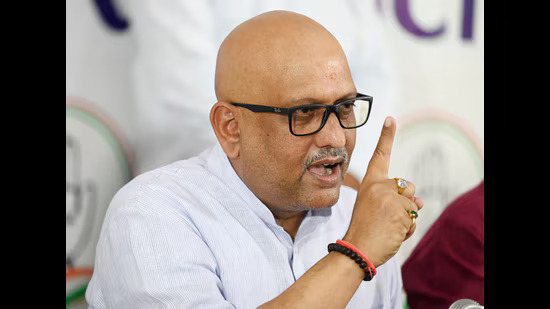
In yet another move that raises questions about its commitment to national interest, the Congress party has stirred up a fresh controversy—this time, casting aspersions on Operation Sindoor, a decisive military response by India against terrorism emanating from across the border. The latest remarks by Ajay Rai, Congress’ Uttar Pradesh chief and a known Modi-baiter, suggest not just political opportunism but a deeper disregard for national security at a time when India should be rallying behind its armed forces.
The Context: A Successful Operation Turned Into Political Football
On May 7, following a brutal terror attack in Pahalgam, Jammu and Kashmir, India launched Operation Sindoor, a precision military offensive that targeted at least nine terror bases inside Pakistan, including high-profile locations linked to Lashkar-e-Taiba and Jaish-e-Mohammed. These groups have long enjoyed safe havens in Pakistan, operating with impunity and posing a persistent threat to Indian lives and security.
The operation marked a shift in India’s counter-terror strategy. Not only did it neutralize major terror hubs, but it also delivered a sharp blow to Pakistan’s military infrastructure, targeting strategic assets like the Nur Khan Airbase and air defence systems. According to Indian defence officials, the operation involved a high degree of coordination and technological superiority, with reports confirming that India shot down both US- and Chinese-made fighter jets deployed by Pakistan.
But instead of lauding the armed forces for this daring and successful mission, Congress leader Ajay Rai raised doubts, alleging inconsistencies in the statements made by top military brass, including the Chief of Defence Staff and the Army Chief. His claim that “something is amiss” (“gadbad hai”) is not just ill-informed—it’s dangerous.
Congress’ Habitual Undermining of National Efforts
This is not the first time the Congress party has attempted to sow seeds of doubt at crucial moments of national significance. From questioning the authenticity of the 2016 surgical strikes to demanding “proof” of the 2019 Balakot airstrikes, Congress has repeatedly taken positions that mirror enemy propaganda more than patriotic concern.
By implying disarray in the ranks of India’s top military leadership, Rai has once again demonstrated a shocking disconnect from the national sentiment and a reckless disregard for morale within the armed forces. His comment that “repeated clarifications prove something is wrong” is not only baseless but also factually incorrect. The armed forces, during and after Operation Sindoor, held coordinated press briefings and released satellite imagery confirming the impact on Pakistani military installations. Independent sources have also corroborated this data, confirming the extensive damage inflicted on airbases such as Sargodha, Bholari, Sukkur, and Rahim Yar Khan.
BJP’s Sharp Rebuttal
The ruling BJP was quick to slam Rai’s comments, accusing the Congress of following “instructions from Colombia”—a jibe at Rahul Gandhi, who is currently overseas. BJP spokesperson Tom Vadakkan described the remarks as part of a larger pattern: “After trying to cast doubts on the Election Commission, the Congress is now trying to build another false narrative. If this gentleman is abusing the defence forces, it’s just not acceptable.”
Vadakkan further emphasized that all heads of the Indian military are united in their account of Operation Sindoor and accused the Congress of lowering troop morale for petty political gains.
Soldiers Deserve Support, Not Suspicion
Even as Rai attempted damage control by saying “Congress considers every soldier supreme” and paid lip service to their bravery, his earlier remarks had already done the harm. You can’t claim to respect the armed forces while simultaneously questioning their integrity and coherence without cause. In times of conflict, national security demands unity—not confusion, not conspiracy theories, and certainly not political sniping.
The Bigger Picture: National Security Is Not a Political Tool
Operation Sindoor showcased India’s growing confidence and capability in tackling state-sponsored terrorism, especially when diplomacy fails. The swift and calculated manner in which the operation was executed sent a clear message to Pakistan: terror will not be tolerated, and India will respond with force when provoked.
Unfortunately, Congress seems more interested in creating domestic turmoil than supporting such clarity in policy. Its leaders are either out of touch with the current strategic doctrine or are willingly playing into narratives that undermine India’s security posture.
At a time when countries around the world are increasingly supporting India’s right to self-defence, internal political divisions that question our armed forces only serve to embolden hostile actors. If Congress continues down this path, it risks not only political isolation but a permanent label of being indifferent—or worse, obstructive—to India’s national interest.
Final Word: Questioning Is Not Treason, But Timing and Intent Matter
To be clear, in a democracy, questioning the government or the military is not a crime. However, there is a line between healthy scrutiny and harmful speculation—especially during sensitive times when military operations are involved. Ajay Rai’s comments cross that line, suggesting either a calculated political maneuver or a glaring ignorance of how national security functions.
In either case, the damage is done—not just to Congress’ credibility, but to the unified front India must present in the face of persistent cross-border threats. When the enemy is watching, divided houses don’t win wars—they invite them.