
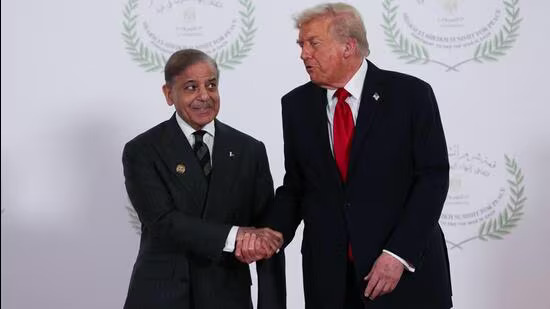
Even as Pakistan Prime Minister Shahbaz Sharif stood on the global stage at the Sharm el-Sheikh peace summit in Egypt, preaching “peace” and “stability,” his own police were brutally gunning down protestors in Islamabad and bombing people in Khyber Pakhtunkhwa. The irony could not have been starker a regime that kills its citizens in the name of Gaza was attempting to wear the mask of a peace messenger abroad. Pakistan’s duplicity, its export of terror into India, and its internal chaos have once again laid bare the hollowness of its leadership, while Prime Minister Narendra Modi’s diplomatic restraint proved India’s wisdom and maturity.
Pakistan’s Bloody Streets and the Gaza Hypocrisy
In recent weeks, Pakistan’s streets have turned into war zones. The same government that claims to champion the Palestinian cause unleashed bullets and tear gas on its own citizens protesting against American intervention in the Israel-Hamas conflict. The rally by Tehreek-e-Labbaik Pakistan (TLP) in Islamabad, which demanded that Pakistan cut ties with the U.S., ended in chaos as the police opened fire, killing several demonstrators. The protesters were marching toward the U.S. Embassy, accusing Washington of bias against Palestine.
While the Pakistan government sought to silence its own people through force, its prime minister was attending the Egypt summit, preaching global harmony and peace. This hypocrisy is emblematic of Islamabad’s political disorder where moral posturing abroad is accompanied by violence and repression at home. The Khyber Pakhtunkhwa region, too, has been bombed repeatedly by Pakistan’s own military, further deepening resentment among tribal citizens.
Pakistan today stands on the verge of a civil war. Its hostile relations with Afghanistan have only worsened after its air strikes on Kabul last week. The Taliban regime in Kabul, which once had Pakistani support, now openly blames Islamabad for violating sovereignty and bombing civilian areas. The rift between the two Islamic nations reflects Pakistan’s diplomatic failure and its inability to maintain peaceful relations even with ideological allies.
Meanwhile, its internal security has crumbled under the rise of extremist factions such as the TLP and Tehreek-e-Taliban Pakistan (TTP). The Pakistani state has lost control over large swathes of territory where the writ of the government is almost nonexistent. Ironically, this collapsing state machinery continues to export terrorism into India, while presenting itself as a peace-loving nation at international forums.
After the horrific Pahalgam terror attack that killed 26 innocent civilians, India launched Operation Sindoor a precise and powerful military response that targeted Pakistan-based terror infrastructure. The Indian Air Force carried out strikes on 11 Pakistani airbases and destroyed major terror camps in Muridke and Bahawalpur. Pakistan, caught completely off guard, soon sought a ceasefire through back channels.
Contrary to Prime Minister Shahbaz Sharif’s later claim that “Donald Trump brokered peace” between India and Pakistan, New Delhi flatly rejected this falsehood. The ceasefire was India’s strategic choice not a diplomatic concession. India’s forces had made it clear that the country would no longer tolerate cross-border terrorism. The contrast between India’s truth-based diplomacy and Pakistan’s habitual deceit once again came to light.
Pakistan’s repeated attempts to distort facts and seek validation through Western intermediaries expose its deep insecurity. While India continues to rely on its self-reliant defense and principled diplomacy, Pakistan’s obsession with international approval only underscores its weakness.
Prime Minister Narendra Modi’s decision to skip the Sharm el-Sheikh peace summit was a masterstroke of strategic restraint. The event, hosted by U.S. President Donald Trump, quickly descended into theatrics and political flattery. Shahbaz Sharif used the opportunity not for diplomacy but for self-promotion recommending Trump for a Nobel Peace Prize and thanking him publicly for “ending the India-Pakistan conflict,” a statement rooted entirely in falsehood.
Had Modi attended, he would have been forced to sit through Sharif’s baseless claims and Trump’s misplaced showmanship. Instead, India deputed Minister of State for External Affairs Kirti Vardhan Singh to represent the country a symbolic but calculated move. Singh’s brief presence at the summit maintained India’s diplomatic engagement without lending legitimacy to the charade.
This is not the first time Modi has deftly avoided a diplomatic ambush. Earlier in June, he had declined Trump’s last-minute invitation to Washington while returning from Canada, knowing that the U.S. President had also invited Pakistan’s army chief, Asim Munir, the same day. India’s foresight prevented any awkward encounter that could have undermined its firm stance on Pakistan-sponsored terrorism.
Congress leader Shashi Tharoor later called Modi’s absence “a missed opportunity,” but the sequence of events at Sharm el-Sheikh proved otherwise. India’s maturity in steering clear of politicized global forums demonstrated both strength and self-respect.
The hypocrisy of Pakistan’s leadership stands completely exposed. A regime that bombs its own people while preaching peace abroad, that fuels terrorism in Kashmir while calling for restraint in Gaza, has lost both moral and political ground. Pakistan’s attempt to present itself as a global peace partner is a hollow charade that the world increasingly sees through.
Prime Minister Modi’s decision to stay away from the theatrics of Sharm el-Sheikh reaffirmed India’s position as a responsible global power. India speaks less but acts firmly whether through counter-terror operations or diplomatic restraint. Pakistan, meanwhile, continues to flounder trapped in lies, violence, and economic ruin. The contrast between India’s rising stature and Pakistan’s decline is the clearest reflection of truth triumphing over deceit on the global stage.