
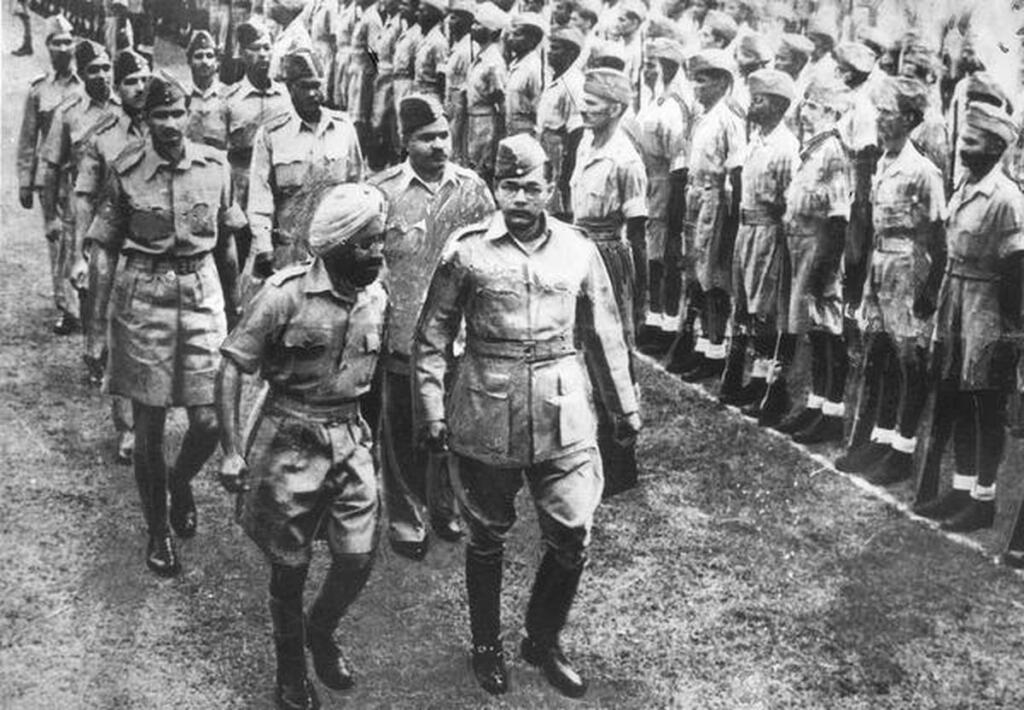
In the pages of India’s freedom struggle, few movements carried the thunder of defiance like the rise of the Azad Hind Fauj the Indian National Army (INA). Born not in the comfort of cities but amid the sweltering jungles of Southeast Asia, this army was forged out of captivity, humiliation, and burning patriotism. It was a rebellion not merely of arms, but of spirit a moment when Indian soldiers under British command turned their rifles toward their colonial masters. Led by the indomitable Netaji Subhas Chandra Bose, the INA became the sword that carved cracks into the mighty British Empire.
The Birth of a Rebel Army: From Captivity to Patriotism
The year 1942 was a turning point in India’s freedom struggle. The Quit India Movement had been crushed with brutal British force, leaving the nation disillusioned. Meanwhile, thousands of Indian soldiers serving the British Army in Southeast Asia found themselves captured by Japanese forces. In their eyes, defeat had a new meaning it was not surrender, but the beginning of rebellion.
Among these prisoners was Captain Mohan Singh, who planted the seed that would soon grow into the Azad Hind Fauj. He envisioned a force of Indians who would no longer fight for a foreign flag but for their motherland. The INA was thus born out of captivity transforming prisoners into patriots, slaves into soldiers of freedom. Their oath was clear the next bullet they fired would not serve the Crown, but India.
Netaji Arrives: Turning Nationalism into Armed Revolution
The INA found its soul in 1943 when Netaji Subhas Chandra Bose arrived from Germany via Japan. His arrival changed everything. With his charisma and unyielding conviction, Bose breathed new life into the scattered remnants of the army. In Singapore, he declared the formation of the Provisional Government of Free India (Arzi Hukumat-e-Azad Hind), on October 21, 1943 announcing to the world that India no longer sought freedom it was ready to claim it by force.
Netaji’s famous call “Give me blood, and I will give you freedom” electrified hearts across continents. His message reached Indian households and army barracks alike, reviving a spirit that British suppression had long tried to extinguish. Under his leadership, the INA became more than a military outfit it was a movement of armed nationalism, discipline, and unity. For the first time, the fight for independence had a uniform, a flag, and a marching army chanting “Delhi Chalo!”
The Power of Organization and Inclusion: Women in Command
Netaji’s leadership redefined the boundaries of freedom and equality. He envisioned the INA as the embodiment of a free India disciplined, diverse, and inclusive. Soldiers trained not only in combat but also in moral and national ideals.
In an unprecedented move, Bose created the Rani of Jhansi Regiment, the first all-women combat unit in modern Indian history, led by the fearless Captain Lakshmi Sehgal. In a conservative colonial India, this decision was revolutionary. It gave women direct participation in a battlefield of liberation a concept far ahead of its time.
These were not mere divisions of war but living symbols of unity. They carried a message that independence was not a political slogan; it was a collective act of national will.
Imphal, Burma, and the Battlefield of Spirit
In 1944, the INA marched with Japanese forces toward Imphal and Burma, aiming to raise the tricolor on Indian soil. The campaign was fierce and symbolic the first armed confrontation between Indians fighting for independence and those still loyal to the British Crown.
Though the campaign did not achieve military victory, it achieved something far greater it ignited the Indian conscience. British officers later admitted that the INA had “changed the loyalty of the Indian soldier forever.” No longer did the Indian jawan see himself as a servant of empire, but as a son of Bharat Mata.
The war also gave the world a glimpse of the awakening of a colonized people disciplined, organized, and ready to sacrifice. Even in defeat, the INA had won a moral and psychological victory that would soon echo in the mutinies of 1946.
A Symbolic Government and a Nation Awakened
The Provisional Government of Free India, established by Netaji, wasn’t a symbolic gesture. It had its own ministers, currency, postal system, and even a flag. It sent a clear message India was no longer begging for freedom; it was declaring it.
When the British tried INA soldiers for treason in the infamous Red Fort Trials of 1945, the backlash shook the empire. Cities like Delhi and Calcutta erupted in protest. From clerks to college students, from soldiers to civilians the entire nation stood behind the INA heroes.
The British realized that their moral hold over India was gone. When the Royal Indian Navy mutinied in 1946, its slogans echoed those of Netaji’s army. The INA had not just fought the British; it had changed the soul of India’s military.
The mysterious death of Netaji in 1945 left behind unanswered questions but an undying legacy. His body may have perished, but his vision lives on in every soldier and citizen of India. The INA proved that freedom is not a gift negotiated at a table but a right earned through sacrifice, unity, and courage.
The tricolor that fluttered over the Red Fort in 1947 was not merely a flag of independence it was the culmination of countless sacrifices, the echo of “Delhi Chalo,” and the blood of those who fought under Bose’s command.
Netaji Subhas Chandra Bose and his Azad Hind Fauj transformed India’s freedom struggle from petitions to power, from moral persuasion to armed resolve. Gandhi awakened India’s soul Bose gave it a sword. And that sword, though silent today, continues to gleam in the pride and valor of India’s armed forces a reminder that true freedom is never given, it is taken.