
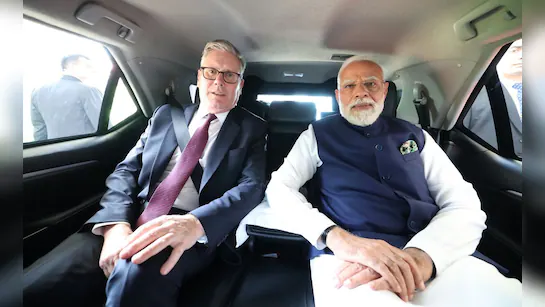
During UK Prime Minister Keir Starmer’s visit to India, the issue of Khalistani extremism was discussed in detail in his meeting with Prime Minister Narendra Modi, Foreign Secretary Vikram Misri said.
So, Prime Minister Narendra Modi has raised the issue of Khalistani extremism during a meeting with his British counterpart Keir Starmer and emphasised that radicalism and violent extremism have no place in democratic societies.
Addressing a special briefing on the UK PM’s visit to India, Vikram Misri said that the Prime Minister noted that freedoms provided by societies should not be allowed to be abused by violent extremism and there was need to move against such elements in the legal framework available on both sides,”
He said PM Modi extended condolences to the victims over the Manchester terror attack, in which a car was driven into members of the public. Two people were killed in the terror incident earlier this month. In the joint statement issued after their meeting, the two Prime Ministers unequivocally and strongly condemned terrorism and violent extremism in all its forms and manifestations.
They called for zero tolerance for terrorism and concerted international efforts to combat terrorism in a comprehensive and sustained manner, in accordance with the UN Charter and international law. They agreed to counter radicalisation and violent extremism; combat financing of terrorism and the cross-border movement of terrorists; prevent exploitation of new and emerging technologies for terrorist purposes; tackle terrorist recruitment; enhance cooperation in information sharing, judicial co-operation, capacity building; and strengthen bilateral and multilateral co-operation in these spheres, including at UN and FATF They condemned in the strongest terms the April 2025 terrorist attack in Pahalgam, J&K.
The two leaders are committed to strengthen co-operation to take decisive and concerted actions against globally proscribed terrorists, terror entities and their sponsors. During his two-day visit, Starmer engaged with business leaders and participated in a series of events. The British Prime Minister is accompanied by high-powered delegation and a 125-strong business delegation. “This is the largest ever business delegation visiting India.
This delegation comprises nine vice-chancellors of nine major universities in the UK, all of which have plans for India. PM Starmer also had engagements with business leaders from India and participated in several events. He visited Yash Raj Films to look at collaboration and cooperation in film production. He also participated in a football-related event. Vikram Misri further said the Free Trade Agreement is undergoing the process of ratification in both countries.
This visit has provided both sides with opportunities to discuss deepening economic engagement in order to derive the full benefits from tariff reduction under the FTA. The UK Secy of Business and Trade and Indian Commerce and Industries minister took stock of trade and investments between India and the UK. The leaders announced new joint investments to boost the climate technology startup fund. This will also help the FTA chapter on innovation. Technology and innovation are the second pillar in focus during the ongoing visit,” he said. Earlier yesterday, PM Modi received PM Starmer at Raj Bhavan for the official segment of the visit, and they had wide-ranging discussions on regional and global issues. Both leaders interacted with VCs from universities in the UK.
Khalistani Issue : A Headache For Both Nations
Khalistani supporters and extremists have for long been expressing anti-India sentiments in the UK. A report into the British government’s ‘Extremism Review’ leaked earlier this year named “pro-Khalistan extremism” among nine emerging threats in the UK.
In 2023, a group of Khalistan protesters breached the perimeter of the building of the Indian High Commission in London, pulled down the Indian flag and vandalised the premises.
In another incident that year, the Indian High Commissioner Vikram Doraiswami was stopped from entering a gurdwara in Glasgow during a visit to Scotland by three Khalistani extremists.
In 2015, the Indian government shared a detailed dossier with the UK on the radicalisation of the Sikh youth in the country’s gurdwaras. “Besides imparting ideological indoctrination, youth have also been imparted theoretical training to make Improvised Explosive Devices (IEDs) using common chemicals by giving live demonstrations,” the dossier alleged, according to The Daily Mail.
Sikh population in the UK
The presence of Sikhs in the UK increased in the aftermath of World War II and India’s Partition. As the war caused labour scarcity in Britain and the 1947 Partition left millions homeless in Punjab, thousands of Sikhs migrated to the European country.
Today, as many as 525,865 people identify as Sikh in the UK, as per the 2021 census. After Canada, the UK is home to the largest Sikh diasporic population in the world.
Tracing the history of Khalistan movement in the UK
It was Jagjit Singh Chohan who emerged as the global voice for a separate Sikh land – Khalistan – in the late 1960s. The dentist-turned-politician was an MLA in the Punjab Assembly from 1967 to 1969. During this period, he also served as the finance minister in the Akali government and the Deputy Speaker of the House.
After his defeat in the 1969 Assembly polls, Chohan shifted to the UK in 1970. He won supporters among the diaspora for the Khalistan movement and even made trips to Pakistan on a British passport to seek support.
During one such visit in 1971, Chohan met Pakistan President Yahya Khan, who promised him support for a separate land for Sikhs. He returned from his trip to London and condemned the alleged oppression of Sikhs in India.
Chohan even went on to publish an advertisement in The New York Times that read: “We have decided to rise and proclaim to the world that we are an undivided nation prepared to fight till the bitter end for an independent Sikh homeland in India.”
He declared himself the president of the “Republic of Khalistan”, and issued passports, postage stamps and currency. Chohan raised funds for the movement and had wealthy Sikh expatriates as his backers, reported The Guardian.
By the early 1980s, the campaign for Khalistan turned violent in Punjab with the rise of militant preacher Jarnail Singh Bhinderwale.
It was only in 1984 that the Khalistan movement gathered steam among the Sikh diaspora. “It was the military crackdown on Bhindranwale, the resulting desecration of the Sikhs’ holiest shrine [the Golden Temple in Amritsar] and its resultant, brutal repression [of militancy in Punjab], that radically altered the [diasporic] Sikhs’ attitude towards India,” political scientist Laurent Gayer wrote in The Globalization of Identity Politics: The Sikh Experience published in 2000 in the International Journal of Punjab Studies.
As per Indian Express, amid militancy in Punjab, the Sikh diaspora canvassed international support for the movement, provided a safe haven to Khalistani organisations and fugitives and rose money for the fight in India. Pro-Khalistan and anti-India messages started being preached at gurdwaras in Britain, Canada and the United States. This continues even today as Khalistanis still have a hold over some Sikh shrines.
While the Khalistan movement has hardly any place in today’s India, it continues to have a presence among a section of the diaspora.