











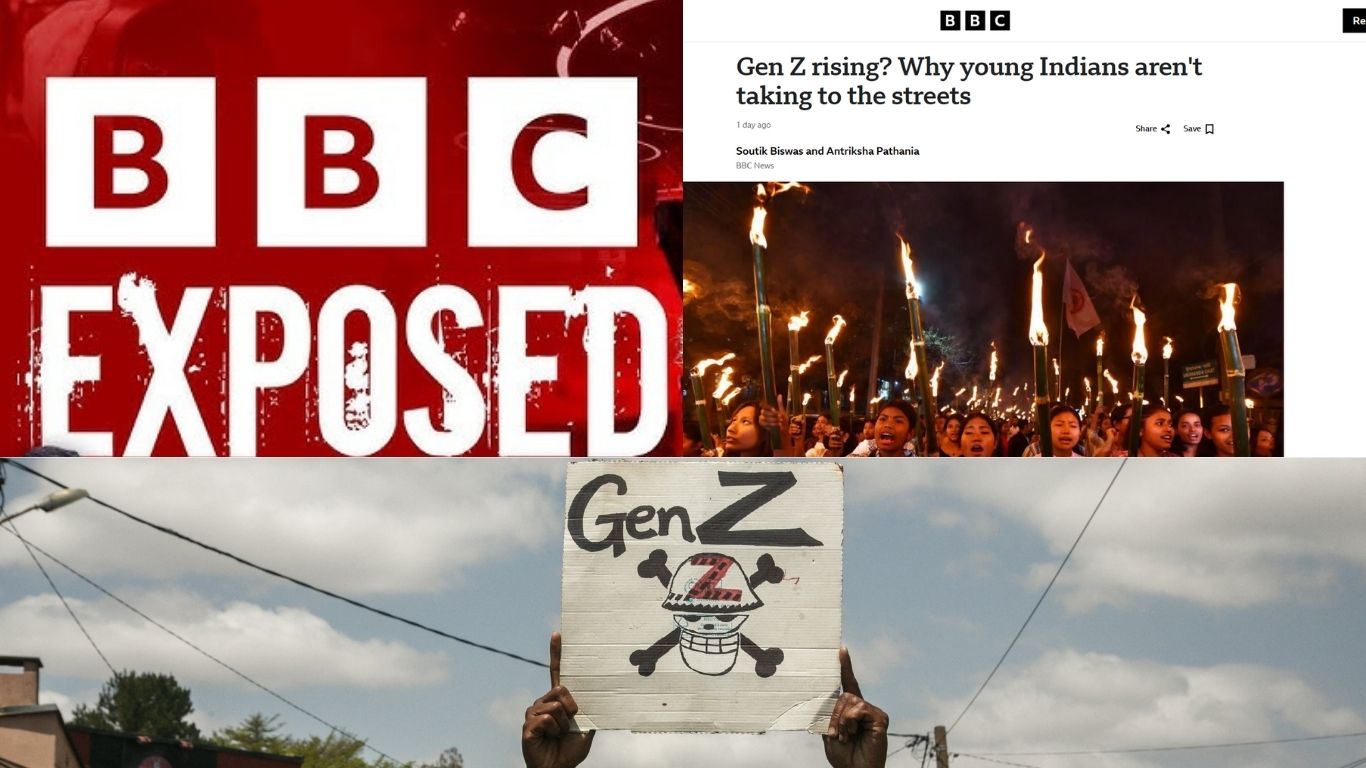
Frustrated by India’s political stability, democratic continuity, and Prime Minister Narendra Modi’s enduring popularity, the BBC has once again blurred the line between journalism and propaganda. Its recent article, “Gen Z Rising? Why Young Indians Aren’t Taking to the Streets,” pretends to be sociological analysis but reads more like a frustrated provocation.
For an organization that insists on neutrality, the BBC’s disappointment that India’s youth aren’t rioting reveals its real intent. The article laments that Indian Gen Z despite being large, educated, and digitally active hasn’t “risen” like their counterparts in Nepal or Bangladesh. Beneath the academic tone lies an unmistakable yearning, a wish to see Indian streets burning, universities protesting, and instability returning a scene Western media finds easier to romanticize and monetize.
Every few months, BBC India publishes a piece that sounds more like psychological warfare than reporting. This latest one is no exception it subtly glorifies anarchy, idealizes violent “youth uprisings,” and portrays peace as passivity.
The BBC’s structure of storytelling is a study in manipulation. It begins by glorifying Asia’s “restless youth” those who “brought down governments in 48 hours,” implying that rebellion and chaos are marks of progress. Then comes the damning comparison, Indian youth are “fragmented,” “fearful,” and “silent.”
The message is barely hidden Indian Gen Z has “failed” its global peers by not revolting. Phrases like “fear of being branded anti-national” and “government demonizing protests” are planted carefully to evoke guilt, not understanding. The piece doesn’t analyze why Indian youth are calm it insinuates that calmness equals cowardice, and restraint equals repression.
This is psychological agitation, not journalism. The intent is to provoke, not inform. For a publication that once prided itself on editorial independence, the BBC now functions as an ideological echo chamber longing for India’s youth to play the role of street revolutionaries in its postcolonial morality play.
The inspiration behind BBC’s lament is Nepal, where violent protests in September 2025 toppled the KP Oli government. BBC describes these events with cinematic romance “youth-led revolts,” “streets roaring with change,” “leaders falling overnight.” But behind this glamour lies blood and ashes.
Nearly 20 people died, ministers were attacked, historic buildings like the Singha Durbar complex were vandalized, and the army imposed curfews to restore order. Today, Nepal teeters on the edge of military intervention. But for BBC, this is “heroism.” It calls it a “template” for Asia’s youth conveniently skipping the bodies buried under that narrative.
Even Nepali protestors later admitted that their movement had been hijacked by infiltrators, turning legitimate dissent into mob violence. The BBC omitted that fact because the truth ruins the drama. After all, the objective isn’t to document Nepal it’s to inspire India’s youth to imitate Nepal.
This isn’t journalism; it’s a recruitment campaign an invitation to chaos, dressed up as commentary.
The BBC’s nostalgia for India’s “glorious protests” from the Anna Hazare movement to the CAA agitation reeks of selective amnesia. It praises those years as the “golden age of dissent,” yet forgets the aftermath burnt buses, communal riots, and blood on Delhi’s streets. Over 50 people died during the CAA violence; public property worth crores was destroyed.
Those “student leaders” BBC idolizes weren’t peaceful reformers but political operatives accused of inciting riots. They are still behind the bars BBC please don’t forget that. Also BBC’s lament for the “loss of street protest culture” is, in truth, a lament for the loss of turmoil.
When India was portrayed as “unstable” and “oppressive,” BBC’s newsroom narratives thrived. But with India now growing at 8%, hosting G20 summits, and showing political continuity, the Western media’s old tropes have collapsed. So, they’ve resorted to rebranding India’s stability as stagnation, and its maturity as fear.
Even more ironic is how the BBC uses terms like “anti-national” as weapons. It claims Indian youth don’t protest because they fear being branded “anti-national” a clever distortion that equates nationalism with authoritarianism. In reality, young Indians simply see through these theatrics. They’ve learned that foreign-funded NGOs, “activist journalists”, and manufactured outrage serve political agendas, not social change.
Unlike the anarchic street politics of the past, India’s Gen Z has evolved. It is no longer a mob waiting to be triggered it’s a generation of creators, coders, and innovators. They build startups, lead digital campaigns, and express dissent through art, policy, and entrepreneurship, not vandalism.
They’ve understood that burning buses doesn’t create jobs, and pelting stones doesn’t reform systems. They are political but digitally, electorally, and intelligently so. This is a transformation the BBC refuses to acknowledge because it dismantles its narrative of India as an “angry, repressed democracy.”
When the BBC cites Umar Khalid’s imprisonment or the Jamia clashes, it’s not out of empathy but nostalgia nostalgia for India’s chaos. The subtext is unmistakable: “You’ve grown too quiet. Don’t you miss the fire?” It mourns the Modi government’s success in restoring campus discipline and transforming universities from battlegrounds into innovation hubs.
India’s campuses now host hackathons, not hunger strikes; patents, not protests. And that’s exactly what frustrates BBC and its ideological kin the West’s colonial discomfort with a stable, confident India.
Western media outlets like the BBC, The Guardian, and The New York Times thrive on dysfunction. They need struggling democracies to validate their superiority. Nations like Nepal, Bangladesh, and Sri Lanka fit neatly into their framework exotic democracies in perpetual crisis. But India, with 370 million Gen Z citizens, strong institutions, and electoral resilience, doesn’t.
Every election since 2014 has reaffirmed India’s democratic stability and youth participation. Modi’s governance model combining digital empowerment, infrastructure growth, welfare expansion, and cultural revival has kept the youth engaged through performance, not propaganda.
The BBC’s claim that youth “avoid politics” is laughable. They are politically active but through votes, volunteering, and vision, not vandalism.
At the heart of BBC’s discomfort is not sociology but civilizational politics. The Western establishment has never forgiven Modi for redefining secularism and restoring pride in India’s Hindu identity. When the Ram Mandir was consecrated, it was more than a religious act it was a civilizational correction, signaling that India would no longer apologize for its faith.
For the Western commentariat, this was blasphemy a Hindu-majority nation finding pride without seeking validation from the West.
The BBC’s yearning for riots reveals more about its ideological despair than about India’s youth. Its editors cannot tolerate an India that is peaceful, progressive, and proud an India that speaks of dharma, development, and digital power in the same breath.
By comparing India to Nepal, it exposes its colonial fantasy: to see the former colony in perpetual conflict, ripe for moral lectures. But India’s Gen Z won’t oblige. It has inherited wisdom, not rage. It has replaced slogans with startups, and revolts with reforms.
So yes, India’s youth are not taking to the streets. They’re taking to the world. And that not chaos is their revolution.