















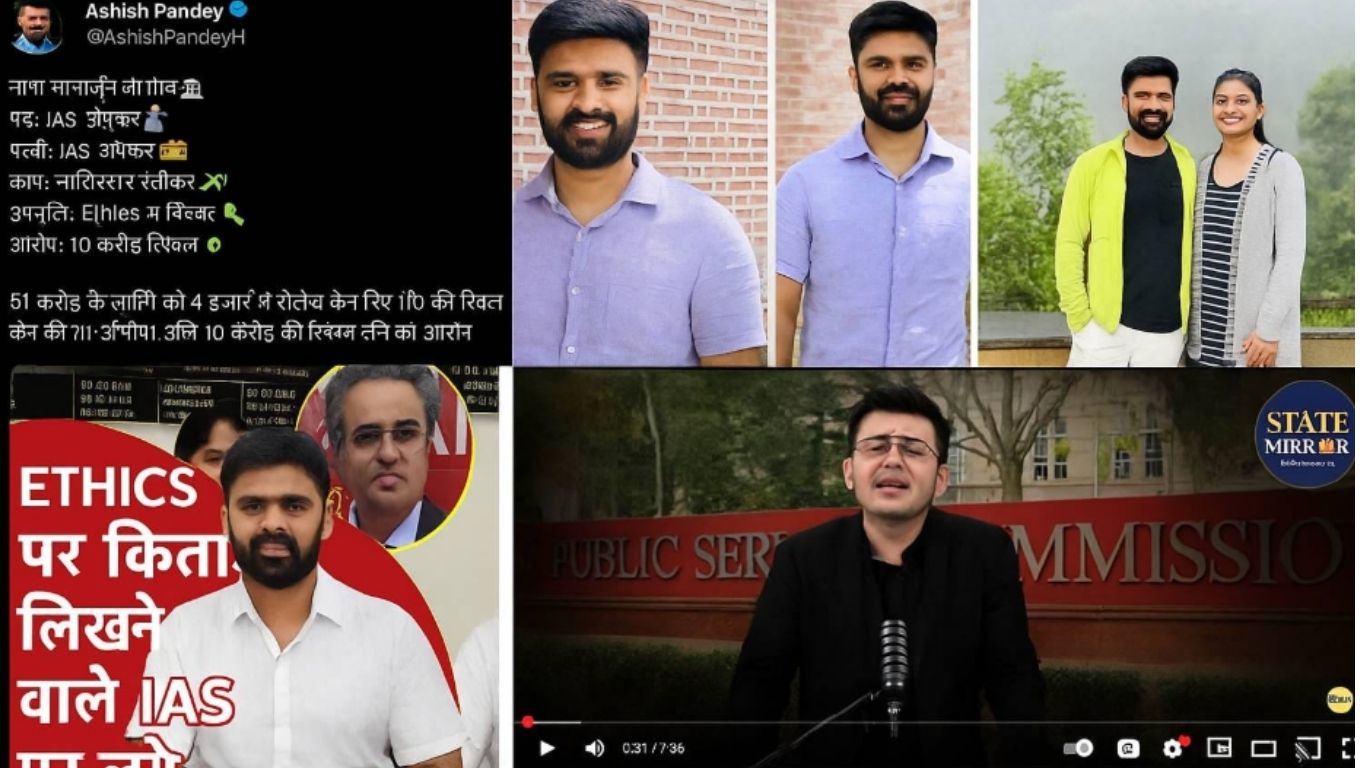
When a young man overcomes social and economic challenges to first become a doctor and then, while working 10–12 hours a day, clears India’s toughest exam to become an IAS officer his story deserves not only to be read and heard, but to be celebrated and learned from.
But one day, a so-called activist accuses this officer of corruption without any evidence, without any facts and the media laps up the story without checking whether the allegations hold any truth, or what kind of record this “activist” himself has. That officer is IAS Nagarjun Gowda, whose book “The Manual on Ethics, Integrity and Aptitude” had earned him much recognition. Ironically, the young IAS officer who once wrote on ethics has once again made headlines this time, because of a major allegation.
The so-called activist facing 7 criminal cases, once externed from the district. The moment the accusation surfaced, social media and sections of the press began branding him as a “corrupt officer.” What they failed to mention was that the RTI activist who accused him of taking ₹10 crore in bribes has seven criminal cases registered against him for blackmail, extortion, and intimidation. He has been jailed multiple times and was even externed from the district once.
For the media, headlines matter and linking the word “corruption” to a young officer known for “ethics” makes for a profitable clickbait story. By now, such reports have reached, or been made to reach, millions.
What’s the real story behind the alleged bribery?
IAS Nagarjun Gowda was accused of accepting ₹10 crore in bribes to waive off a massive fine imposed on a private company. The story begins in Harda district, Madhya Pradesh. A section of the Betul–Indore Four-Lane Highway, being built under the Bharatmala Project, passes through Harda. The construction of this stretch had been awarded to a private company named PATH.
The allegation: the company excavated 3.11 lakh cubic meters of soil and murum from Andherikheda village without permission. Acting on the report, then-ADM Praveen Phulpagare issued a notice of ₹51,67,64,502 to the company as penalty.
Before the case could proceed, ADM Phulpagare was transferred, and Nagarjun Gowda took charge as ADM, Harda. When the matter came before him for hearing, he reduced the penalty from ₹51 crore to just ₹4,000. At first glance, this looks suspicious. But what’s the truth?
A closer examination of the earlier notice, the company’s defense, investigation reports, and ADM Gowda’s order revealed a very different story.
Our investigation found…
The ₹51 crore mentioned was not a final order, but merely a notice, and by law, every notice must be followed by a proper hearing.
During the hearing, several facts came to light:
• Of the 19 land plots (khasra numbers) where illegal mining was alleged, 7 already had valid mining permissions. Excavation was either ongoing or completed earlier. • 6 other plots had been legally allotted to different companies a decade ago, and those companies had already carried out the work. • The alleged illegal excavation dated back to 2020, while PATH company was awarded the project only in 2021 meaning, the blame for past digging was wrongly pinned on the new company. • Some of the farmers whose lands were involved had dug ponds themselves under government schemes. Even that excavation was counted as illegal mining and added to the company’s record. • The first notice had been issued without following due procedure. A re-investigation found no solid evidence either. • The tehsildar who issued the notice admitted in court that he found nothing on the ground and had issued the notice based on a media report. • There was no record of how much excavation had been done earlier by other companies or landowners the mining department simply dumped all historical activity of the past decade on this one firm.
The basis of the penalty itself was flawed. The formula used for imposing fines multiplies the volume of material excavated by the royalty (₹50 per cubic meter here), and then fines the violator 15 times that amount, plus an equal amount for environmental damage.
However, according to a state government notification, murum and soil used in Bharatmala and Sagarmala projects are exempt from royalty i.e., the royalty is zero. And when the base value is zero, the fine too must be zero.
This was the company’s legal argument during the hearing and it was upheld as valid under the rules. Even for the remaining plots, investigators found no conclusive evidence a fact they themselves recorded on file.
And as per both Supreme Court rulings and Madhya Pradesh mining laws, no fine can be imposed without evidence.
Six months of hearings fine revoked due to lack of evidence
When the case finally came before IAS Nagarjun Gowda, he examined all evidence and found none to substantiate the alleged illegal mining.
It turned out that the mining department, in an attempt to cover up its own negligence, had dumped old excavation figures on a new company. With no proof to support the charges, the old notice issued during ADM Phulpagare’s tenure could not stand.
Accordingly, ADM Gowda passed a fact-based, lawful order, revoking the baseless penalty.
The activist’s pattern: repeated false allegations. The so-called activist Anand Jat has a long history of making similar baseless accusations against multiple individuals, including state ministers. In this case too, he provided no proof. In his own statement, Anand Jat admitted he had no evidence, and had made the allegations based on hearsay.
The allegations may sound serious but facts say otherwise. At first glance, the charges seem grave and if there were any truth to them, they should indeed be investigated. However, our investigation found no violation of rules or evidence of wrongdoing.
So the question arises: what about the reputation of the IAS officer? The trust he built among lakhs of young Indians what happens to that?
Clearly, one man’s hunger for headlines and the media’s obsession with clickbait have caused serious damage to an officer’s credibility.
The blame lies not only with TRP-driven media but also with the system that allows such narratives to thrive. Perhaps that is why ADM Nagarjun Gowda not only annulled the company’s fine but also pulled up the mining department responsible for years of negligence the same department that ignored illegal excavation for years and, once caught, sought an easy scapegoat.
For this young officer, these headlines and controversies are a harsh lesson a reminder that he must now fight and reform the very system he is part of.