
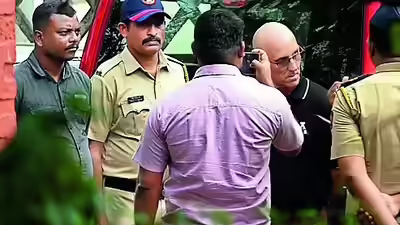
A sleepy Bhiwandi village in Maharashtra has suddenly turned into the epicentre of a global intrigue. On October 3rd, police arrested 58-year-old James Watson, a U.S. national living in Thane, along with two Indian aides, for allegedly attempting to convert Hindu villagers to Christianity under the guise of a “healing prayer meeting.” What initially seemed like a case of illegal conversion has now taken on a far more complex hue raising questions about foreign interference, missionary fronts, and the possibility of covert operations by CIA exploiting India’s vulnerable rural belts.
According to Bhiwandi police, Watson, who entered India on a business visa, was found organising religious gatherings without official permission. Alongside him, two local collaborators Sainath Ganpati Sarpe (42) from Vasai and Manoj Govind Kolha (35) from Chimbipada were arrested after locals complained about open proselytisation.
The case came to light when Ravindra Bhurkut (27), a local resident, filed a complaint at the Bhiwandi Taluka Police Station. Around 11:30 a.m. on Friday, he witnessed a gathering of about 30–35 villagers outside Kolha’s residence. There, Watson and his aides allegedly preached about Christianity, mocked Hindu rituals, and claimed that only through conversion could villagers “find true happiness and divine success.”
Even more disturbingly, the accused reportedly asked if any underage girls were unwell, jotted down the names of four minors, and proceeded to place their hands on the girls’ foreheads, claiming to heal them through “divine energy.” Witnesses said the men offered “wine prasad” as part of the ritual a practice alien to local traditions.
A Businessman or a Missionary in Disguise?
Police investigations soon revealed that James Watson’s business visa was being blatantly misused for religious activities a violation of both Indian visa rules and the Foreigners Act. While Watson claimed to be a businessman, intelligence sources suspect a deeper agenda.
Watson’s repeated travels across India over the last few years often to conflict-prone or economically weaker districts have drawn scrutiny. His pattern mirrors what security agencies describe as the “faith-based infiltration model,” where foreign nationals enter India on non-religious visas but later engage in covert evangelical or intelligence-gathering activities.
Foreigners posing as businessmen or social workers have been known to establish low-profile networks in rural areas They offer aid, preach miracles, and slowly build influence among vulnerable groups. Sometimes, these operations are linked to data gathering, demographic mapping, or even attempts to stir social unrest.
Echoes of the Naxal-Missionary Corridor
The timing and location of Watson’s activities are raising alarm bells. Bhiwandi lies within proximity to regions where radical networks have previously surfaced including areas where the NIA busted ISIS-linked sleeper cells. This overlap is fuelling concerns that conversion networks may be camouflaging more sinister operations.
In recent years, security analysts have pointed out the overlap between missionary activity zones and Naxal corridors across India stretching from Chhattisgarh, Jharkhand, Odisha, Maharashtra to Andhra Pradesh. Social media discussions have already drawn parallels, calling Watson’s arrest “a classic CIA-style operation using missionary fronts to penetrate tribal and rural communities.”
These theories stem from past revelations. For instance, intelligence reports from Nepal and Myanmar have hinted at Western NGOs allegedly aiding anti-India elements. A former U.S. Marine-turned-Pastor based in Nepal was once accused of helping Kuki insurgents in Manipur with logistics and weapon-handling guidance. Watson’s case, some argue, fits into this disturbing pattern faith cloaked as outreach, hiding espionage or destabilization objectives.
Following Bhurkut’s complaint, Bhiwandi police booked Watson and his aides under Sections 299 and 302 of the Bharatiya Nyaya Sanhita (BNS) dealing with deliberate acts to outrage religious feelings as well as provisions of the Foreigners Act for visa misuse, and the Maharashtra Prevention and Eradication of Human Sacrifice and Black Magic Act, 2013.
Police Inspector Harshvardhan Barve speaking to media outlets confirmed that further investigations are underway to trace Watson’s financial transactions and prior travel records. “The accused misused his visa for religious activity. We are checking his digital devices and the sources of his funding,” he said.
Meanwhile, the local community remains on edge. Villagers in Chimbipada expressed shock and anger over how a “foreigner” managed to hold gatherings without local awareness. Many called for stricter screening of foreigners entering on business or NGO pretexts, especially in sensitive regions.
Double Standards and Global Hypocrisy
Watson’s arrest has reignited debates about Western double standards when it comes to India. While Western countries often claim to promote religious freedom, their silence on illegal conversions and interference in India’s internal affairs speaks volumes.
Observers note a troubling trend that India and African nations are treated as testing grounds for aggressive missionary activities and experimental social interventions, while such actions would be deemed illegal or unacceptable in Europe or America.
Watson’s presence in India on a business visa while indulging in religious manipulation underlines the ongoing exploitation of visa categories by foreign entities a loophole that allows external actors to enter the social fabric of India unnoticed.
The James Watson episode is not isolated. Over the years, similar cases have emerged where foreign nationals, claiming to be social workers, missionaries, or NGO representatives, were caught conducting religious conversions or gathering local intelligence. These “soft interventions” serve as modern tools of geopolitical influence exploiting poverty, caste divisions, and ignorance to alter local demographics and loyalties.
Intelligence circles warn that these are not random cases but parts of a calibrated design. The use of faith as a front for ideological influence is an old tactic one that India must counter with both legal firmness and community vigilance.
India Must Guard Its Soul and Sovereignty
James Watson’s arrest in Maharashtra has peeled back another layer of a troubling reality how easily foreign operatives, disguised as missionaries or businessmen, can infiltrate India’s rural heartland. While the investigation continues, one truth stands clear: faith cannot become a weapon for manipulation, nor can India afford to treat such incidents as isolated crimes.
The government must tighten visa norms, increase surveillance on missionary-linked NGOs, and ensure strict punishment for conversion attempts under foreign influence. For far too long, India’s openness has been exploited by those who view its villages as laboratories for social or ideological experimentation.
This is no longer just about religion it is about national security, cultural survival, and sovereignty. The arrest in Bhiwandi is not merely a police case; it is a reminder that in the shadows of globalization and missionary outreach, the line between “preaching” and “penetration” has grown dangerously thin.