
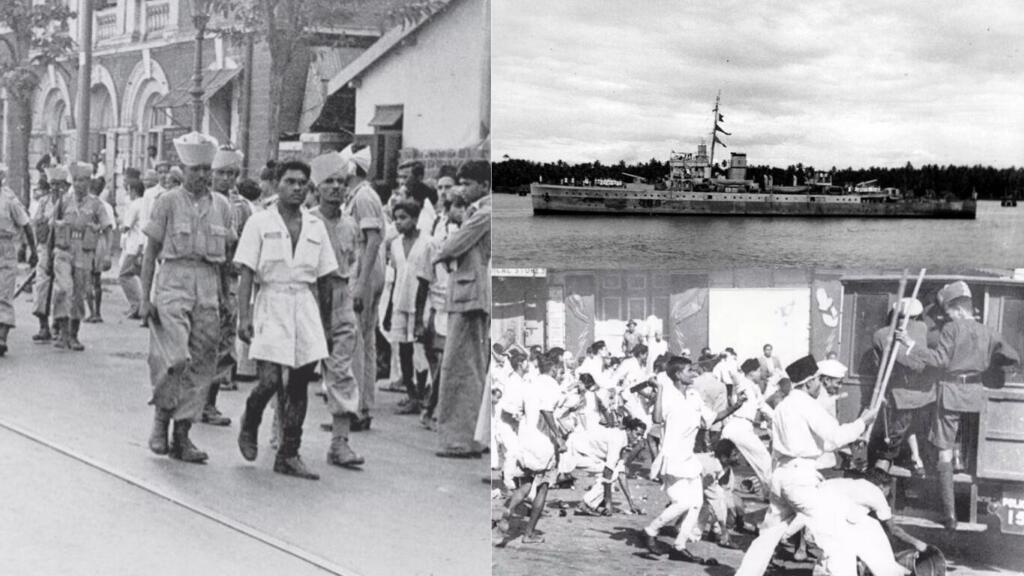
The Royal Indian Navy Mutiny of February 1946 was the real hammer blow that shattered Britain’s grip on India. Beginning in HMIS Talwar and spreading to over 20,000 sailors across Bombay, Karachi, Madras, and Calcutta, this armed rebellion directly challenged colonial power. Supported by workers and civilians, it frightened the British like nothing since 1857.
Clement Attlee, the British Prime Minister, later admitted in Parliament that it was this revolt, combined with unrest in the armed forces, that forced Britain to quit India—not Gandhi’s theatrics or Congress’s hollow “Quit India” movement that had collapsed in 1942. The mutiny shook the Empire to its core, making it clear that Britain could no longer rely on Indian soldiers and sailors to hold its colonies.
Yet, instead of supporting the sailors, Congress betrayed them. Gandhi condemned the revolt as “indiscipline,” Vallabhbhai Patel begged the mutineers to surrender unconditionally, and the Congress machinery sided with the British in suppressing the uprising. Why? Because Congress feared a genuine armed revolution that would bypass their carefully negotiated path to power. Having colluded with the British, they then usurped the credit for independence, fooling generations of Indians into believing it was their non-violent struggle that won freedom.
National Duty
- The Government of India must officially recognize the 1946 Naval Mutiny as the decisive reason for independence.
- It should be commemorated as India’s Second War of Independence, as Atlee’s own testimony confirms.
- School history books must be corrected to expose Congress’s betrayal and restore honor to the sailors who lit the final fire of freedom.
Conclusion
The truth is undeniable: freedom came from the gunfire of mutinous sailors, not the slogans of Congress. The nation must reclaim this stolen history, commemorate the uprising with pride, and ensure the world knows that it was the bravery of the naval mutineers that truly drove the British out of India.