








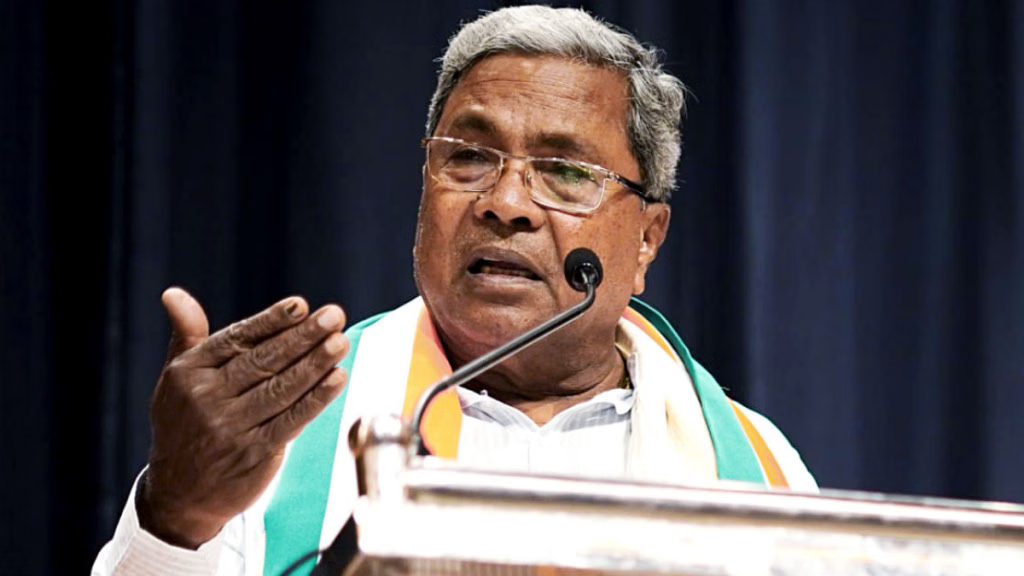
Karnataka Chief Minister Siddaramaiah stirred a political storm with his recent remarks on religious conversions and inequality within the Hindu society after he said that “if there was equality in our Hindu community, then why would anyone convert?”
Addressing a public event, the Karnataka Chief Minister questioned why conversions happen and linked them to social hierarchies and discrimination within the Hindu community.
“If there was equality in our Hindu community, then why would anyone convert?” Siddaramaiah said. “If there was equality, why did untouchability come into existence? Did we create untouchability? There can be inequalities in Islam, Christianity, or any religion. Neither we nor the BJP asked anyone to convert, but people do convert, and it is their right,” said Siddaramaiah.
The comments triggered sharp responses from the opposition BJP, who accused the Chief Minister of selectively targeting Hinduism while avoiding critique of other religions.
Leader of Opposition in the Legislative Assembly, R Ashoka, hit out strongly, questioning Siddaramaiah’s focus. “When it comes to equality, you always target Hinduism, don’t you, Chief Minister Siddaramaiah? Do you have the courage to question Muslims on equality?” he asked.
Ashoka raised concerns over certain Islamic practices and referenced the Pahalgam terror attack, restrictions on women in mosques, opposition to the banning of triple talaq, and interpretations of the Quran relating to non-Muslims.
“Yes, caste system is a curse within Hindu society, this is a fact. But many great reformers have taken birth to correct and transform Hindu society with time. The Hindu community has the strength to self-correct and change. From Basavanna to Swami Vivekananda, from Dr BR Ambedkar to the present, countless reformers have worked, and continue to work, towards improving Hindu society. But in Islam, the deep-rooted fundamentalism and jihadi mindset have never been questioned or corrected. Even if reformers have emerged, Muslims have never accepted such change,” Ashoka claimed.
He further said that Muslims traditionally idolise rulers like Aurangzeb and Tipu Sultan rather than reformers like Saint Shishunala Sharif or Dr APJ Abdul Kalam. Urging the CM to abandon what he described as a “leftist perspective,” Ashoka said Siddaramaiah should speak as a “responsible leader” and not demean Sanatana Dharma.
Leader of the Opposition in the Legislative Council, Chalavadi Narayanswamy, also took aim at the CM, alleging an attempt to divide people along caste and religious lines.
“Now the caste survey has options such as Dalit Christian, Lingayat Christian, Vokkaliga Christian. This is nonsense, and he has done this to please Sonia Gandhi,” Narayanswamy said.
Former Chief Minister Basavaraj Bommai also entered the fray, arguing that true equality stems not from religion, but from human values.
“Equality doesn’t come from religion, but from love, affection, and honour. No religion can truly bring equality,” Bommai said.
He criticised the ongoing caste survey, calling it unconstitutional and politically motivated. “Only the Government of India has that authority. They can do surveys, but not a census,” he asserted.
On the inclusion of conversion data, Bommai raised legal and procedural concerns and said, “If a column is added for converted Christians, then there should also be columns for converted Hindus and Muslims. It is illegal to add a ‘conversion’ column. There already exists an ‘Others’ column which even includes ‘Nastik’ (atheists).”
Caste Stratification Among Bhartiya Muslims: Historical Roots and Contemporary Realities
The presence of caste-based divisions within the Bhartiya Muslim community has long been acknowledged, both historically and in modern scholarly discourse. As far back as 1871, Henry Waterfield, while presenting the census report to both Houses of the British Parliament, remarked, “Caste system is perhaps as prevalent among the Mahomedans as among those professing Hindoo religion.”
The 1901 caste census further formalised these distinctions, identifying Muslim castes such as Sheikhs and Sharifs. This internal stratification was also officially recognised in the Sachar Committee Report (2006), which categorised Indian Muslims into three broad groups based on their social and educational status:
- Ashrafs – Muslims without any social disabilities, considered the upper strata
- Ajlafs – Those equivalent to Hindu Other Backward Castes (OBCs)
- Arzals – Communities parallel to Hindu Scheduled Castes (SCs)
The term “Muslim OBCs” is often used to collectively describe both Ajlafs and Arzals. Within these broad categories exist a wide range of sub-castes, each with its own social standing and internal hierarchy.
At the top of this structure are the Ashrafs, who are regarded as the “creamy layer” of the Bhartiya Muslim community. Among them, the Sayyeds and Shareefs occupy the highest ranks. The Sayyeds, believed to be descendants of Husayn Ibn Ali (grandson of Prophet Muhammad), and the Shareefs, descendants of Hasan Ibn Ali (his brother), are traditionally endogamous and rarely marry outside their caste. These groups are influential and hold significant religious and social capital within Muslim society.
Caste Discrimination and the Pasmanda Identity
Despite the egalitarian ideals of Islam, caste discrimination continues to impact the majority of Indian Muslims. Approximately 85 per cent of the community falls outside the Ashraf category and are collectively referred to as Pasmanda Muslims — a term popularised in 1988 by journalist and activist Ali Anwar. He highlighted the lack of representation for lower-caste Muslims in both religious leadership and political institutions.
Although Pasmandas were granted OBC status in 1990, this has not significantly translated into political representation. Discrimination persists despite gains in education and affirmative action.
Between 1952 and 2004, an analysis of Muslim representation in the Lok Sabha paints a stark picture. While Ashrafs, who make up only 2.1 per cent of the population, secured 4.5 per cent of the seats, Pasmandas — comprising 11.4 per cent of the population — managed to secure a meagre 0.8 per cent of seats.
This disparity reveals the entrenched socio-political marginalisation faced by lower-caste Muslims, even within their own religious community.
The data underscores a critical need to address caste-based inequities not just in Hindu society, but also within the Muslim social framework, where inclusion and representation remain elusive for a large section of the population.





