
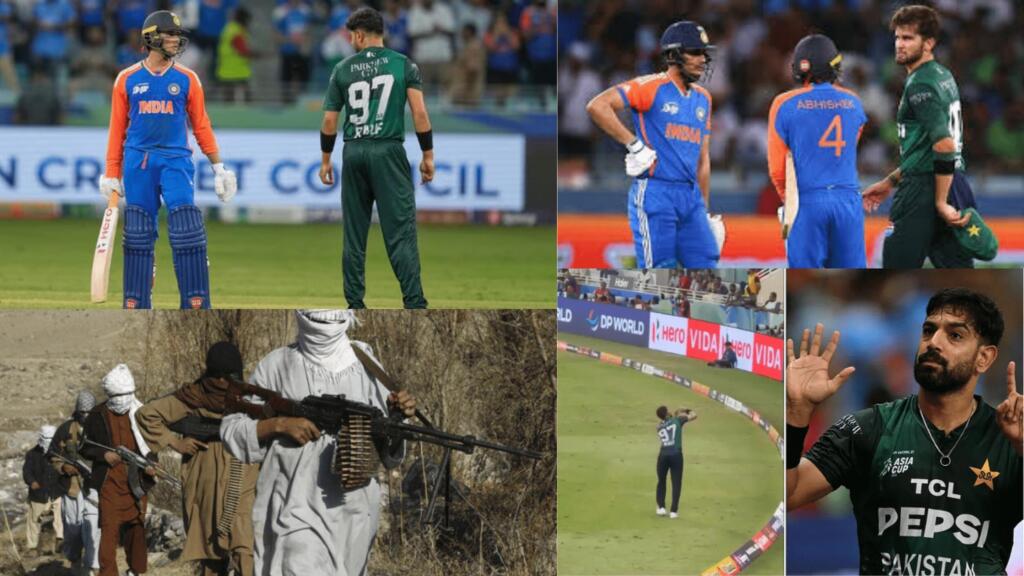
Pakistani cricketers’ provocative gestures during the Asia Cup 2025 match against India, especially like Farhan’s AK-47 gunfire mimicry and Rauf’s plane-shooting taunt, have exposed their Jihadist mentality. Their antics, seen as militant symbolism on the pitch, have exposed the jihad rot that has percolated every strata of Pakistani society. It has bolstered the case for a boycott of the Pakistani team.
Pakistani opener Sahibzada Farhan’s half-century celebration and fast bowler Haris Rauf’s response to Indian fans have brought to the fore the team’s “Jihadist” mentality. In the Super Fours match on Sunday (September 21,2025), Sahibzada Farhan mimicked firing an AK-47 gun after reaching 50, while moments later, Haris Rauf, irked by chants of “Kohli, Kohli” from the stands, gestured as if shooting down planes and flashed six fingers. His act was a reference to Pakistan’s fake claims of having downed six Indian aircraft during Operation Sindoor a claim dismissed by international observers as lacking any credible proof.
The bravado came even as Pakistan was battered on the field other than the defeat it faced from Indian forces in May. On Sunday, India beat Pakistan for the second time in a week in the Asia Cup 2025 series. The Pakistan team’s loss in 11 of the last 17 Asia Cup matches against India, excluding no-result games, hasn’t instilled any humility in the cricketers. That boorishness was on display on Sunday too, with provocative gestures reflecting a persistent lack of sportsmanship. India and Pakistan matches have always been high-octane games, and tensions have at times soared, but such a display of militant mindset was revealed by Pakistani cricketers on the field for the first time Former skipper Inzamam-ul-Haq and Mohammed Yousuf, who converted from Christianity, were among those who practised Islam on the field, but the current lot of players like Sahibzada Farhan and Haris Rauf have gone a step further in openly embracing the militant identity.
Pakistan is a known exporter of terror, and it was the attack on terrorist camps in Bahwalpur and Muridke under Operation Sindoor that sparked the four-day war between India and Pakistan in May. Islamabad has also been on the FATF grey list for terror financing.
Farhan and Rauf have brought that terrorist symbolism to the “gentlemen’s game”.
India’s reply came with professionalism and measured aggression, exactly as the game demands. Abhishek Sharma referred to his innings as a reply to Pakistan for “coming at us without any reason”.
While receiving the Player-of-the-Match award, Abhishek Sharma said, “The way they were coming at us without any reason, I didn’t like it at all. And I thought that this is the only answer that I could give with my bat and obviously with the win towards my team…”
The BCCI and the Indian government have been facing criticism for agreeing to play Pakistan in the Asia Cup, with many fans questioning whether cricket diplomacy should continue at all.
Yet again, Pakistani players have blurred the spirit of sportsmanship.
Critics have long noted that Pakistani cricket carries an undercurrent of overt religiosity. It has allowed the Jihadist mentality, to creep into the sport from time to time.
When Pakistani players’ performance falters, this spirit surfaces.
The 2007 World Cup in the West Indies is one of the most cited examples. Several players, influenced by the Tableeghi Jamaat a conservative Islamic missionary group skipped training sessions to preach to locals.
Former Pakistan Captain Inzamam once praised wicketkeeper-batsman Mohammad Rizwan, saying, “Rizwan doesn’t let non-Muslims come near Namaz. That’s why he’s the best captain.”
He also said, “The Pakistan cricket team would invite Indian Muslim players Irfan Pathan, Mohammad Kaif, and Zaheer Khan to listen to Maulana Tariq Jamil’s speeches in our dressing room.
Statements by a former top player reveal the mindset within the team itself.
In 2014, batsman Ahmed Shehzad was caught on a field mic telling Sri Lanka’s Tillakaratne Dilshan, “If you are a non-Muslim and you turn Muslim, no matter whatever you do in your life, straight to heaven.”
At the same time, Hindu spinner Danish Kaneria has repeatedly claimed that his faith cost him opportunities and respect. He alleged that his career was derailed in a setup where religious conformity mattered more than raw talent, highlighting systemic exclusion.
These episodes paint the team not just deeply devout but aggressively so.
Cricket has always prided itself on its traditions of grace, humility, and fair play.
It is called the “gentlemen’s game” for a reason.
Gestures like Sahibzada Farhan’s AK-47 gunfire mimicry when he reached 50 on Sunday, and Haris Rauf’s aircraft pantomime show how Pakistani players are shattering the ethos of sportsmanship.
It’s a very different matter to not shake hands, but terror-war mimicry on the field is unheard of.
After Pakistan’s loss and the unsportsmanlike behaviour, not just Indians, cricket fans from across the world trolled the Pakistani players.
“Haris Rauf has been declared – The New ‘Field Marshal’ of Pakistan, after his hammering from 25 years old Abhishek Sharma. It’s like Brahmos hitting Nur Khan Base at Night, an user posted on X, attaching a clip of Rauf alluding to Indian fighter jet being hit.
On a serious note, this display exposes the terrorist psyche that has permeated every sector and strata of Pakistani society because of military-mullah rule over the decades.
“Pakistani cricketer Sahibzada Farhan mimicked an AK-47 with his bat during a match against India. This isn’t just a gesture t reflects a deeper problem. From military generals to actors, doctors to cricketers, radical jihadist symbolism is ingrained in Pakistan’s psyche. Decades of militarisation and extremism have ensured that violence is glorified as culture,” wrote Zahack Tanvir of The Milli Chronicle.
Indian Captain Suryakumar Yadav trolled Pakistan Team saying “You guys (Media) should stop asking about the rivalry. If there’s a scoreline of 7-7 or 8-7, then it’s called a rivalry. But if the scoreline is 10-1 or 13-0, it’s not a rivalry anymore”.
For India, such moments strengthen the argument against continued cricketing ties with Pakistan. While handshake snubs or heated words are part of the game, gestures of violent acts, of gunfire, and shooting down planes, cross a line. Team India has shown that intensity and rivalry can be channelled without invoking religious or militant undertones. Of the hundreds of lessons that Pakistan needs to learn is that cricket is a game, not a holy war.