
Shardiya Navratri, the sacred nine-day festival of devotion, commenced on September 22 and will culminate with Dusshera on October 2. Each day of this festival is dedicated to one of the Navadurgas, the nine forms of Goddess Durga. The third day is devoted to Maa Chandraghanta, the powerful Goddess who symbolizes bravery, peace, and the dispelling of suffering. She is believed to bless her devotees with happiness, prosperity, and spiritual awakening. The story of Maa Chandraghanta reflects the eternal message that courage and grace must walk hand in hand in the path of dharma.
The Divine Form and Symbolism of Maa Chandraghanta
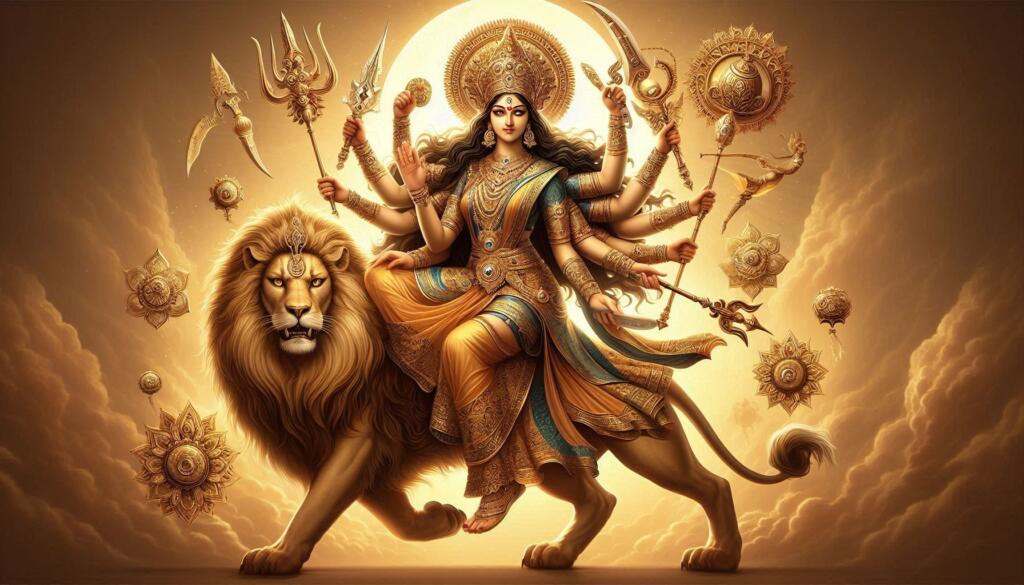
Maa Chandraghanta is considered the married form of Goddess Parvati after her union with Lord Shiva. As per legend, she began adorning her forehead with a crescent moon resembling a bell (Ghanta), which earned her the name Chandraghanta. She is depicted with a golden complexion, riding a tiger or lion that symbolizes dharma and valor.
The Goddess is portrayed with ten hands and three eyes, signifying supreme vision and power. In her left hands, she carries a trident, mace, sword, and a kamandal, while another hand remains in Varada Mudra, symbolizing blessings. In her right hands, she holds a lotus, arrow, bow, and a rosary, while the final hand is in Abhaya Mudra, offering fearlessness to devotees. Her image represents readiness for battle yet radiates serenity, combining fierce protection with motherly compassion.
The Legend of Chandraghanta and Jatukasura
According to the Shiva Purana, shortly after her marriage to Lord Shiva, Goddess Parvati faced the demonic threat of Jatukasura, a bat-demon sent by Tarakasura to prevent the birth of Shiva and Parvati’s divine child. Jatukasura unleashed his army of bats, plunging the earth into darkness and causing chaos everywhere.
To protect her home and the world, Goddess Parvati invoked her Chandraghanta form. She used the crescent moon on her forehead to illuminate the skies, and the sound of her bell disoriented the bats. With unmatched courage, she engaged in battle and ultimately defeated Jatukasura with her sword. This divine victory demonstrated her role as a protector of righteousness and justice, affirming her place as a warrior goddess who safeguards her devotees.
Spiritual Significance and Chakra Connection
Maa Chandraghanta is associated with the Manipura Chakra, or solar plexus chakra, which governs self-confidence, determination, and willpower. Worshipping her helps devotees overcome fears, set healthy boundaries, and cultivate inner strength. Her blessings are believed to remove obstacles, cleanse sins, and dispel both physical and mental suffering.
Astrologically, she governs the planet Shukra (Venus), which is linked with love, beauty, and harmony. Hence, invoking her during Navratri is said to bring both material well-being and spiritual enlightenment. Her sound, symbolized by the divine bell, is considered a shield that wards off negative energies and evil spirits.
Worship, Rituals, and Devotees’ Belief
On the third day of Navratri, devotees worship Maa Chandraghanta with rituals that include offering flowers, chanting her mantras, and meditating on her form. Her puja is believed to provide instant results, as she is ever-ready to remove the distress of her followers. By worshipping her, devotees gain valor equal to that of a lion and the serenity of moonlight.
For sadhaks, this day marks the awakening of foresight and leadership qualities as the mind enters the Manipura Chakra. It is said that the sound of her divine bell constantly protects devotees from unseen dangers, guiding them toward peace and righteousness.
The Eternal Grace of Maa Chandraghanta
Maa Chandraghanta embodies the balance of fearlessness and compassion. Her form reminds devotees that true strength comes not only from might but also from grace and inner serenity. On the third day of Navratri, invoking her blessings inspires courage, spiritual clarity, and freedom from suffering. Her radiant presence continues to guide devotees toward peace, justice, and unwavering devotion, ensuring that dharma triumphs over darkness.