
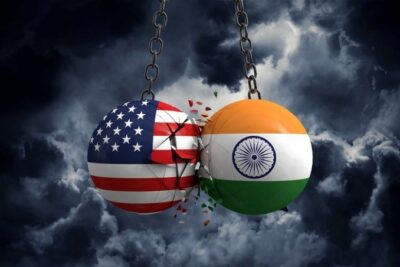
The United States loves to play the victim in trade wars. And in Donald Trump, this narrative finds its loudest cheerleader. From his “Truth Social” rants to campaign rallies, Trump projects America as a helpless giant bled dry by India’s “unfair” trade practices. He paints the US as the greatest victim of India in commerce, branding the relationship a “one-sided disaster.” But facts demolish this fiction. If America truly wants to complain about trade deficits, it should look at China, the EU, Mexico, or even Vietnam where the gaps run several times deeper. With India, the story is starkly different.
The Numbers Tell a Different Tale
Trump’s rhetoric ignores the bigger picture. Let’s start with the data. America’s trade deficit with China is $270 billion, with the EU $161 billion, Mexico $157 billion, Vietnam $113.1 billion, Taiwan $67.4 billion, Japan $62.6 billion, South Korea $60.2 billion, Canada $54.8 billion, and Thailand $41.5 billion.
With India? Just $41.5 billion. That’s not even close to the top offenders. Yet, Washington chooses to dramatize its deficit with India as if it were the greatest trade injustice in modern history. The selective outrage reveals less about economics and more about political grandstanding.
The Reality: America Runs a Surplus with India
What Trump conveniently omits is that the US actually makes more money off India than it loses. According to the Global Trade Research Initiative (GTRI), America enjoys a $35–40 billion surplus when all commercial earnings are considered.
Here’s how:
-
Tech giants Google, Meta, Amazon, Apple, Microsoft—earn $15–20 billion annually from India’s digital economy.
-
Consumer brands like Coca-Cola and McDonald’s pull in another $15 billion.
-
Wall Street firms and consultants take $10–15 billion in fees from India.
-
Global capability centers of Walmart, IBM, Dell, and others generate $15–20 billion, profits booked in the US.
-
Add to this Hollywood, Netflix, pharma royalties, and defence sales, and the balance tilts further in America’s favour.
And let’s not forget: Indian students in US universities contribute $25+ billion every year in tuition fees and living costs, directly enriching American institutions and local economies. If this is a “disaster,” it’s one most countries would gladly welcome.
Tariffs: The Selective Truth
Trump claims India charges America the “highest tariffs in the world.” Once again, the charge doesn’t hold. India has progressively liberalised its markets over decades, opening doors in ways that no longer resemble the “closed economy” of the past.
In ongoing trade talks, India has even offered to cut tariffs to zero on many products, especially industrial and automobile goods. These categories make up over 95% of US exports to India. That effectively gives America duty-free access.
Yes, India has redlines certain sensitive sectors like dairy and agriculture remain protected. But that’s not unfairness; it’s policy sovereignty, the same shield Washington uses to protect its own farmers and workers.
The Russia Angle: Sovereignty, Not Subservience
Trump also drags Russia into the trade debate, accusing India of buying oil and defence systems from Moscow instead of Washington. But India’s choices in energy and defence are guided by national interest, not by American whims.
India’s strategic autonomy means balancing relationships with multiple powers whether it’s the US, Russia, or Europe. To suggest that India must abandon long-standing defence and energy ties to appease Washington is not diplomacy; it’s bullying.
In fact, defence trade between India and the US has grown from virtually zero in 2000 to nearly $22 billion in 2024. Hardly the mark of a “one-sided disaster.”
America’s Selective Outrage
For all of Trump’s thunder, the truth is that America profits handsomely from India. It is not a victim, and certainly not facing the kind of trade imbalances it does with China, Mexico, or the EU.
Singling out India is not about economics it’s about politics, posturing, and perhaps a bruised ego. Many recall Trump’s failed attempt to claim credit for “mediating” India-Pakistan peace, a claim New Delhi firmly dismissed. That rebuff, some argue, still rankles.
At its core, Trump’s rant is less about tariffs and trade, and more about wielding India as a campaign punching bag. But India is no soft target. The facts and the future speak otherwise.