
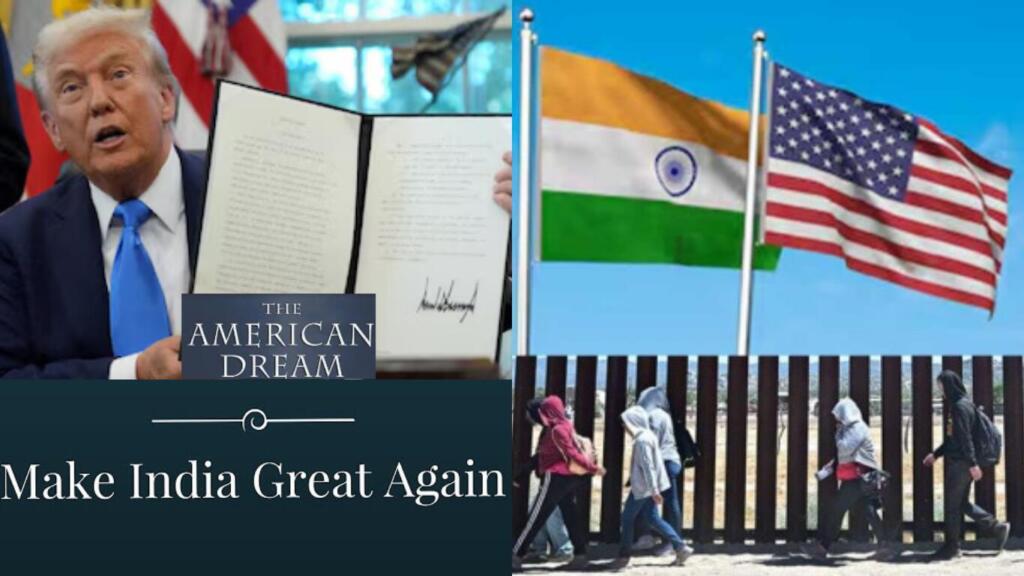
The H-1B visa has long been the backbone of Indian professionals seeking opportunities in the United States, powering Silicon Valley and contributing significantly to the American economy. But on Friday, US President Donald Trump upended decades of policy with a dramatic executive order: a $100,000 fee for every H-1B application, effective September 21, 2025. Trump framed this as a measure to protect American jobs, accusing tech companies of abusing the visa system. But with Indians accounting for nearly three-quarters of all H-1B approvals, the brunt of this levy will initially fall on India, threatening IT exports, reshaping hiring models, and sparking fears of a mass talent reversal. This development raises critical questions not just for Indian IT firms, but also for the US, because in long run it will affect America’s future as a global innovation hub.
What Trump’s Order States
The proclamation takes effect from 12:01 am EDT on September 21, 2025, and applies to all H-1B workers entering the US after that date. Under the new system, employers must pay $100,000 per worker and provide proof of payment. The Department of State and the Department of Homeland Security are instructed to deny entry to anyone whose employer has not paid.
While the order does not directly reference dependents, companies have also advised H-4 visa holders spouses and children of H-1B professionals to avoid travel to prevent re-entry complications. The levy is valid for 12 months, with the possibility of extension at Trump’s discretion.
This is a seismic change considering that, until now, H-1B fees ranged around $1,500–$2,500. The sudden jump to six figures fundamentally alters the cost-benefit equation for employers and workers alike.
Who Are the Most Affected
India’s dominance in the H-1B program is unmatched. In FY 2023, Indian nationals received 191,000 visas; in FY 2024, the figure crossed 207,000. By contrast, China’s share hovered around 12 per cent. That means over 200,000 Indians currently depend on H-1Bs to work in the United States.
The financial implications are staggering. Even if just 60,000 Indians are directly impacted this year, that translates to a collective burden of $6 billion annually (₹53,000 crore). If enforced at renewals as well, the cost for India could soar to over ₹1.8 lakh crore every year.
For individuals, the story is grim. A mid-level Indian engineer in the US earning $120,000 annually would lose nearly 80 per cent of their income to visa costs, making migration financially unviable. For students transitioning from US universities to H-1Bs, the dream of working in America could effectively close.
The Impact on Indian IT Giants
Indian IT firms Infosys, TCS, Wipro, HCL, and Cognizant have historically relied on H-1B visas to deploy thousands of engineers to client sites in the US. This onshore-offshore model has been central to India’s IT boom and its $250-billion export economy.
But with the new levy, junior and mid-level deployments become impossible. Sending a fresh graduate or mid-level programmer on a $100,000 visa fee makes no financial sense. This will force companies to recalibrate delivery models, shifting more work back to India or expanding to alternative hubs like Canada and Mexico.
A Bengaluru-based executive explained in ‘X’ and said: “The US is essentially pricing itself out of the very talent pool that sustains its digital economy. Indian firms will adapt, but American corporations will feel the real pinch.”
Already, shares of Infosys and Wipro dropped 4.5 per cent on Wall Street after the announcement, reflecting investor anxiety over shrinking profit margins.
Why US Tech Firms Are Also Exposed
While the order is aimed at protecting “American workers,” US-based giants such as Amazon, Microsoft, Meta, and Google rely heavily on H-1Bs. In just the first half of 2025, Amazon alone secured approvals for 12,000 H-1Bs, while Microsoft and Meta cleared more than 5,000 each.
The exposure extends beyond Big Tech. Citigroup, Capital One, Verizon, and AT&T are now among the top end-users of H-1B contractors, particularly in areas like cloud computing, AI, and semiconductors. These companies will now face enormous costs to retain critical talent.
Startups and research labs are even worse off. With limited budgets, a $100,000 fee makes hiring global talent nearly impossible. The result could be a chilling effect on America’s ability to attract niche expertise, leaving the US vulnerable to brain drain and slowing innovation.
Trump’s Rationale: Protecting American Jobs?
The White House has justified the order as a job protection measure. Trump argued that the H-1B system has been “abused” to replace Americans with cheaper foreign labor. His administration insists that the six-figure levy will ensure only the most skilled and necessary foreign professionals are admitted.
Commerce Secretary Howard Lutnick went further, saying: “No more will big tech companies train foreign workers at low cost. They must pay the government $100,000 and then the employee’s salary. The priority is training Americans.”
But critics argue that this framing ignores the reality of the US labor market. The talent shortage in high-demand fields AI, quantum computing, cybersecurity cannot be solved overnight by training local graduates. As analyst Jeremy Goldman put it: “This move risks taxing away America’s innovation edge.”
Legal Questions Around the Fee
Immigration experts also question whether such a fee is legally defensible. Under current law, visa fees are meant to cover administrative costs, not act as revenue-generating levies. Aaron Reichlin-Melnick of the American Immigration Council noted: “Congress has not authorized a six-figure application fee. This could face significant legal challenges.”
Lawsuits from tech industry bodies and immigrant rights groups are widely expected. If courts rule against the administration, the policy could be overturned, but litigation may take months, leaving uncertainty hanging over Indian professionals and their employers.
How This Fits Into Trump’s Broader Immigration Agenda
The H-1B levy is part of a wider immigration reset under Trump. Three key steps stand out:
-
The $100,000 H-1B fee – pricing out mid-level skilled workers.
-
Rollback of visa interview waivers – making renewals slower and more cumbersome.
-
The “Gold Card” scheme – offering fast-tracked residency for wealthy investors who bring $5 million or more.
Together, these reflect a philosophy of restricting skilled migration while courting wealthy elites. It marks a stark departure from America’s historic role as a magnet for global talent.
What Happens Next for India and the US?
The United States issues 85,000 H-1Bs annually through a lottery. With the new costs, smaller companies and new graduates may withdraw from applying, reducing demand. Employers may instead reserve sponsorship only for ultra-specialized, high-paying roles, shrinking opportunities for Indians at entry and mid-levels.
For Indian workers already in the US, travel restrictions loom large. Anyone stepping out risks having to pay the $100,000 fee upon re-entry. Companies have issued strict advisories warning staff to remain in the country until clarity emerges.
For India, this could spark a reverse brain drain. Skilled professionals who once dreamt of settling in America may now prefer opportunities in India’s booming tech ecosystem or in friendlier hubs like Canada, Australia, and Europe.
A Turning Point for Global Talent Mobility
The Trump administration’s $100,000 H-1B levy marks one of the most dramatic shifts in US immigration policy in decades. By making the visa prohibitively expensive, the order risks crippling Indian IT firms, straining American companies, and disrupting the career trajectories of hundreds of thousands of professionals.
While framed as a protectionist measure, it may ironically undermine the very sectors America seeks to safeguard technology, finance, and advanced research by driving talent elsewhere. For India, the short-term pain is undeniable, but the long-term opportunity may lie in retaining top talent and strengthening its own tech ecosystem.
Indians will bear the heaviest burden of this policy, both financially and professionally. But the move also exposes the fragility of America’s innovation engine, which depends deeply on global expertise. Whether the fee survives legal challenges or not, it signals a pivotal moment: the world’s brightest minds may now look beyond the US, forcing both Washington and New Delhi to rethink how they engage with global talent in an era of shifting power and opportunity.