
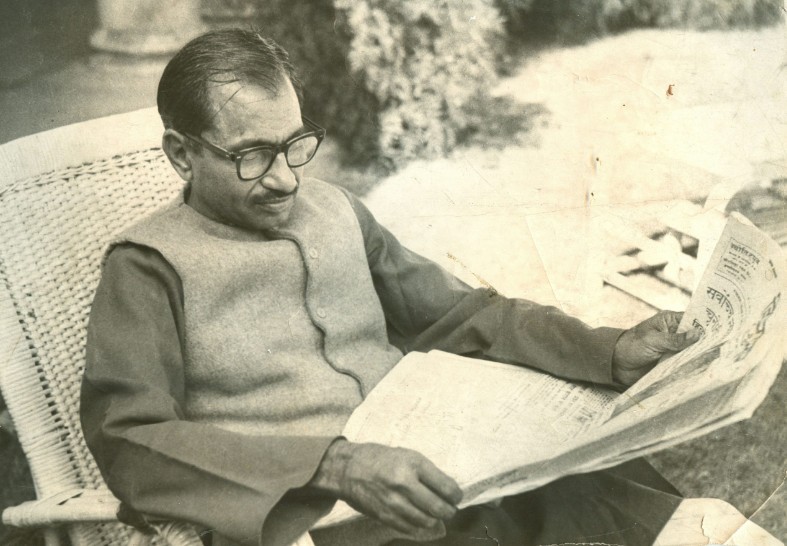
September 25 marks the birth anniversary of Pandit Deendayal Upadhyaya, a towering thinker, philosopher, and nationalist leader whose vision of “Antyodaya” — uplifting the last person in society — continues to inspire India’s socio-political fabric.
Prime Minister Narendra Modi said that he was the great son of Mother India and the pioneer of Integral Humanism.
In a social media post extending his homage, PM Modi said that his nationalist ideals and the principle of Antyodaya, which guided the nation towards prosperity, will continue to be invaluable in the development of a prosperous India.
Union Home Minister Amit Shah paid tribute to leader of the Bharatiya Jana Sangh, Pandit Deendayal Upadhyaya at the BJP Headquarters in New Delhi on the occasion of the late leader’s 109th birth anniversary.
BJP national president and Union Minister JP Nadda joined Amit Shah in the homage ceremony. Later, both leaders planted a sapling at Deen Dayal Upadhyay Park in the national capital to mark the occasion.
Life and Struggles of Deendayal Upadhyay
Born in 1916 in Mathura — the same year that witnessed the Congress-Muslim League pact at Lucknow engineered by Mahatma Gandhi — Deendayal Upadhyay’s life was marked by adversity from an early age. He lost both his parents before the age of eight and spent his formative years in hardship.
Yet, his academic record stood out. Upadhyay excelled in school, earning scholarships that paved the way for a BA in English. Though he enrolled for an MA, the death of a close relative prevented him from completing it. He later cleared the civil services examination — an impressive feat — and earned the nickname “Panditji” for appearing in traditional dhoti-kurta and cap.
Despite his success, Upadhyay chose not to join the government service. Instead, in 1942, he dedicated himself as a lifetime volunteer (pracharak) of the Rashtriya Swayamsevak Sangh (RSS), which he had joined in 1937.
His Journey with RSS and the Jana Sangh
Guided by senior RSS leaders like Nanaji Deshmukh and Bhau Jugade, Upadhyay began his organisational work in Lakhimpur district of Uttar Pradesh.
He went on to establish Rashtra Dharma Prakashan, a publishing house in Lucknow, which launched the magazine Rashtra Dharma. Later, he founded the weekly Panchjanya — now the RSS’s mouthpiece — and the daily newspaper Swadesh.
Upadhyay’s political journey took a decisive turn in 1951 when he joined hands with Syama Prasad Mookerjee, who had resigned from Jawaharlal Nehru’s cabinet over the Nehru-Liaquat pact.
Mookerjee launched the Bharatiya Jana Sangh and, on the recommendation of RSS chief MS Golwalkar, inducted Upadhyay into the party. He began as the general secretary of the Uttar Pradesh unit and eventually rose to become the national general secretary.
After Mookerjee’s death in 1953, Upadhyay played a key role in shaping the BJS’s ideological and organisational framework for over 15 years.
The Thinker Behind ‘Integral Humanism’
Deendayal Upadhyay is remembered most for formulating the philosophy of Integral Humanism — a socio-political thought which the BJP today considers central to its ideological base. His philosophy emphasizes a “classless, casteless and conflict-free social order” rooted in Indian cultural values.
He viewed the nation as a living organism — with a body, mind, intellect, and soul — and believed that dharma was essential to peace and prosperity.
Launching the centenary celebrations in Kerala, Prime Minister Modi highlighted Upadhyay’s inclusive vision, “Deendayalji used to say that if equality has to be achieved, people at the higher level have to bend down and support those who have been exploited and neglected.”
Further emphasising his social vision, PM Modi said, “Fifty years ago, Deendayal Upadhyayji said Muslims should not be treated as different people. Do not reward them, do not rebuke them, but empower them. Muslims should not be looked down upon nor should they be seen as merely a vote bank. Consider them your own.”
BJP leaders often cite his doctrine of Antyodaya — the upliftment of the last person in society — as the inspiration behind various pro-poor and welfare schemes of the Modi government.
Legacy, Controversy, and Inclusion in Curriculum
Though hailed by the BJP as a visionary, Upadhyay has not been without critics. Some accuse him of holding a biased view towards Muslims and of overlooking caste discrimination in his lectures. Nevertheless, several BJP-ruled states have introduced chapters on his life and philosophy in school curricula, arguing that his thoughts deserve renewed understanding in a modern context.
Mysterious End
Upadhyay’s death remains one of the most mysterious episodes in modern Indian political history.
According to the Dr Syama Prasad Mookerjee Research Foundation, “Around 3.45 a.m. on Feb. 11, 1968, the leverman at the Mughalsarai station informed the Assistant Station Master that about 150 yards from the station, towards the south of the railway line, a dead body was lying near the electric pole No.1276.”
That body was later identified as that of Deendayal Upadhyay, who had boarded the Pathankot-Sealdah Express at 7 pm in Lucknow. The train did not go directly to Patna. Bogeys were usually detached at Mughalsarai and linked to the Delhi-Howrah Express.
Upadhyay was last seen at the station around 2.15 am. The Delhi-Howrah Express departed at 2.50 am without him. By then, he was already dead. His body was taken to Delhi, where President Zakir Hussain and Prime Minister Indira Gandhi were among those who paid homage.
As the BJP continues to draw from his ideas to counter the Congress-led vision of India, Deendayal Upadhyay’s legacy is now firmly enshrined in the party’s ideological foundation.
Whether one views him as a philosopher-saint of Indian nationalism or a controversial thinker, Upadhyay remains a pivotal figure in the political evolution of post-independence India.