
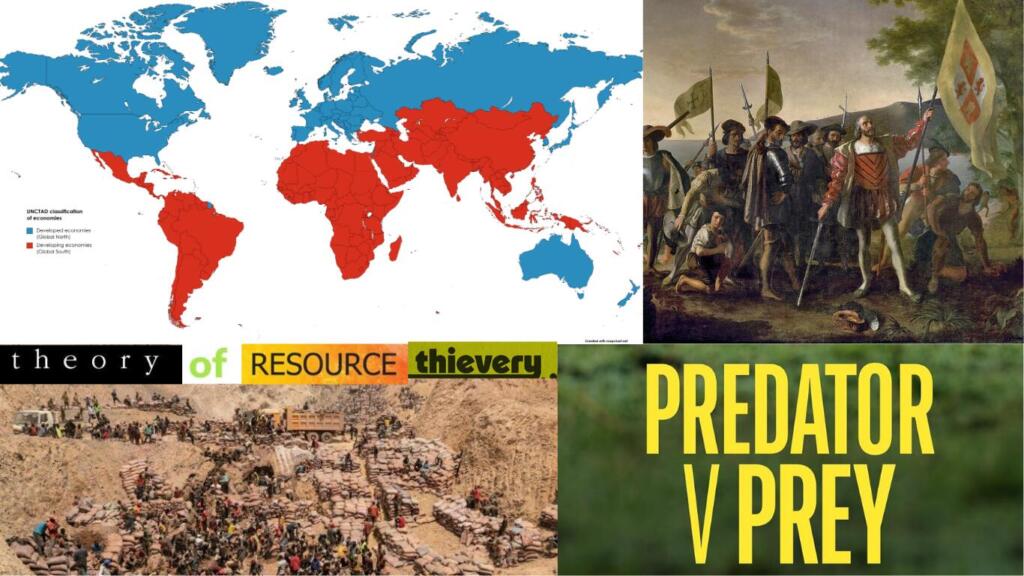
The Theory of Resource Thievery directly challenges the mainstream economic theory of “Resource Curse” narrative. It reveals that powerful nations and elites do not ascend through innovation or fair exchange, but through systematic plunder of weaker, resource-rich societies. What is presented as “economic theory,” “development aid,” or “geopolitical wisdom” is, in truth, a carefully engineered framework to normalize exploitation. Colonialism and empire are not historical anomalies but deliberate, generational thefts institutionalized into global systems. The predators weave political, economic, and academic theories not to uplift the prey, but to justify extraction and perpetuate dependence. These so-called “knowledge systems” act as psychological chains—convincing the prey that their own impoverishment is natural, inevitable, or even deserved—while, in reality, it is the outcome of orchestrated predation. The essence of the Theory is clear: socio-economic models imposed by predators are never neutral. They are predatory weapons designed to protect plunder, mask injustice under the guise of progress, and secure permanent advantage for the predators at the prey’s expense.
The Theory of Resource Thievery argues that when a technologically and militarily advanced group (the Predators) encounters a less militarily advanced but a developed or resource-rich group (the Prey), the Predators will inevitably construct a system to extract, monopolize, and perpetuate control over the Prey’s resources.
This is not merely theft through brute force—it is a total system of domination, engineered to outlast direct conquest. The Predators deploy a spectrum of weapons—political, economic, psychological, and physical—woven together to ensure the Prey remains disempowered, dependent, and exploitable across generations.
The Lie of Mainstream Theories
Yet, strikingly, this fundamental truth is absent from most mainstream theories of economics, geopolitics, and international relations. Instead of acknowledging organized theft as the engine of empire, dominant theories present sanitized narratives of “free trade,” “security,” “civilization,” and “development.” These frameworks do not expose colonial exploitation; they justify and perpetuate it.
- In economics, global financial institutions speak of “growth” and “assistance,” but enforce debt traps, austerity, and dependency that strip nations of sovereignty.
- In politics, the rhetoric of democracy and governance is used to mask puppet regimes installed to protect Predator interests.
- In geopolitics, the balance-of-power theories erase the central fact that much of this “balance” is maintained through the looting of weaker nations.
- In military doctrine, interventions are framed as humanitarian or security-driven, even when they are naked seizures of land, oil, minerals, labour, knowledge or data.
By excluding resource thievery from their frameworks, these theories perform the Predator’s most crucial task: they normalize theft as order and disguise exploitation as help.
History, however, unmasks the lie. It is not a tale of civilization and progress—it is a chronicle of organized theft. The powerful did not rise by creating wealth of their own; they rose by stealing it from others. Every empire, every colonial state, every so-called great power has thrived by bleeding weaker nations dry.
This is the essence of the Theory of Resource Thievery: wherever a Predator meets a resource-rich Prey, a system of domination is erected—not to uplift, but to plunder. And this theft is never temporary. It is institutionalized, sanctified, and perpetuated across generations, until the Prey is reduced to dependency not only materially, but also psychologically.
The Weapons of Plunder
Predators never rely on brute force alone. They deploy an arsenal of weapons—political, economic, psychological, cultural, and military—each sharpening the other.
Political Weapons
- Puppet governments dressed up as “legitimate leadership.”
- Laws that criminalize resistance but protect exploitation.
- Bureaucracies designed not to govern but to extract.
This is politics as warfare—where ballots and constitutions hide the bayonets of the empire.
Economic Weapons
- Entire economies re-engineered to export raw wealth while importing misery.
- Debt and “aid” turned into chains of permanent servitude.
- Currencies manipulated, markets rigged, industries strangled before they can rise.
The result: a rich land with starving people. This is the current economic theory of RESOURCE CURSE : a psychological weapon to pacify the PREY.
Psychological & Cultural Weapons
- Indigenous traditions mocked as backward; Predator culture glorified as universal.
- Religions imported, imposed, conversions (by lies, deceit or brutal force) and weaponized to fracture solidarity.
- Fear cultivated through public punishments until obedience feels natural.
This is conquest of the mind—where the prey begins to justify their own chains.
Physical Weapons
- Massacres, engineered famines, epidemics deliberately allowed to spread.
- Armed militias and police states crushing uprisings.
- At its extreme: extermination of entire peoples to make room for settlers.
Here the mask drops, and the Predator shows its true face.
The Institutions of Eternal Theft
Even after colonial flags come down, the machinery of thievery continues. The empires left behind extractive institutions—global financial bodies, trade agreements, aid programs—presented as benevolent, but engineered to guarantee that wealth keeps flowing outward.
- IMF loans demand austerity, privatization, and starvation wages.
- Trade regimes punish manufacturing in the Global South while rewarding raw exports.
- “Aid” creates permanent dependency, a leash disguised as a gift.
Colonialism did not end. It simply put on a suit and tie, moved to a conference hall, and renamed itself globalization.
The Blood Trail of History
The Americas were bled first—90% of indigenous populations exterminated by disease, massacre, and hunger, clearing the way for gold, silver, and land theft on a continental scale. Survivors were forced into Christianity, turning conquest into salvation.
India was next—its world-leading textile and other industries destroyed, its famines weaponized, its economy restructured into a raw-material pipeline for Britain. A land that once held more than a quarter of the world’s wealth was reduced to poverty while London glittered with stolen riches.
Congo under Leopold II of Belgium, became a horror unmatched—hands chopped off as quotas, villages burned, millions dead, all for rubber. A genocide for profit, celebrated in European capitals.
The Middle East became a laboratory for puppet states and engineered borders. Oil wealth that should have uplifted its people became a curse, controlled by foreign corporations, defended by foreign armies, siphoned into foreign banks.
Africa, looted and tortured as a colony of multitude of synthetic borders, after “independence” was shackled again by debt. IMF austerity stripped education, healthcare, and food subsidies, while multinationals stole cobalt, diamonds, and gold. Civil wars were fueled by outside powers eager to secure mines. The slave ships left, but the chains never broke.
Latin America lived under the boot of coups and “banana republics”—governments toppled whenever they dared to put people over profit. Today, its lithium, oil, and water are the new battlegrounds.
The Theory is Alive in 2025
Resource thievery did not die with colonialism; it mutated. The predators have changed uniforms, but the prey is the same.
- Africa’s minerals: China builds railways for access, America builds bases for control. Both plunder cobalt, coltan, and rare earths vital for AI, EVs, and weapons.
- The Middle East: Puppet monarchies guarantee oil flows. When leaders resist—like in Iraq or Libya—they are bombed into submission.
- South America’s lithium: Coups, sanctions, and “civil society” movements appear every time a government dares to nationalize its wealth.
- Food & water: Foreign corporations seize farmland in Africa and Asia for exports, while locals starve. Rivers become geopolitical weapons—choked or diverted at will.
- Digital empires: Big Tech has become the new colonial master, extracting not gold or oil but data, the resource of the future. Payment systems, surveillance platforms, and AI monopolies now chain nations as effectively as gunboats once did.
The logic is unchanged: what is yours is ours, what is ours is untouchable.
Naming the Predator
The world is told to accept this system as natural, inevitable, or even benevolent. But there is nothing natural about theft, nothing inevitable about dependency, nothing benevolent about starvation imposed by policy.
The Theory of Resource Thievery unmasks the global order for what it is: a predator–prey system where wealth flows upward and suffering flows downward.
The predator no longer wears a crown—it wears a corporate logo. It no longer waves a flag—it signs trade agreements. It no longer arrives with soldiers—it arrives with bankers, missionaries, and aid consultants.
But the result is identical or worse: land stripped, people broken, futures stolen.
Until the prey refuses to play their assigned role, the predators will keep feeding.
Breaking the Chains: Paths of Resistance
Naming the predator is not enough. To survive, the prey must transform into hunter, builder, and guardian. The following are not utopian dreams but survival strategies for any nation or people seeking to escape the machinery of thievery:
1. Economic Sovereignty
- Reject extractive trade arrangements that trap nations as raw material suppliers.
- Build industries at home—manufacture what you mine, process what you grow.
- Pursue debt independence by refusing toxic loans and creating regional banks outside Predator control.
2. Cultural and Psychological Liberation
- Revive indigenous religions, languages, traditions, and knowledge systems.
- Expose the Predator’s propaganda as manipulation, not truth.
- Restore pride in self-sufficiency, not dependency.
A people that knows its worth cannot be tricked into servitude.
3. Technological Self-Reliance
- Treat control of data, AI, and communications as vital as control of oil.
- Build open-source, sovereign technologies instead of depending on Predator monopolies.
- Train citizens in science and engineering to break the intellectual monopoly.
Digital colonialism is the new frontier—resistance must be digital as well.
4. South–South Alliances
- Form coalitions of prey nations to resist divide-and-rule tactics.
- Pool resources, technologies, and defense capabilities.
- Trade directly with one another rather than through Predator-controlled systems.
Only unity can break the chokehold of predators who thrive on division.
5. Strategic Defense of Resources
- Nationalize critical resources like water, food, energy, and minerals.
- Guard them with strong legal frameworks and, if necessary, strong militaries.
- Use resource wealth to uplift citizens, not feed foreign stock markets.
The first duty of sovereignty is to protect what belongs to the people.
Final Word: From Prey to Predator of Predators
The predators have ruled for centuries by writing the script of history. It is time to tear up that script.
Nations of the Global South are not destined to be mines, plantations, or databases for foreign powers. They are civilizations with deep roots, vast potential, and the right to prosper on their own terms.
The future will belong either to those who resist extraction and reclaim sovereignty, or to those who accept their chains as normal.
The choice is stark: remain prey or rise as predators of predators.