
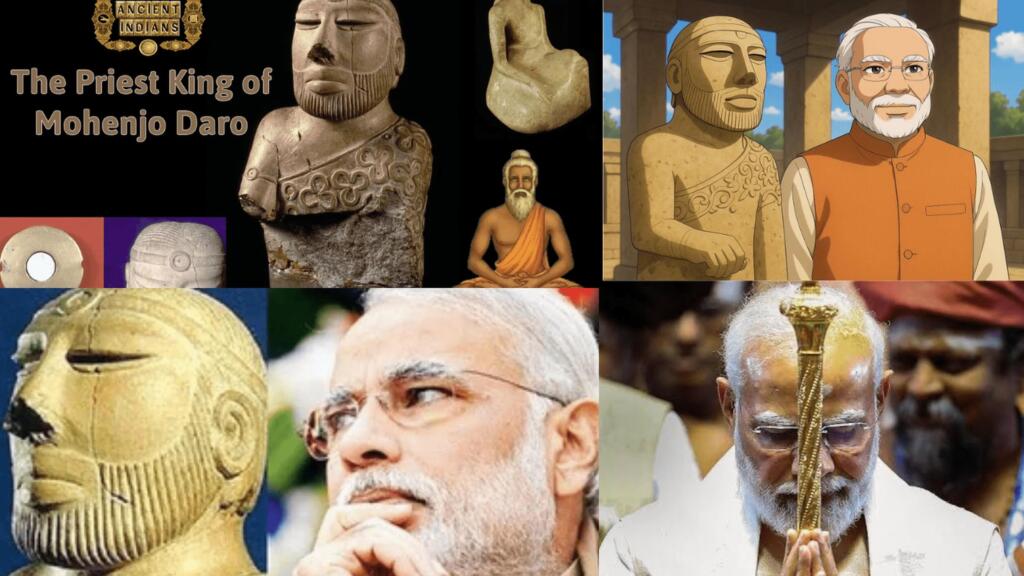
They called him “Priest King” four thousand years ago, carved in stone at Mohenjo-daro, a figure of quiet authority and spiritual power. Today, that name has returned on social media not for an archaeologist’s discovery, but for Prime Minister Narendra Modi. Why? Because millions see in him the same combination of statesmanship, simplicity, and strength that the Indus Valley “Priest King” once represented. With his shawl, his beard, his calm composure, and his ability to guide a civilization towards greatness, Modi is being compared to a timeless archetype of leadership. And this comparison has shaken the political debate across the region.
The Origins of the Priest King Statue
The story of the “Priest King” begins in the Indus Valley Civilization, one of the oldest and most advanced civilizations of the Bronze Age. Excavated in Mohenjo-daro, the bust was discovered in 1925 by Indian archaeologist Kashinath Narayan Dikshit. Standing just 18 cm tall, carved from steatite, the figure wears a shawl decorated with trefoil patterns, draped over one shoulder. His half-closed eyes suggest meditation, his beard is carved with intricate lines, and a headband rests on his hair. Scholars have debated for decades whether he was a ruler, a priest, or a symbolic representation of authority. But one thing is certain the statue radiates dignity, discipline, and power rooted in spirituality.
Why Modi Is Being Called the Modern Priest King
Fast forward four millennia, and social media users are calling Modi India’s “Priest King.” Not because he looks identical to that bust, but because the symbolism fits perfectly. Modi, with his simple attire and signature shawl, resembles the timeless leader whose authority was not just political, but also civilizational. His leadership embodies that same blend of dharmic values and practical governance. While the world trembles under instability, India stands strong under his guidance. This is why the image has gone viral because people see in Modi not just a politician, but a statesman who represents continuity from ancient Bharat to modern India.
A Stable India Amid a Turbulent World
Why has this comparison gained traction now? Look at the global scenario. Nepal is rocked by violent protests and leadership change. Pakistan is bankrupt and politically fractured. Bangladesh is sliding into civil strife. Sri Lanka is still recovering from collapse. Ukraine is war-torn. Turkey struggles with inflation. Russia is sanctioned and isolated. Even Palestine is in chaos. In contrast, India is stable, growing, and respected globally. And at the center of this strength stands Modi, a leader rooted in India’s dharmic identity, just like the Priest King was rooted in the Indus Valley’s civilization.
The Irony of Pakistan Owning the Priest King Bust
It is also important to understand the historical irony. In 1972, under the Shimla Agreement, India handed over the Priest King bust to Pakistan, where it now rests in Karachi. Yet today, it is India that embodies that legacy, not Pakistan. While Pakistan reels under extremism, debt, and chaos, India is seen as the true inheritor of that ancient wisdom and strength. This is where Modi’s comparison becomes meaningful because it reflects a living connection to Bharat’s civilizational continuity.
A Civilizational Continuity
The Priest King of Mohenjo-daro may have been carved in stone, but the spirit he represented quiet authority, dharmic grounding, and civilizational leadership lives on. In Narendra Modi, people see that same spirit alive in the 21st century. This is why the comparison has struck a chord. Because while the world falters, India is rising. And at its helm stands a leader who embodies both the past and the future a true “Priest King” of Bharat’s resurgence.