
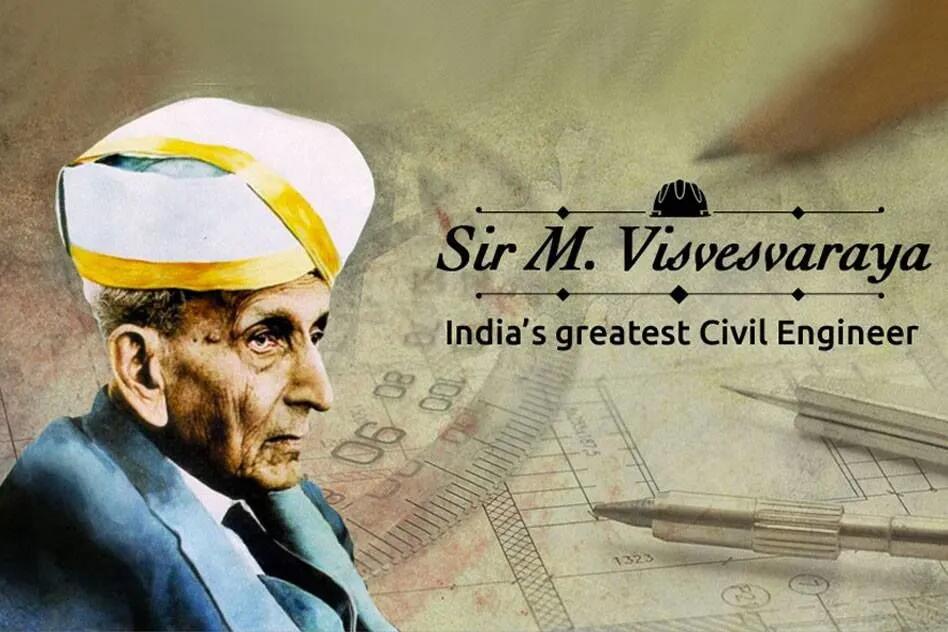
Every year on September 15, India celebrates Engineers’ Day, a national observance dedicated to honouring the contributions of engineers to the country’s development. The date was chosen to mark the birth anniversary of Sir Mokshagundam Visvesvaraya (1861–1962), popularly known as Sir MV, one of India’s greatest civil engineers and administrators. His vision, innovation, and leadership helped lay the foundations of modern engineering in India, earning him immense respect both in the country and abroad. Alongside India, countries such as Sri Lanka and Tanzania also commemorate September 15 as Engineers’ Day, recognizing the global significance of his work.
The 2025 theme for Engineers’ Day is “Engineering Excellence Drives India Forward”, aligning with the national vision of Viksit Bharat 2047. It highlights how engineering continues to remain central to India’s growth story, just as it was during the life and career of Visvesvaraya.
A True Visionary
Mokshagundam Visvesvaraya was born on September 15, 1861, in the small village of Muddenahalli in present-day Karnataka. Born into a traditional Telugu Brahmin family, he grew up in modest circumstances after losing his father at a young age. Despite financial constraints, his determination to pursue education remained unwavering. He completed his schooling in Chikkaballapur before moving on to study at the University of Madras, where he obtained a Bachelor of Arts degree.
Driven by a keen interest in technical knowledge, Visvesvaraya later enrolled at the College of Science in Pune (then Poona), where he studied civil engineering. His brilliance became evident during his academic years, and upon graduation, he was recruited as an Assistant Engineer in the Public Works Department of the Bombay Presidency. At just 22 years old, he began his professional career, working on critical infrastructure projects that would shape the course of India’s engineering history.
Contributions to Engineering and Public Works
Visvesvaraya’s engineering genius soon came to the forefront. One of his earliest works involved designing a complex pipe syphon system to carry water across the Panjra river, a solution that showcased his ability to blend technical expertise with practical innovation. His career took him across the Indian subcontinent, where he introduced pioneering methods in irrigation, water supply, and flood management.
In 1899, he designed the Block System of Irrigation for the Deccan canals, a method intended to ensure equitable distribution of water among villages and improve agricultural productivity. He also addressed the issue of “muddy and discoloured” water in the city of Sukkur, located on the banks of the Indus River, by devising innovative filtration and supply mechanisms.
Perhaps his most famous invention was the automatic sluice gates, which regulated water flow in reservoirs and prevented flooding. These gates were patented and later installed in the Krishnaraja Sagar (KRS) Dam in Karnataka during the 1920s. The dam itself, one of the largest in Asia at the time, remains a testament to his engineering foresight.
His technical contributions were not limited to India. During his travels abroad, he studied irrigation systems in Italy, drainage works in Milan, and water management practices in other parts of Europe, bringing back insights that he adapted to Indian conditions. His work reflected a balance of traditional wisdom and modern scientific understanding, a hallmark of his legacy.
Dewan of Mysore and Nation Builder
Beyond his technical achievements, Sir Visvesvaraya also played a crucial role as an administrator. In 1909, he joined the Mysore State Service as Chief Engineer and later became the 19th Dewan of Mysore in 1912. During his tenure, he transformed Mysore into one of the most progressive princely states in India.
Under his guidance, several landmark projects were initiated, including the establishment of the Mysore Soap Factory, the Mysore Iron and Steel Works, the State Bank of Mysore, and the University of Mysore in 1916. These institutions not only boosted industrial and economic development but also laid the groundwork for modern education and self-reliance in India.
Despite his reformist zeal, Visvesvaraya remained a man of principle. In 1918, he voluntarily resigned from his position as Dewan over disagreements on policies regarding reservations in state jobs. His resignation was not a withdrawal from public life but rather a reflection of his integrity and strong adherence to personal convictions.
After his retirement, he continued to contribute to national development by chairing committees such as the Bombay Technical and Industrial Education Committee, the Bombay University Committee for Promoting Chemical Industries, and the Cauvery Canal Committee. His advisory roles and institutional contributions helped prepare India for the industrial era that followed independence.
Philosopher, Author, and Advocate of Modernisation
Visvesvaraya was not only an engineer and administrator but also a thinker deeply concerned with India’s socio-economic conditions. He authored two influential books, “Reconstructing India” (1920) and “Planned Economy of India” (1934), which laid out his vision for industrialisation, economic planning, and self-reliance. Decades before independence, he argued for a scientific approach to nation-building, emphasising efficiency, innovation, and the harnessing of human talent.
In his speeches and writings, he often urged Indians to shed fatalistic attitudes and embrace modern scientific thinking. Addressing students at Central College, Bangalore, in 1912, he highlighted the difference between Western economies based on scientific precision and discipline, and India’s reliance on tradition and sentiment. He believed progress required adopting the rigor of modern civilisation while adapting it to Indian realities.
His observations during his travels also shaped his outlook. In Japan, he was struck by how education, particularly for girls, directly influenced the nation’s economic strength. He lamented that while Japan had over 1.5 million girls in school, India had far fewer despite its larger population. For him, education was the cornerstone of progress, and he tirelessly advocated for institutions that could provide practical and technical training to the youth.
Legacy and Commemoration
Sir Visvesvaraya lived to the remarkable age of 101, passing away in 1962. By then, he had witnessed the transformation of India from a colony to an independent nation, with many of his ideas forming part of the country’s developmental agenda. His contributions earned him numerous honours, including knighthood by the British in 1915 and the Bharat Ratna, India’s highest civilian award, in 1955.
Engineers’ Day is thus not merely a celebration of his birthday but also a tribute to the profession of engineering itself. It acknowledges the role of engineers in advancing technology, building infrastructure, and driving economic growth. Across India, educational institutions, professional bodies, and industries organise conferences, workshops, and seminars on this day to inspire future generations of engineers.
It is worth noting that while India observes Engineers’ Day on September 15, the world celebrates World Engineering Day for Sustainable Development on March 4, as designated by UNESCO. This international observance highlights the role of engineers in achieving the United Nations’ Sustainable Development Goals, emphasising the balance between progress and environmental responsibility.
Prime Minister Narendra Modi on Monday (September 15,2025) paid tribute to Sir Visvesvaraya and greeted engineers across the nation, highlighting their role in building Viksit Bharat. His message reflected the enduring relevance of engineering excellence to India’s journey towards inclusive and sustainable growth.
A Life that Continues to Inspire
Sir M. Visvesvaraya’s life was a remarkable blend of intellect, integrity, and nation-building. From his innovations in irrigation and water management to his leadership as Dewan of Mysore and his writings on economic planning, he left behind a legacy that continues to inspire engineers and policymakers alike. Engineers’ Day serves as a reminder that the profession is not merely about technical skills but also about vision, responsibility, and dedication to national progress.
By honouring his memory each year, India not only celebrates its greatest engineer but also reaffirms its commitment to harnessing engineering excellence for future growth. In a rapidly changing world, where technology shapes every aspect of human life, the spirit of Visvesvaraya’s message that progress requires discipline, innovation, and scientific thinking remains more relevant than ever. His life stands as a testament to the idea that engineering, when guided by a sense of duty and service, can truly transform a nation.