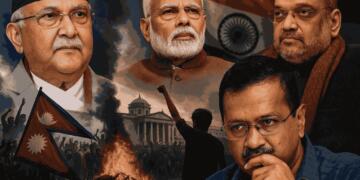
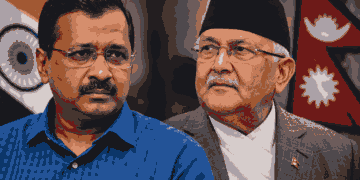










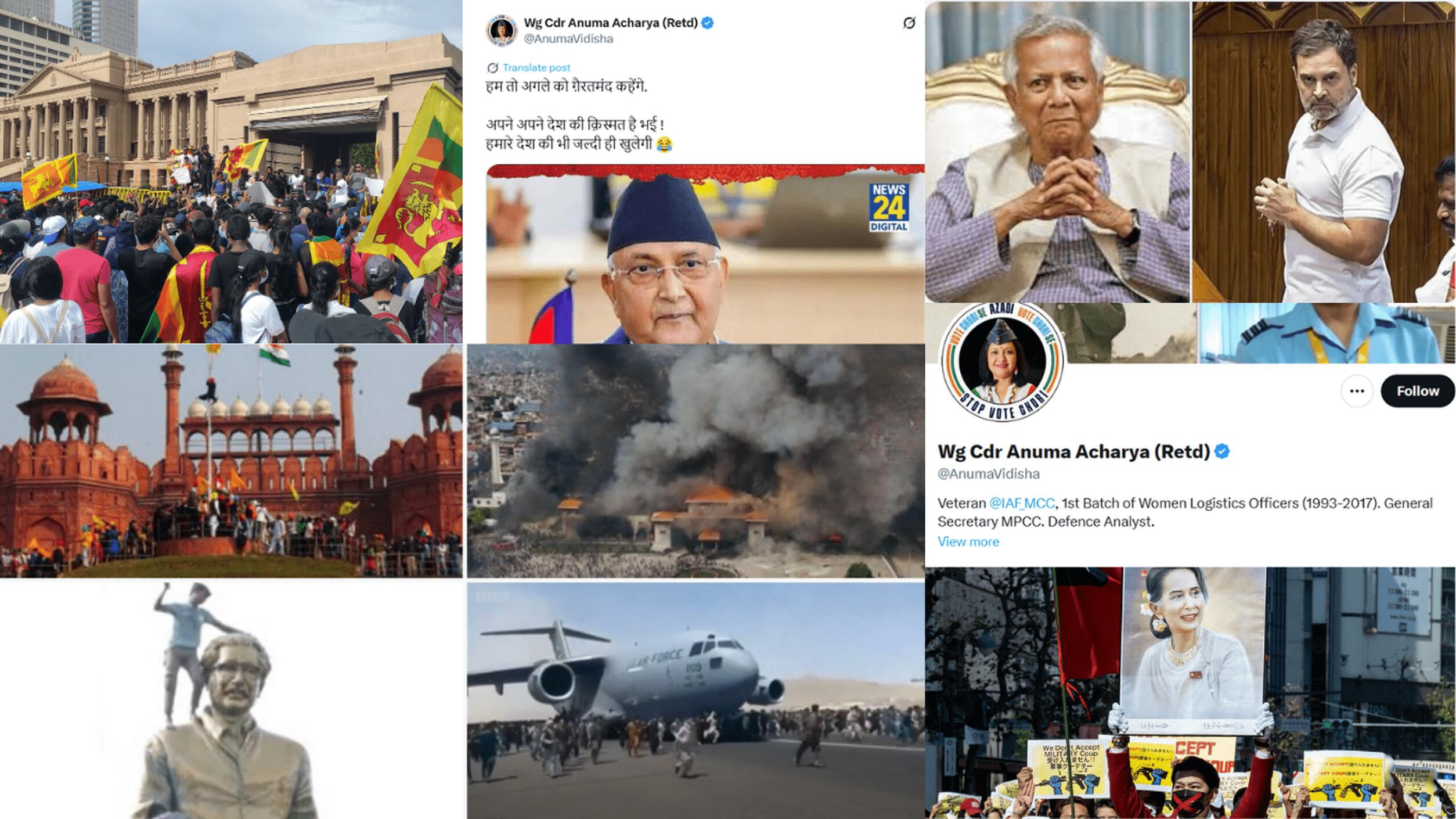
In recent weeks, a disturbing trend has emerged among members of the Congress and Aam Aadmi Party (AAP). From sly comparisons of Finance Minister Nirmala Sitharaman with viral videos of Nepal’s ministers being chased by mobs, to suggestive comments wishing for a Nepal-style uprising in India, certain political voices are openly flirting with the idea of regime change. Leading the charge is Anuma Acharya, a former IAF officer and now Congress spokesperson, who stooped to mocking India’s Finance Minister indirectly in the context of Nepal’s violent protests.
This is not just irresponsible rhetoric it reveals a dangerous dream shared by sections of the opposition: if they cannot defeat Prime Minister Narendra Modi electorally, perhaps chaos in the streets can do the job. But history proves otherwise. India’s democratic fabric, strong state institutions, and vigilant citizenry make such plots impossible. To understand why, one must first look at the broader regional playbook of the so-called Deep State and then examine why India stands apart.
India’s Opposition Dreams of a Similar Script
It is against this backdrop that Congress and AAP members, frustrated at their repeated electoral failures, appear to be “auditioning” for a similar color revolution in India. Anuma Acharya’s tasteless tweet comparing Sitharaman with Nepal’s finance minister was not just personal mockery it was political signaling. AAP MP Sanjay Singh too openly said India should “learn from Nepal,” hinting at a street-led overthrow. Their rhetoric echoes the same themes used during the Shaheen Bagh protests, the farmers’ agitation, and most recently, Rahul Gandhi’s “vote chori” campaign. Each time, the goal has been the same: delegitimize the government, sow chaos, and invite foreign validation.
But what the opposition fails to grasp is that India is not Pakistan, Sri Lanka, or Nepal. Attempts to transplant a foreign script into India’s soil have already failed multiple times.
The Playbook of Destabilization Across South Asia
The idea of using street protests and chaos to topple elected governments is not new. Over the past four years, South Asia has witnessed a domino effect of regime change, often pushed by Western-backed propaganda. It began in Myanmar in 2021, when Aung San Suu Kyi’s government was ousted and the country was plunged into a civil war. Afghanistan followed soon after, collapsing into Taliban control when U.S. forces withdrew. In Pakistan, Imran Khan was removed after exposing a U.S. diplomatic threat; in Sri Lanka, the Rajapaksa government fell amidst debt-fueled protests. Bangladesh, too, saw the ouster of Sheikh Hasina after she refused to give the U.S. military access to St. Martin’s Island. Most recently, Nepal’s KP Sharma Oli was toppled amid Gen Z-led street revolts, suspiciously resembling the same foreign-scripted color revolutions elsewhere.
Each of these upheavals carried the same DNA: Western funding, manipulated outrage, weaponized social media, and weak national institutions unable to resist external meddling. The tragedy is that each nation is still paying the price for this chaos civil wars, puppet regimes, and broken democracies.
Why Past Attempts to Destabilize India Failed
The opposition’s most ambitious coup attempt came during the farmers’ protests of 2020–21. Massive international campaigns, celebrity endorsements from abroad, and orchestrated street protests sought to create the impression of a country on the brink. Yet Prime Minister Modi, showing remarkable foresight, withdrew the farm laws, disarmed the movement, and denied the foreign script its climax.
Shaheen Bagh in 2019–20 was another such attempt. A sit-in, packaged as a “people’s revolution,” was amplified globally. But it eventually fizzled out once its foreign links and deliberate communal undertones became clear. Even during the pandemic, attempts to brand India as a “failing state” collapsed when the government’s vaccine diplomacy and management of crises won global praise.
In each case, the script failed not because the opposition lacked zeal, but because India’s democratic resilience, national unity, and Modi’s political shrewdness ensured stability.
Why India Cannot Be Nepal
Nepal’s Gen Z protests succeeded because the state there was weak, society was fractured, and foreign powers had direct leverage. India, by contrast, is fortified against such vulnerabilities. For one, the Indian armed forces remain firmly apolitical, loyal only to the Constitution, not to political games. The police and surveillance systems are strong enough to prevent any large-scale anarchic movement.
Secondly, India has an inbuilt safety valve: elections every five years. Even the angriest citizen knows that ballots, not bullets, decide power. This democratic rhythm denies regime-change conspirators the excuse of “no outlet for dissent.”
Thirdly, India’s Gen Z is not Nepal’s Gen Z. While frustration exists, it is fractured across caste, language, and region. Moreover, Indian youth are deeply career-focused, tied down by exams, jobs, and family expectations. Risking police cases or a criminal record for someone else’s political agenda is simply not an option. For them, rebellion happens online through memes, reels, and hashtags not on the streets with stones and Molotov cocktails.
The Opposition’s Self-Defeating Strategy
What Congress and AAP fail to recognize is that such rhetoric only exposes their desperation. Having failed to defeat Modi electorally for 11 years, they are now fantasizing about civil unrest. But even this fantasy backfires. Indians remember the chaos of the Emergency and value stability over rebellion. Every attempt to incite unrest only strengthens Modi’s image as the guarantor of order and continuity.
This explains why Modi continues to command over 70% approval, while opposition figures struggle to mobilize even their own cadres. Anuma Acharya’s political irrelevance she once managed only 607 votes in a Madhya Pradesh election symbolizes this futility.
Regime Change Is a Dead Dream in India
The opposition may mock, incite, or even flirt with foreign-inspired scripts of chaos, but the reality is clear: India is not Nepal, not Sri Lanka, not Pakistan. Its institutions are stronger, its people more informed, and its democracy too entrenched for any coup-style experiment to succeed. The very idea of a “civil war-like situation” in India is laughable, for it would backfire instantly, uniting Hindus, awakening silent majorities, and cementing Modi’s leadership even further.
Congress and AAP’s daydreams of regime change are not just politically immature they are politically suicidal. For every time they indulge in such fantasies, they remind India why Narendra Modi remains the subcontinent’s most unshakable leader.