
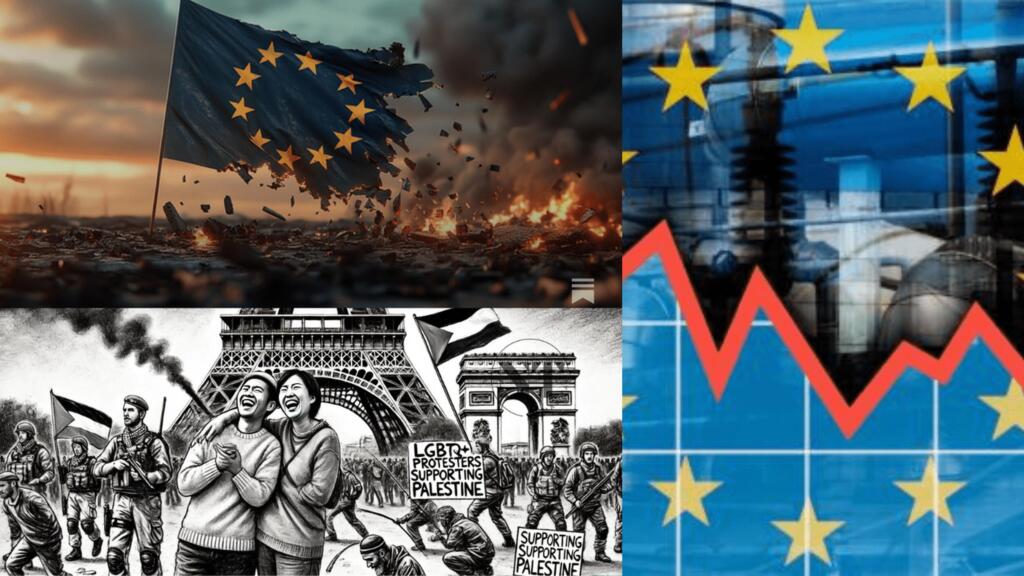
Europe today finds itself in the middle of an undeniable decline. Its economy is stagnating, its population is rapidly aging, and its political unity is crumbling. Yet, amid this collapse, Europe’s centuries-old colonial arrogance and misplaced moral superiority remain intact. The irony is striking—while Europe can no longer even meet its basic needs of food, energy, labor, and markets without external dependence, it still seeks to “lecture” the world on values and governance. The truth, however, is that Europe needs India far more than India needs Europe. At a time when the world is shifting towards multipolarity, India must exercise caution and engage only in partnerships that genuinely serve national interests, under strict terms.
Colonial Sins and Their Lingering Shadow
Europe’s decline cannot be understood without revisiting its colonial past. From the 18th to the 20th centuries, European powers built their wealth by looting and enslaving other nations. Britain, France, Spain, Portugal, Belgium, and the Netherlands extracted unimaginable resources from Asia, Africa, and the Americas. Gold, silver, diamonds, spices, and textiles worth billions were plundered, leaving colonized nations impoverished.
This looting was accompanied by genocides. Indigenous populations in the Americas, Australia, and Africa were massacred in the name of conquest. Entire cultures were erased through forced conversions, while missionaries and the Church legitimized colonialism under the guise of religion. Colonial powers further resorted to political deceit—branding themselves as “civilized” while demonizing native populations as “savages.”
This colonial mindset did not end with decolonization. Even today, Europe’s media, politics, and diplomacy carry the same arrogance, evident in their patronizing lectures to countries like India on “human rights” and “democracy.” But the global south is no longer silent, and Europe’s false superiority is being increasingly exposed.
Europe’s Economic Decline: Dependency and Stagnation
The harsh reality is that Europe’s economic engine is faltering. Its dependence on external energy and resources has made it vulnerable, particularly after the Russia-Ukraine conflict. With Russian gas supplies restricted, countries like Germany and Italy saw their industries stagnate almost overnight. Energy insecurity is crippling Europe’s industrial competitiveness, especially against nations like China and the United States.
Economic data paints a grim picture. According to IMF and Eurostat figures, the EU’s GDP growth averaged less than 0.8% in 2024–25, with Germany’s economy even contracting by -0.3% in 2023. Germany’s auto and chemical industries, once symbols of strength, are slipping behind global competitors. France is battling repeated farmer protests, while Britain has been in steady decline since Brexit.
Demographics add to the crisis. By 2050, 30% of the EU’s population will be over 65, making it one of the oldest regions in the world. This shrinking workforce is forcing Europe to rely heavily on migrant labor. Meanwhile, poverty is spreading—93 million Europeans now live below the poverty line, and homelessness is rising in countries such as France and Germany.
This combination of energy dependency, industrial decline, and demographic collapse underscores why Europe is no longer a reliable partner but a desperate player in global trade.
Political Fragmentation and the Weapon of Narratives
Alongside its economic struggles, the EU faces widening political fissures. France and Germany, the supposed anchors of Europe, are increasingly at odds over industrial and defense policies. Eastern European nations like Poland and Hungary openly defy Brussels’ so-called “liberal values.” Brexit has already set a precedent, and separatist movements in Catalonia, Scotland, and Belgium continue to simmer.
Amid these internal fractures, Europe continues to weaponize its media to maintain influence. Narratives attacking India are common, especially around democracy and human rights. Meanwhile, European platforms show sympathy for countries like Pakistan while ignoring their failures. However, these propaganda tactics are weakening. With the rise of independent media and global internet access, Europe’s narrative monopoly is breaking apart.
This weakening influence is evident in Africa and Asia, where Europe’s former colonies no longer bow to its dictates. European powers that once looted these regions are now losing ground to China, Russia, and increasingly, India.
Lessons for India: Engage on India’s Terms
Europe’s decline offers a crucial lesson for India. With its youthful population, growing economy, and technological advancements, India holds the leverage. But any engagement with Europe must be conditional and selective.
-
Bilateral Deals, Not Bloc-Level Traps:
The EU as a bloc often tries to impose collective conditions on India. This must be avoided. India should negotiate FTAs only on a country-by-country basis, ensuring maximum advantage. -
Selective Partnerships:
Some European nations still offer strategic value. Germany’s advanced technology, France’s defense expertise, and Nordic nations’ energy innovations can benefit India. But deals with weaker economies in Europe offer little in return and should be deprioritized. -
Strict Conditions for Cooperation:
-
Mandatory FDI and technology transfer in India.
-
Trade settlements in Indian rupees, gold, or through UPI.
-
Sovereign guarantees from European governments to secure Indian interests.
-
A clear ban on sheltering anti-India groups or fugitives.
-
Reciprocity in healthcare and insurance to boost Indian medical tourism.
-
-
Dispute Resolution on India’s Terms:
Any disagreements in trade or investment must be resolved under mechanisms chosen by India, not under biased European frameworks.
By applying such conditions, India can ensure that Europe’s engagement benefits Indian growth while protecting national sovereignty.
India Must Lead, Not Follow
Europe, once the epicenter of colonial dominance, now finds itself cornered—its economy stagnating, its population aging, and its influence shrinking. Yet, its colonial arrogance persists, reflected in its continued attempts to lecture and pressure nations like India. But the world has changed. India is no longer the exploited colony; it is a rising power with the potential to lead in the 21st century.
For India, the strategy is clear: engage with Europe only when it serves India’s interests, and only under terms that guarantee tangible benefits. India must not fall for bloc-level traps or empty moral posturing. Instead, it should leverage its strong position to extract the maximum value from any partnership.
In essence, Europe’s decline is not India’s burden. If Europe wishes to partner with India, it must do so with humility and fairness. For India, this is an opportunity to cement its place as a confident, self-reliant power—no longer lectured, but leading the global conversation.