
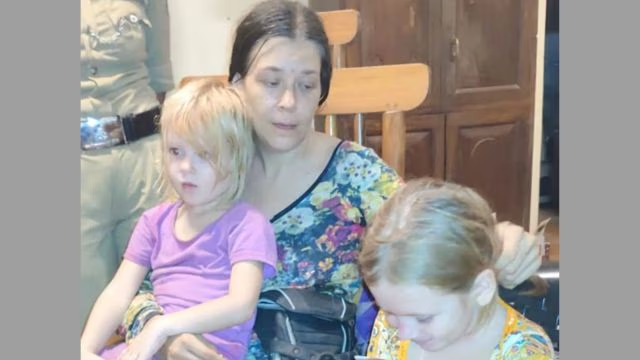
Deep within the dense, rain-soaked Gokarna forest of Karnataka, the police stumbled upon a Russian woman and her two children who were found living in a secluded cave in the Ramateertha hills of Kumta taluk in Uttara Kannada district earlier in July this year.
The 40-year-old Russian woman Kutina Nina Vladimirovna was found living in the forest cave with her daughters, Preya (6) and Ama (4), where they had spent nearly two weeks in isolation.
The police officials who had found the mother and her two daughters while patrolling Ramateertha Hill to ensure tourist safety, following which, they promptly rescued the trio on July 11.
For months, the mother and daughters had lived in the forest, out of sight, in silence, away from society, surviving off the land and an unwavering determination to remain unseen.
Kutina had entered India on a business visa and reached Gokarna, a coastal pilgrim town in Karnataka, via Goa. As per reports, police said that the Russian national’s visa expired nine years ago, making her an illegal resident.
Hailing from Russia, Kutina had been travelling the world for the last 15 years.
“Over the past 15 years, I’ve been to around 20 countries. My children were all born in different places. I delivered all of them myself, without hospitals or doctors, because I know how to do it. No one helped me, I did it alone,” Kutina said.
Kutina claimed the family moved to the forest voluntarily, but following their rescue, they were now being kept in uncomfortable and unhygienic conditions.
Reportedly, when asked why Kutina hadn’t returned to Russia, she cited a series of personal tragedies, legal issues and emotional burdens.
“There have been many complicated reasons. First, there were multiple personal losses — not just the death of my son, but also a few other close people. We were constantly dealing with grief, paperwork, and other problems,” she stated.
Following the death of her eldest son Dima in Russia in 2024, Kutina reportedly retreated into herself — and into the forest.
A well-travelled interior designer once, who had seen 20 countries, Kutina left it all behind, finding refuge in India’s spiritual heartland.
The Israeli ‘Connection’ and Espionage Suspicions
The mystery deepens with a disputed connection. Police documents list an Israeli businessman as her husband, something Kutina vehemently denies.
This contradiction has prompted Indian intelligence agencies to dig deeper. Is this merely a matter of outdated paperwork, or does it point toward something more clandestine — possibly even espionage?
For now, no concrete evidence of illegal activity has emerged. But when someone chooses isolation over interaction — particularly in a foreign land — the security radar naturally lights up.
After the rescue, Kutina and her two daughters were placed in a detention centre in Tumkur, while her 11-year-old son was sent to a children’s home in Goa. Since then, all communication has been cut off.
The separation has taken a visible toll — both physical and emotional. Health reports say the children are suffering from vitamin deficiencies and signs of trauma.
In one heartbreaking statement from detention, Kutina said, “We have not committed any crime. Just let me meet my son, and I will return to my country. The forest gave us peace — this place only brings pain.”
That sentence alone has ignited calls for a more humane and compassionate approach, even as the legal machinery continues its slow churn.
Kutina claimed her life in the cave was harmonious and far from the way it was portrayed in news coverage.
“We woke up with the sun, swam in rivers and lived in nature. I cooked on a fire or gas cylinder depending on the season, and got groceries from a nearby village. We painted, sang songs, read books, and lived peacefully,” she said.
A Diplomatic Tightrope
This is no longer just a local case. With Russia watching closely, and whispers of international involvement, New Delhi must walk a tightrope. On one hand lies the humanitarian imperative — the rights of a mother and her children. On the other, the responsibility of national security and rule of law.
India and Russia share decades of strong diplomatic ties. But how this case is handled could set a precedent, not only for bilateral relations but for the treatment of foreign nationals who fall between the cracks of the legal system.
The Way Forward
As of now, Kutina remains in detention, her children still apart, and her future uncertain. But two parallel paths must be pursued:
- Humanitarian Resolution: Immediate efforts should be made to reunite the mother and children, ensuring access to healthcare and psychological support.
- Legal Clarity: Visa details must be verified transparently, and the Israeli ‘connection’ investigated without presumption. If no wrongdoing is found, facilitate her safe return to Russia.
A Story That Transcends Borders
This is not just the story of a Russian woman hiding in a cave. It is a story of grief, resilience, motherhood, and mystery. It is a test of how far a system can bend to accommodate humanity without breaking its own laws.
The woman and her two daughters have been temporarily shifted to a women’s rehabilitation centre.
Meanwhile, police and forest officials searched the cave and recovered Nina’s passport and visa which had expired on April 17, 2017.
Authorities have reached out to the Foreigners Regional Registration Office (FRRO) in Bengaluru to initiate the process of sending the woman and her children back to Russia.