
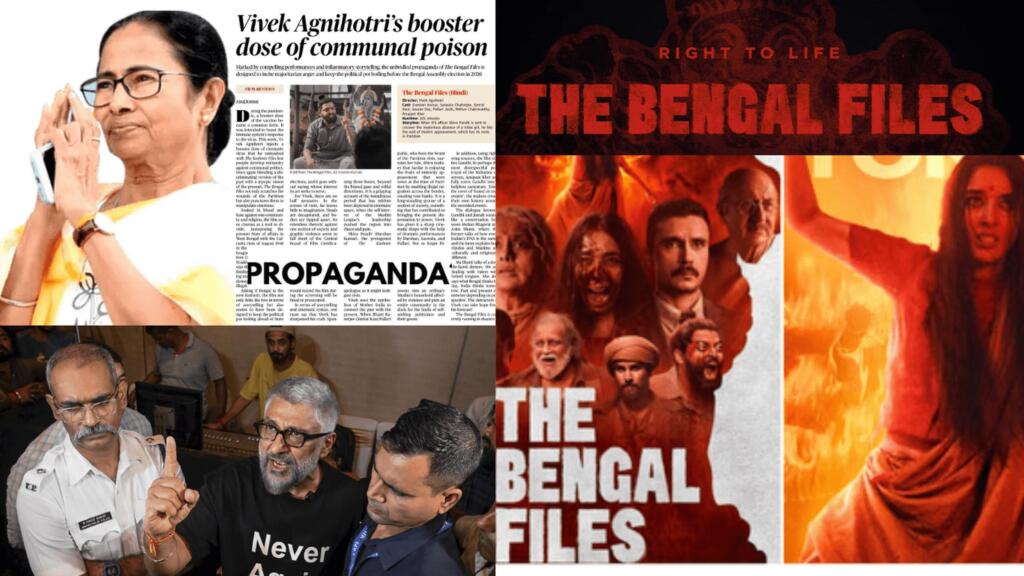
The Bengal Files has become more than just a film it has emerged as a battlefield for truth, memory, and justice. While audiences across India are getting to witness Vivek Agnihotri’s chilling recreation of Bengal’s darkest chapter, the very soil where this genocide took place, West Bengal, is being denied that right. The question that every Indian must now confront is simple: Why should the people of Bengal be deprived of their right to see the story of their ancestors, while the rest of the nation and the world watch?
Hollywood has never shied away from producing films that expose Nazi atrocities, ensuring the horrors of the Holocaust remain etched in global consciousness. Yet, in a supposedly free India, a film that dares to expose Islamic atrocities against Hindus faces censorship, boycotts, and intimidation. The answer lies in Mamata Banerjee’s vote-bank politics in West Bengal and the Left-liberal ecosystem’s fear of Hindu awakening.
Mamata Banerjee’s Silent Ban and Media Distortion
The Mamata Banerjee government has ensured an “unofficial ban” on the film, effectively silencing a story that speaks for thousands of Hindu families butchered, violated, and erased from historical discourse. What makes this tragedy worse is not merely Bengal being kept in darkness once again, but the active collaboration of sections of the media that distort reality and mock Hindu suffering.
Newspapers like ‘The Hindu’ have gone beyond neutrality, openly dismissing the film’s attempt to narrate history. This is not just a controversy over a movie; it is about whether Hindus will ever be permitted to tell their truth in a country that calls itself democratic. The moment Hindus dare to reclaim their narrative, the intellectual elite and political class rise to crush it under the guise of “communal harmony.”
When ‘The Hindu’ reviewed the movie, it complained that Agnihotri’s camera “never zooms into an ordinary Muslim’s household” and allegedly put an entire community in the dock. The hypocrisy could not have been more glaring. While the review accused Hindus of bias for simply retelling their own tragedy, it conveniently ignored the fact that history itself testifies to mass participation of Muslims in the 1946 violence.
The Brutal Truth of Direct Action Day
Here is the reality that the secular media and the appeasement-driven political class never wish to highlight. Direct Action Day in August 1946 was not orchestrated by politicians in isolation it was carried out by ordinary Muslims who willingly participated in the bloodshed. It was not Mohammad Ali Jinnah alone who wielded the knife. It was the Muslim mobs in Calcutta and later in Noakhali who slaughtered Hindu men, butchered bodies, and hung mutilated torsos in butcher shops.
Hindu girls were dragged away, violated, and forced into marriages with their tormentors. Entire families were wiped out in the name of Islam, simply because the Muslim League demanded Pakistan. These are not exaggerated tales they are the lived experiences of survivors, preserved in memoirs, testimonies, and contemporary reports. Yet, the same media that questions Agnihotri never dares to write about this. Their so-called “morality” applies only when Hindu voices must be silenced.
The hypocrisy deepens when one asks: why does the media never question why Muslim mobs repeatedly take to violence at the call of political and religious leaders? Why is the brutality of those mobs justified or ignored, while any attempt to highlight Hindu genocide is instantly labeled “communal”? If Hindus retell their tragedy today, they are not inventing hatred; they are recording history.
Mamata Banerjee’s Politics of Appeasement
This fear of truth is what Mamata Banerjee and her Trinamool Congress (TMC) government dread the most. The Bengal Files disrupts her carefully manufactured narrative of secularism and appeasement, exposing the suppressed memory of Hindus that her regime relies on erasing.
In Bengal, theatre owners have been threatened, multiplex chains warned, and distributors intimidated. No official notification bans the film, but the “unofficial ban” is far more sinister because it operates without accountability. Pallavi Joshi, the film’s producer and lead actor, has already written to President Droupadi Murmu, detailing how FIRs, trailer blocks, and coordinated boycotts targeted the project even before its release. If this is not state-sponsored censorship, then what else can it be called?
Films glorifying minority narratives face no resistance and often receive state patronage. Yet a film that portrays Hindu pain and Hindu suffering is immediately branded “sensitive,” “dangerous,” or “divisive.” Mamata Banerjee, who projects herself as the cultural guardian of Bengal, cannot tolerate a film that forces her people to remember what they were once made to forget.
Erased History and Hindu Resistance
The erasure of Bengal’s genocide is not new. Generations have grown up in silence, with textbooks refusing to narrate the reality of Direct Action Day or the Noakhali massacres. What is rarely remembered is that Hindus did not remain passive forever. Resistance was organized by men like Gopal Mukherjee, who fought back against the perpetrators. Importantly, that resistance targeted only those who took part in killings, sparing women and children a fact that demonstrates the moral distinction between the victims and the aggressors.
Yet today, under Mamata Banerjee, this selective amnesia continues. The ruling ecosystem would rather erase Hindu trauma than risk alienating a particular community’s votes. The suppression of history, therefore, is not about communal harmony it is about electoral arithmetic and political survival.
The Truth Cannot Be Buried Forever
The Bengal Files is not merely a cinematic project it is a reckoning. Just as The Kashmir Files forced India to confront the exodus and genocide of Kashmiri Pandits, this film reminds the nation that Partition was not just about borders on a map. It was about Hindu lives destroyed, Hindu women dishonored, and Hindu civilization torn apart. As Vivek Agnihotri rightly put it: “If Kashmir hurt you, Bengal will haunt you.”
That haunting memory is precisely what Mamata Banerjee wishes to suppress. It disrupts her politics of denial, her vote-bank calculations, and the media’s carefully curated silence. But history has a way of breaking through censorship. No matter how many theatre owners are threatened, how many distributors are silenced, or how many reviewers distort reality, the truth has a way of reaching people.
Suppressing the truth will not erase it. Bengal deserves to know. India deserves to remember. And history will judge harshly those who once again attempted to silence it.