
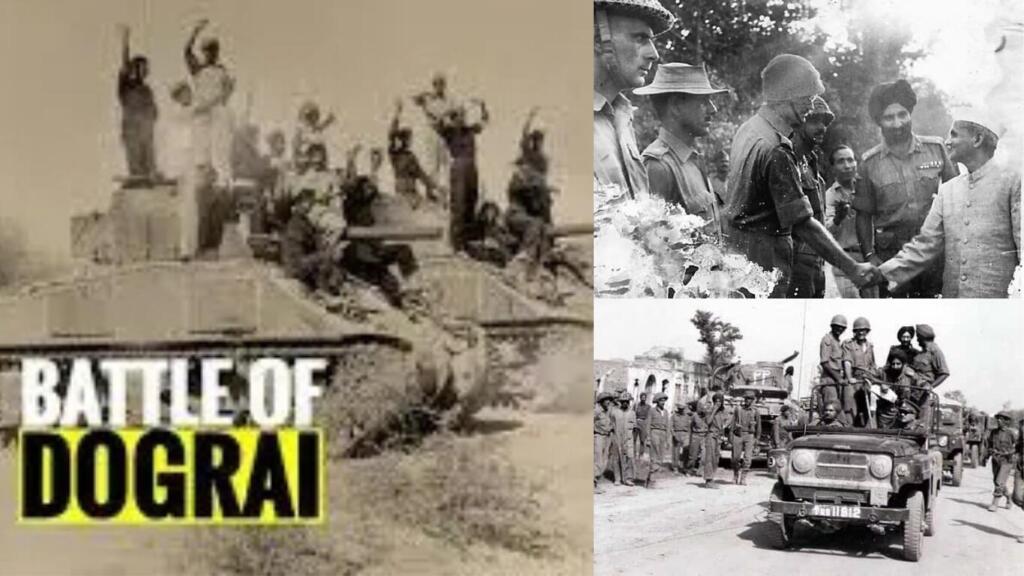
History often celebrates the wars a nation fights, but it sometimes overlooks the incredible sacrifices of the men who fought them. On the night of September 21–22, 1965, the Indian Army’s 3 JAT battalion engraved its name in glory by storming the Pakistani stronghold of Dograi, just outside Lahore. This was no ordinary operation. It was one of the fiercest infantry battles fought by the Indian Army, where every street, every house, and every lane became a trap. Pakistan had claimed Dograi to be an unbreakable fortress, protected with minefields, artillery, armour, and pillboxes. Yet, within hours, the Indian Jats shattered this illusion, planting victory on enemy soil. The capture of Dograi was not only a tactical win but also a psychological triumph that displayed the unshakable will of Indian soldiers under an extraordinary leader.
Dograi: The Fortress That Had To Fall
The Battle of Dograi holds a unique place in India’s military history. Located just a few kilometres from Lahore, Dograi was a vital objective. Its capture meant choking Pakistan’s supply routes and directly threatening their heartland. The Pakistan Army, well aware of its importance, turned the town into a fortress. Layers of minefields, artillery support from heavy guns, armoured reinforcements, and concrete bunkers guarded the area. To any strategist, a frontal assault looked like certain death.
But to 3 JAT, this was not just another mission it was a matter of pride. Every soldier knew they were being asked to attempt the impossible, but they also knew they carried the weight of India’s honour. To retreat or fail was not an option.
The Leadership of Lt Col Desmond Hayde
At the heart of this mission was Lt Col Desmond Hayde, a leader who embodied discipline and courage. Known for his austere lifestyle, Hayde neither smoked nor drank, and his commitment to fairness and efficiency earned him deep respect. He was no distant commander; he knew his men by name, by village, and by family. His close bond with his troops transformed 3 JAT into a well-oiled machine of discipline and brotherhood.
In the opening phase of the war on September 6, 1965, 3 JAT had already surprised Pakistan by capturing Dograi and even crossing the Ichhogil Canal. Yet, due to the absence of reinforcements, they were forced to withdraw a bitter moment for men who had seen victory so close. That setback only hardened their determination. Fate was about to give them another chance.
Preparation in the Face of Fire
From September 8 to 21, 3 JAT was stationed at Santpura, just west of Wagah. Pakistani artillery shelled them daily, but instead of demoralising the soldiers, it toughened them. Men grew so accustomed to shelling that they treated it with disdain. The battalion studied the terrain, patrolled aggressively, and memorised every bush, trench, and building around Dograi. By the time the final assault order came, 3 JAT was mentally and physically prepared.
On the night of September 21, under the cover of darkness, the battalion advanced. What followed was sheer hell. Pakistani guns thundered, pillboxes spat fire, and every alley became a death trap. But the Jats pressed on. House by house, bunker by bunker, they cleared Dograi in brutal close-quarter combat. Bayonets clashed, grenades exploded, and the so-called unbreakable fortress collapsed. More than 300 Pakistani soldiers were killed, many more wounded, and in a dramatic turn, their commanding officer was captured alive.
Victory That Shook Pakistan
The fall of Dograi was more than the capture of a town. It was a crushing blow to Pakistan’s morale. The myth of Dograi’s invincibility had been demolished by Indian grit. For his leadership, Lt Col Hayde was awarded the Maha Vir Chakra. But beyond medals and honours, the victory demonstrated a timeless truth of war: when Indian soldiers fight with conviction, no obstacle is insurmountable.
Pakistan’s desperate counter-attacks failed miserably. Their tanks and artillery could not shake the determination of the Jats. By morning, the Indian tricolour flew proudly over Dograi, just a few kilometres from Lahore. International pressure may have forced India to halt its advance, but history remembers that Lahore itself trembled because of the courage of 3 JAT.
Dograi : A Testament to Indian Courage
For the men of 3 JAT, Dograi was not merely a military objective it was a saga of sacrifice, honour, and unbreakable will. The victory became a shining example of what disciplined infantry, inspired leadership, and national pride can achieve. Even today, the Battle of Dograi is studied in military academies as one of the toughest and most decisive infantry battles ever fought by India.
As the ceasefire silenced the guns, the soldiers of 3 JAT stood tall, knowing they had carved history with their blood and courage. Dograi became more than a battlefield it became a symbol of India’s fearless spirit, a reminder of the price of freedom, and a warning to every enemy who dares underestimate the Indian Army.
The night of September 21–22, 1965, will forever remain etched in India’s memory. It was the night when the Jats of 3 JAT stormed Dograi, made Lahore tremble, and raised the tricolour high. This was India’s triumph, this was 3 JAT’s glory, and this was the Battle of Dograi an immortal chapter of Indian military pride.