
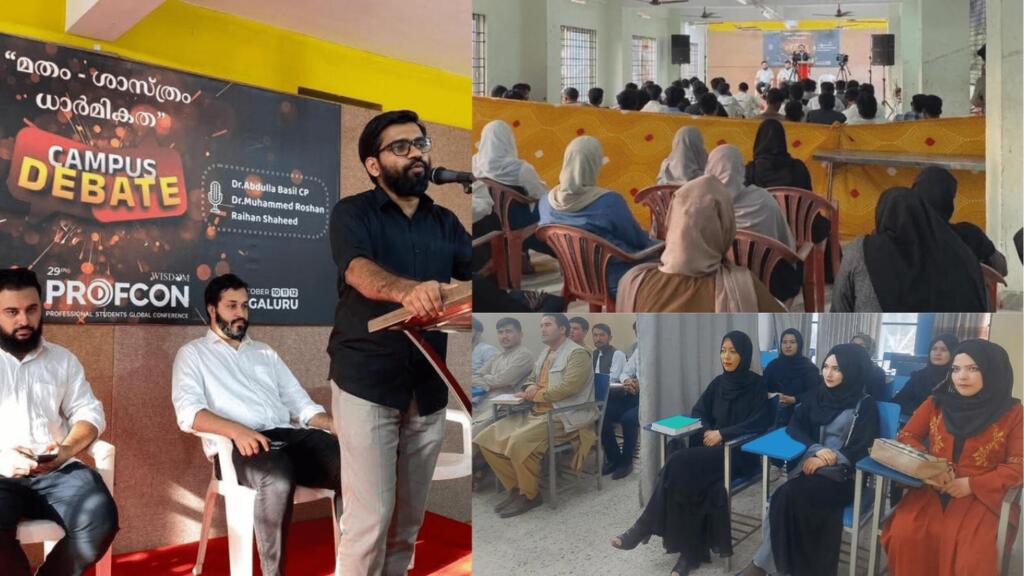
Cochin University of Science and Technology (CUSAT) in Kerala has once again found itself in the middle of controversy after an event organised by the Wisdom Islamic Organisation, affiliated with the fundamentalist Mujahid movement, triggered outrage across the state. The programme, presented as a campus debate on the theme ‘Religion, Science and Morality’, went viral for its Taliban-style gender segregation, where male students were seated in front rows while female students were forced to sit behind a curtain. Critics argue that such practices, especially within a government-run educational institution in a state hailed for its literacy and progressive credentials, are deeply disturbing and dangerous for Kerala’s democratic ethos.
Taliban Parallels: Creeping Radicalism in Kerala
Photographs from the event revealed an alarming picture female students completely obscured, prevented from directly viewing the stage or interacting with male counterparts. This arrangement was not just a cultural choice but carried symbolism that evoked the harsh restrictions enforced by the Taliban in Afghanistan. Since returning to power in 2021, the Taliban has rolled back women’s rights drastically, banning girls from education beyond sixth grade, shutting them out of workplaces, and even barring them from public spaces like parks and gyms.
The visuals from CUSAT reflect a similar attempt to normalize regressive practices in the name of religious morality. For many, this is a clear warning sign of how radical Islamic organisations are increasingly finding space in Kerala’s educational institutions. Critics fear that this is more than an isolated incident—it is part of a larger ideological penetration that seeks to curb women’s freedom and push campuses into fundamentalist frameworks.
CUSAT Alumni Event and Afridi Controversy
This is not the first time CUSAT has faced criticism for allowing events linked to fundamentalist groups. Earlier this year, on May 25, 2025, the Cochin University BTech Alumni Association UAE (CUBAA-UAE) organised Ormachivadukal Season 2 at the Pakistan Association Hall in Dubai. The event, which was supposed to be an inter-collegiate cultural programme, sparked outrage after former Pakistani cricketers Shahid Afridi and Umar Gul appeared on stage.
Afridi, notorious for his repeated anti-India comments on Kashmir, was honoured and celebrated with chants of “Boom Boom” from the crowd. The timing of the felicitation was even more controversial, coming just weeks after the Pahalgam terror attack of April 11 and India’s robust military response under Operation Sindoor on May 7. CUBAA later claimed Afridi’s presence was “unannounced and unsolicited,” but venue records showed that arrangements had been made in advance. The Akhil Bharatiya Vidyarthi Parishad (ABVP) has since demanded a probe, including NIA investigation and cancellation of passports of organisers involved.
Political Blind Spot: CPI(M) and Congress Under Fire
The recurring controversies at CUSAT highlight a troubling trend in Kerala’s political climate. The CPI(M)-led government under Chief Minister Pinarayi Vijayan, along with its student wing SFI, is being accused of turning a blind eye to Islamic organisations that exploit campuses for radical propaganda. Even the Congress, while posing as an opposition, has avoided direct confrontation with these groups, leading to further disillusionment among citizens.
Kerala has long projected itself as a model state with high literacy, gender equality, and social progress. Yet, incidents like these undermine that image, raising questions about whether regressive practices are being tolerated for political convenience. By allowing extremist narratives under the pretext of debates and cultural events, campuses risk being converted into ideological laboratories that poison young minds with communal and radical thought.
Safeguarding Kerala’s Democratic Spaces
The CUSAT controversies are not just campus-level disturbances but reflect a deeper ideological struggle unfolding in Kerala. From Taliban-style gender segregation to honouring anti-India figures like Afridi, these incidents expose how radical outfits are attempting to erode the progressive values that the state has long cherished.
Universities are meant to be spaces for free thinking, debate, and progress. Instead, when government campuses host events that enforce segregation or glorify those who insult India, it signals a dangerous departure from democratic principles. Unless strict action is taken by authorities and political parties abandon their appeasement tactics, Kerala risks sliding into a regressive space that betrays its own proud legacy of education and social advancement.