
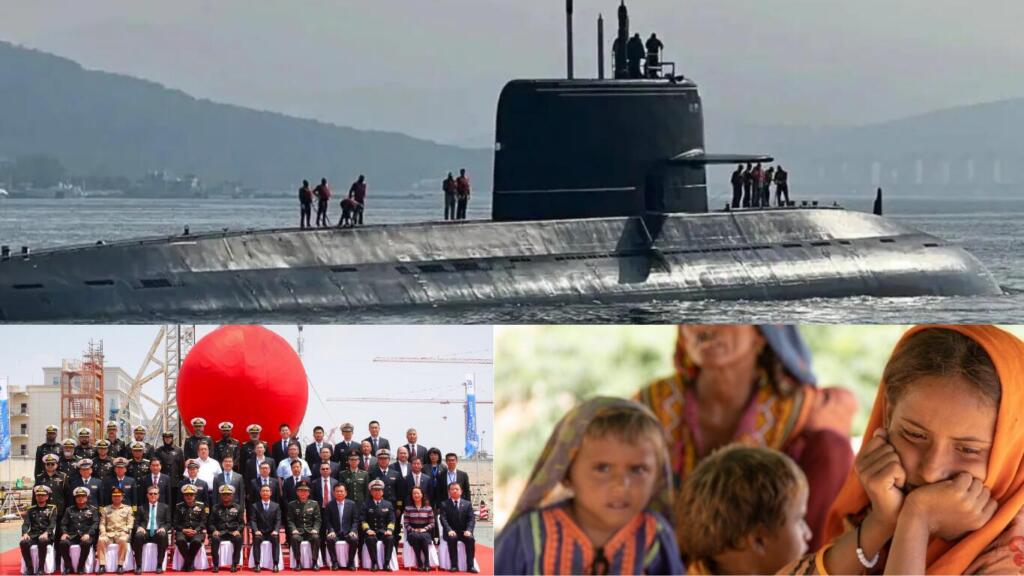
Pakistan’s spending priorities tell a troubling story. While billions are committed to defence purchases such as submarines, schools and hospitals are starved of funds, placing the future of an entire generation in jeopardy.
Internationally, it is recommended that a nation spend at least 4% of its GDP on education. Pakistan has never reached that threshold. Worse, expenditure has fallen from an already abysmally low 2% in 2018, to 1.7% in FY2022, 1.5% in FY2023, and just 0.8% in FY2025. That figure amounts to roughly $3.2 billion for nationwide schooling.
The consequences are stark: more than one in three Pakistani children—about 26 million—are out of school. Learning poverty is acute, and girls in many districts are disproportionately excluded. To put the funding gap in perspective, the $5–6 billion earmarked for the Hangor submarine programme could finance nearly two years of education nationwide.
A fragile health system
Public health faces similar neglect. In FY2024, Pakistan spent just 0.9% of GDP (PKR 924.9 billion) on healthcare. According to the Ministry of Finance, this is barely enough to keep the system functioning, leaving little scope for expansion.
Vaccination campaigns have shown limited progress, but nearly a million children missed their doses, leaving them vulnerable to preventable diseases. Undernutrition worsens the crisis: stunting affects around 40% of under-fives, or 12 million children. Yet nutrition programmes receive only $200–300 million a year. On that scale, the Hangor deal could bankroll targeted nutrition for two decades.
Fiscal trade-offs
The fiscal backdrop makes these choices more severe. In FY2024–25, more than half of Pakistan’s national budget went to interest and debt servicing, leaving little for development. The Malala Fund notes that repeated promises to prioritise education and health have not materialised, as social spending is squeezed to accommodate both debt and defence.
Against this background, the submarine deal stands out. Pakistan ordered eight Hangor-class submarines from China at an estimated cost of $5–6 billion. This is equivalent to the entire national education budget for a year, or nearly two years of health outlays.
Futility of the Hangor deterrence
From a strategic standpoint, the Hangors are unlikely to alter the military balance. India’s sophisticated anti-submarine warfare capabilities—including P-8I Poseidon aircraft, advanced sonars, and surface ship defences significantly reduce the submarines’ operational effectiveness. Analysts note that Pakistan’s submarine fleet, while potentially complicating India’s naval calculus, does not provide a decisive edge. At best, the Hangors are symbolic deterrence assets, not game-changers.
This raises a pressing question: why devote billions to equipment that cannot meaningfully shift strategic realities, while basic investments in children, health and human security are chronically underfunded?
Losing a generation
The implications are long-term and severe. Underinvestment in education and health today means a workforce less productive, growth prospects weaker, and resilience to crises diminished. Pakistan is already highly vulnerable to floods, heatwaves and epidemics—the devastation from repeated flooding has shown how fragile the country remains. Children are the first to bear the brunt of these emergencies, and they are the ones being left behind by policy choices today.
Pakistan is building submarines while losing a generation. The statistics are unambiguous, the priorities mismatched, and the costs nothing short of generational.
(This article is written by Aritra Banerjee)


(Aritra Banerjee is a Defence, Foreign Affairs & Aerospace Journalist, Co-Author of the book ‘The Indian Navy @75: Reminiscing the Voyage’ and was the Co-Founder of Mission Victory India (MVI), a new-age military reforms think-tank. He has worked in TV, Print and Digital media, and has been a columnist writing on strategic affairs for national and international publications. His reporting career has seen him covering major Security and Aviation events in Europe and travelling across Kashmir conflict zones. Twitter: @Aritrabanned)