
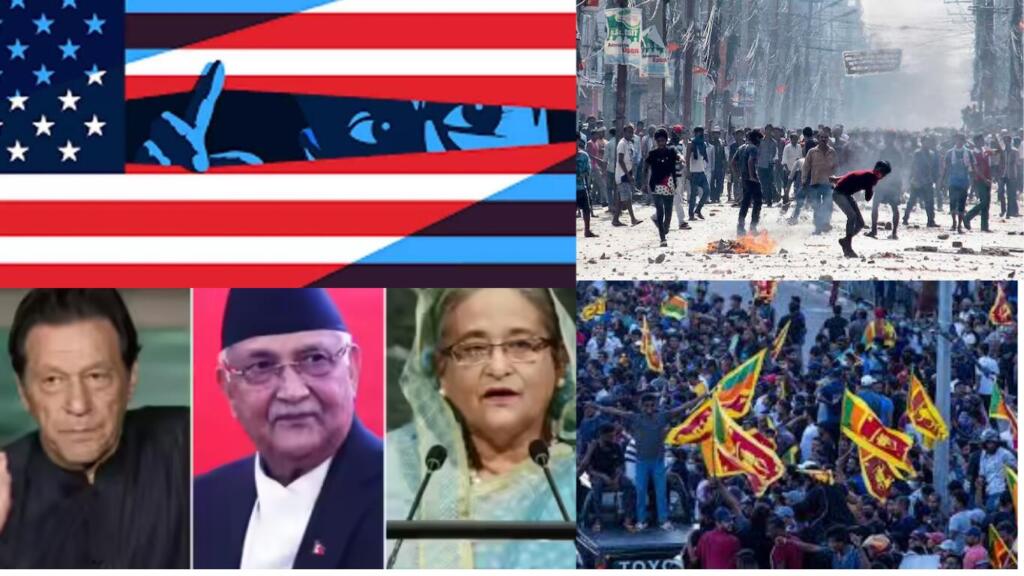
South Asia, a region pulsating with promise and poised to reshape the global economic order, has become the latest battleground for a covert, high-stakes geopolitical contest. India’s rapid economic growth and expanding influence threaten to upend entrenched global power structures, provoking a calculated and insidious response from the United States. Far from the benevolent partner it claims to be, Washington is engaged in a covert sabotage campaign designed to fracture South Asia politically and economically, erecting artificial barriers to India’s progress. This hidden agenda weaponises aid, diplomacy and ideology to destabilise Nepal, Sri Lanka, Bangladesh and other neighbours, all with the singular aim of stunting India’s rise and maintaining American hegemony.
The Dark Blueprint: US Strategic Manipulation to Contain India
Beneath diplomatic pleasantries and development rhetoric, the US pursues a sophisticated, multidimensional strategy meticulously designed to keep India’s ambitions in check:
Political Subversion Through Proxy Factions and Covert Interference
From 1996 to 2006, the US played a decisive role in Nepal’s violent Maoist insurgency by labelling the Communist Party of Nepal (Maoist) a terrorist organisation while backing the royal government. This included tacit support for the controversial 2005 royal coup, which suspended democracy and amplified repression, fuelling political chaos and anti-American sentiment. By empowering compliant elites and undermining nationalist or leftist forces, the US fomented deep fractures in Nepal’s political fabric. Similar tactics played out in Bangladesh and Sri Lanka, where Washington exploited ethnic, political and social divisions to weaken governance and erode trust.
Economic Sabotage via Conditional Aid and Sovereignty Undermining
US ‘development’ aid operates as a wolf in sheep’s clothing. Nepal’s Millennium Challenge Corporation (MCC) compact, a $500 million infrastructure grant, includes clauses that supersede Nepali law and compromise sovereignty, sparking protests and political deadlock. Such economic fetters systematically frustrate South Asian states’ ability to build resilient economies and cooperative projects, the foundations of India’s vision for regional integration, ensuring sustained dependency and arrested growth (World Bank Data). Nepal remains dependent on foreign aid for nearly 30% of its development budget.
Divide-and-Rule Geopolitics: Situated strategically as a buffer state between China and India, Nepal occupies a critical geopolitical space. The US exploits this role and coerces smaller neighbours into its orbit, intensifying India-China rivalry and compelling nations to choose sides. This divide-and-rule tactic fosters distrust and rivalry, crippling South Asia’s collective influence and undermining regional cooperation forums such as SAARC, which have stagnated amid external interference.
Cultural and Ideological Engineering to Fragment Societies
Washington also uses NGOs and social initiatives, especially promoting LGBTQ+ rights and secularism, as ideological Trojan horses. While couched in human rights language, these programs frequently clash with local religious and traditional values, intensifying societal discord and nationalist backlashes that detract attention from urgent economic development.
Consequences: US-Engineered Chaos Undermining South Asia’s Potential
The fallout is stark and corrosive:
• Nepal: MCC’s controversial provisions have inflamed political conflicts, fractured national unity and delayed vital infrastructure. Growth fluctuated sharply recently, dropping from 7.1% in 2018 to just 1.9% in 2023 (World Bank).
• Sri Lanka: US diplomatic pressures have exacerbated ethnic tensions amid economic collapse, with inflation surpassing 60% in 2022, crippling recovery efforts (IMF Sri Lanka Report, 2023).
• Bangladesh: Aid conditionalities deepen political divides and deter investments, slowing infrastructure crucial for South Asian economic connectivity (World Bank).
Together, these disruptions fracture the foundation of South Asian regionalism, stalling essential cross-border cooperation and infrastructure projects vital to India’s economic integration plans.
The Real Target: Thwarting India’s Economic Rise
India remains the primary victim of US strategic sabotage. By destabilising neighbouring states, Washington chokes India’s regional developmental initiatives, disrupts supply chains, and halts infrastructure projects central to India’s global economic ambitions. Frontier-state crises divert Indian resources from growth to crisis management, while artificial barriers imposed by US-aligned policies strangle critical markets for Indian exports and investments. Strategically, this ensures India’s rise is hindered, allowing the US to maintain Indo-Pacific dominance by neutering India’s regional influence.
Exposing and Resisting US Strategic Subversion
The United States’ involvement in South Asia is a cynical, malicious campaign masquerading as aid and diplomacy, explicitly designed to cripple India’s economic and strategic ascent by fomenting chaos, enforcing dependency and sowing social discord. This duplicitous strategy ruthlessly undermines sovereignty, perpetuates instability, and stalls development to preserve American hegemony. South Asian nations, led by India, must resolutely reject this pernicious manipulation by asserting strategic independence, strengthening regional unity and cultivating self-reliant development grounded in local realities. Only by exposing and resisting these imperial machinations can South Asia break free from foreign subjugation and reclaim its sovereign right to emerge as a major global power.
(Ashu Mann is an Associate Fellow at the Centre for Land Warfare Studies. He was awarded the Vice Chief of the Army Staff Commendation card on Army Day 2025. He is pursuing a PhD from Amity University, Noida, in Defence and Strategic Studies. His research focuses include the India-China territorial dispute, great power rivalry, and Chinese foreign policy.)