
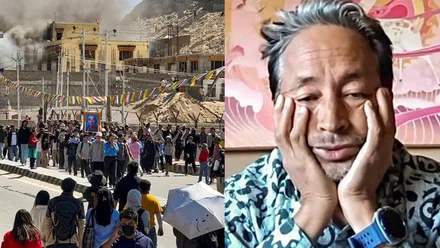
The Central Bureau of Investigation (CBI) has opened an inquiry into alleged violations of the Foreign Contribution (Regulation) Act (FCRA) by the Himalayan Institute of Alternatives Ladakh (HIAL), an institution founded by educationist and activist Sonam Wangchuk. According to NDTV Officials confirmed that the probe, launched two months ago, is scrutinising foreign funding received by the institute and is also reviewing Wangchuk’s controversial visit to Pakistan on February 6 this year. The investigation comes at a time when Ladakh is witnessing violent protests over demands for statehood and inclusion under the Sixth Schedule, and the role of Sonam Wangchuk has come under sharp scrutiny for allegedly provoking unrest.
In August, the Ladakh administration cancelled a land allotment to HIAL, sparking outrage among Sonam Wangchuk’s supporters and protest groups. While Ladakhi bodies accused the government of attempting to silence dissent, officials argued that the allotment violated regulations. The CBI’s probe into HIAL is now likely to provide crucial answers on whether foreign influence or financial irregularities contributed to the recent surge of unrest in the region.
From Hunger Strike to Violence: The Escalation in Leh
The controversy deepened after Sonam Wangchuk launched a hunger strike pressing for statehood and Sixth Schedule protections for Ladakh. His protest drew national attention, but government sources now allege that his methods were far from peaceful. Despite repeated appeals from local leaders to end the agitation, Wangchuk continued his strike and made references to Arab Spring-style uprisings and Gen Z-led protests in Nepal remarks that the Centre believes misled and inflamed local youth.
The tension exploded on September 24, when violent clashes broke out in Leh. Four people were killed and at least 80 injured, including 40 police personnel. Groups of protestors resorted to stone-pelting, arson, and vandalism, setting vehicles on fire and targeting key buildings. The headquarters of the Bharatiya Janata Party (BJP) and the Ladakh Hill Council were among the sites attacked. Police and paramilitary forces used teargas shells to disperse the mobs and restore order, but the violence left the peaceful region shaken.
Government officials directly linked the violence to Wangchuk’s rhetoric. A Ministry of Home Affairs (MHA) statement underlined that, while the government was already engaged in structured dialogue with Ladakhi groups through the High-Powered Committee (HPC), Wangchuk deliberately continued his hunger strike and invoked provocative comparisons to global protest movements. His call, according to the MHA, “guided” the mob that eventually turned violent.
Centre’s Stand: Dialogue Over Anarchy
The Modi government has maintained that it remains committed to the empowerment and welfare of Ladakh, pointing to recent achievements through structured dialogue. The MHA highlighted that the HPC mechanism had already delivered tangible results, including raising Scheduled Tribe reservation in Ladakh from 45% to 84%, introducing one-third reservation for women in local councils, granting official language status to Bhoti and Purgi, and initiating recruitment for 1,800 posts.
Government representatives emphasised that further talks were already lined up, with a high-powered meeting scheduled for October 6 and even advanced discussions being considered for late September at the request of Ladakhi bodies. Against this backdrop, the eruption of violence has been described by the Centre as both unnecessary and politically engineered. “When talks are already lined up, why was violence provoked in this peaceful place?” officials asked, underlining that the process of dialogue was yielding results before being sabotaged.
The Centre further accused certain “politically motivated individuals” of attempting to derail the peace process for personal or ideological gain. By invoking dangerous parallels to Arab Spring uprisings, Wangchuk, it said, pushed Ladakh’s youth towards confrontation instead of constructive engagement.
Political Angle: Congress and the Mob Factor
The violence has also triggered a fierce political blame game. BJP IT Cell chief Amit Malviya openly accused Sonam Wangchuk of anarchism and linked the unrest to Congress support. In a post on X (formerly Twitter), Malviya wrote: “Anarchist Sonam Wangchuk first incited mobs on 10th Sept, and with Congress’s help, he set Leh on fire on 24th Sept. His actions have been anything but peaceful. What he preaches on national TV and what he practices are poles apart.”
Government sources reinforced this view, suggesting that the situation in Ladakh did not spiral out of control on its own but was “deliberately engineered.” They pointed out that while young people participated in the protests, they were victims of misleading rhetoric and manipulation. The underlying agenda, according to these sources, was political derailing dialogue to maintain agitation and weaken BJP’s growing influence in the region.
The targeting of BJP’s Leh headquarters and the Ladakh Hill Council’s office lends weight to suspicions of a pre-planned conspiracy. Setting ablaze political party offices in a Union Territory that has seen consistent dialogue initiatives from the Centre reflects, in the government’s view, a deliberate attempt to shift focus from constructive negotiation to street-level confrontation.
Ladakh’s Path Forward: Development, Dialogue, and Stability
While protests led by the Leh Apex Body (LAB) and Kargil Democratic Alliance (KDA) have been continuing for over four years, the recent escalation marks a turning point. The government has underlined that it has consistently engaged with these bodies through both formal and informal channels. Series of HPC meetings and sub-committees were created to address their concerns. By including new members as suggested by the LAB and KDA, the government has demonstrated flexibility and inclusiveness.
At the same time, officials stress that no amount of violence or incitement can be allowed to derail Ladakh’s developmental trajectory. From increasing tribal representation to creating employment opportunities and safeguarding cultural identity, the Centre has showcased measurable progress. The administration insists that Ladakh’s youth must not be misled by personal ambitions of individuals but should instead benefit from the structured empowerment being rolled out.
Order Over Chaos
The unfolding crisis in Ladakh is not merely a story of protests gone wrong; it is a stark reminder of how provocative rhetoric can destabilize a sensitive region. With the CBI now investigating Sonam Wangchuk’s institute for FCRA violations and scrutinising his Pakistan visit, the larger question of foreign influence and political engineering looms large. The Centre’s position is clear: dialogue, development, and democratic engagement are the only legitimate paths forward.
Attempts to import templates of foreign uprisings like the Arab Spring into Ladakh not only endanger peace but also rob its youth of genuine opportunities created through structured negotiations. By standing firm against mob incitement while keeping the door open for dialogue, the government has signaled that Ladakh’s future lies not in chaos, but in constructive partnership with the Union of India