
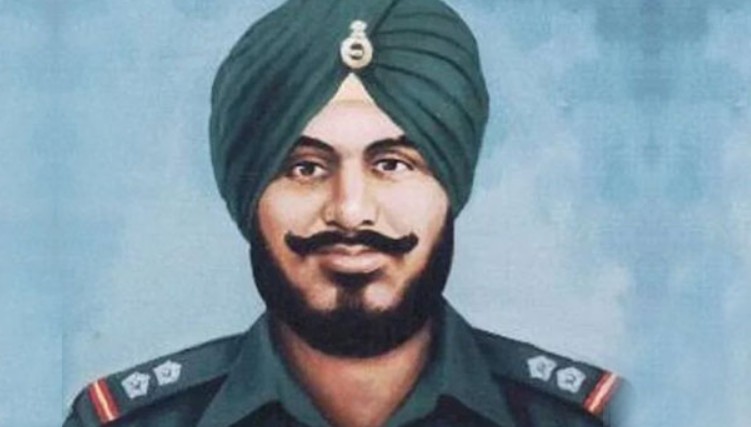
In a time of adversity, true heroes emerge not from grand speeches or polished uniforms, but from raw courage, quiet resolve, and selfless sacrifice.
As India marks the 104th birth anniversary of Param Vir Chakra awardee Subedar Joginder Singh on Friday, we remember not just a name in history, but a man who rewrote the meaning of bravery on a freezing ridge near Tongpen La, defending his motherland to his last breath.
Subedar Joginder Singh’s name is etched forever in the annals of Indian military history. Born on September 26, 1921, in the humble village of Mahla Kalan, Punjab, he went on to earn India’s highest military honour — the Param Vir Chakra — for his extraordinary valour during the Sino-Indian War of 1962.
The 1962 war with China is remembered as a dark chapter — a story of loss, misjudgment, and unpreparedness. But woven into its folds are tales of incredible courage, where men like Subedar Joginder Singh rose beyond the call of duty.
At Tongpen La near Tawang, facing a massive Chinese offensive, Subedar Joginder Singh led his 23-men platoon in what would become a legendary last stand — a tale of resistance that still reverberates through the icy ridges of Arunachal Pradesh.
The Making of a Soldier
Subedar Joginder Singh was born to Sher Singh Sahnan and Krishan Kaur, a proud farming family who instilled in him the values of hard work, humility, and honour. After completing his 10th standard, he joined the British Indian Army at just 15, enlisting in the 1st Sikh Regiment on September 28, 1936.
Serving with distinction in Burma during World War II, and later in Kashmir during the 1947-48 conflict, Joginder carved a reputation as a fearless and disciplined soldier. But it was in 1962, during the Chinese aggression, that his destiny would call.
The Last Stand at Tongpen La
As Chinese forces surged past Namka Chu, eyeing Tawang, Joginder Singh and his platoon were ordered to defend the critical IB Ridge near Bum La. With only 23 soldiers, outdated Lee Enfield rifles, no winter gear, and dwindling ammunition, the odds were starkly against them.
On the freezing dawn of October 23, 1962, the Chinese launched a three-wave attack, each consisting of over 200 troops. But Joginder Singh had anticipated this. He and his men had dug trenches, built bunkers, and studied every inch of the terrain. They let the enemy come close — then unleashed devastating fire, mowing down the first wave.
As a second wave approached, he held his ground, even as bullets tore through his thigh. Refusing evacuation, he manned a light machine gun himself, rallying his men with Sikh battle cries, “Jo Bole So Nihal! Sat Sri Akal!”
When ammunition ran out, Joginder ordered a bayonet charge, leading from the front, clashing in brutal hand-to-hand combat. The Chinese were stunned by the sheer ferocity of the Indian counterattack. But eventually, the numbers overwhelmed them.
Wounded, captured, but unbroken, Subedar Joginder Singh succumbed in Chinese captivity. Of his 23 brave men, only three survived — those he had sent back for ammunition.
Honour and Legacy
For his unflinching courage, leadership, and supreme sacrifice, Subedar Joginder Singh was posthumously awarded the Param Vir Chakra. In a rare gesture of honour, the Chinese repatriated his ashes with full military honours in May 1963, recognizing the valour of the man who had defied an army.
His citation read, “Throughout the action, Subedar Joginder Singh displayed devotion to duty, inspiring leadership and bravery of the highest order.”
Today, his memory lives on:
- A statue in Moga, Punjab
- A memorial at IB Ridge in Arunachal Pradesh
- A Shipping Corporation of India vessel named after him
- A Punjabi biopic, with Gippy Grewal portraying his life
Subedar Joginder Singh is more than a name on a medal list. He is a symbol — of duty, of resistance, of fearlessness. His battle cry still echoes across the ridges he defended, and his legacy continues to inspire generations of Indian soldiers and citizens alike.
A deeply moving and evocative inscription that pays a quiet yet powerful tribute to the brave soldiers who laid down their lives in the Eastern Sector during the 1962 India-China War, particularly at Walong in Arunachal Pradesh reads, “The sentinel hills that round us standbear witness that we loved our land. Amidst shattered rocks and flaming pinewe fought and died on Namti Plain. O Lohit gently by us glidepale stars above us softly shineas we sleep here in sun and rain.”- An inscription at Walong War Memorial in Arunachal Padesh.”
These lines — carved into stone at the Walong War Memorial — speak not only for the gallant warriors who fell in the easternmost front of the 1962 war, but for every soldier who stood tall in the face of overwhelming odds, who fought not for medals, but for duty, honour, and country.
Among them stood Subedar Joginder Singh, Param Vir Chakra, the Lion of Tongpen La, whose fearless resistance at the IB Ridge has become the stuff of legend. His legacy, like these immortal words, whispers through the misty hills of Arunachal Pradesh and echoes across the nation.