
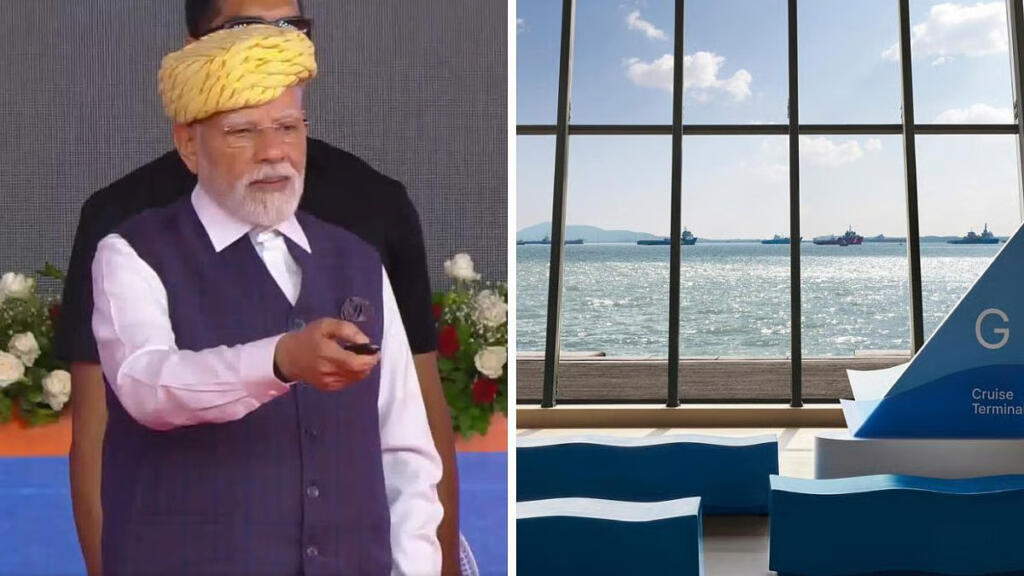
Prime Minister Narendra Modi on Saturday inaugurated the Mumbai International Cruise Terminal (MICT), a state-of-the-art maritime hub at Indira Dock, marking a defining moment for India’s cruise tourism and port-led development. The inauguration was part of a larger set of projects worth over ₹7,870 crore in the maritime sector that the Prime Minister unveiled during his visit to Gujarat’s Bhavnagar. Altogether, Modi inaugurated and laid the foundation stones of development projects worth more than ₹34,200 crore, reinforcing his government’s focus on infrastructure and self-reliance.
The Mumbai International Cruise Terminal, spread across a sprawling 4,15,000 square feet, has been built as India’s largest facility dedicated to cruise tourism. Designed as a world-class gateway for domestic and international sea travel, the MICT is not just an architectural marvel but also a symbol of India’s growing ambition to position itself as a global maritime power. With this inauguration, Mumbai is set to emerge as a prominent hub for luxury sea voyages, blending efficiency with tourism appeal and enhancing India’s soft power on the global stage.
A Landmark for Maritime Travel
The MICT represents a landmark achievement in India’s maritime expansion, developed at a cost of ₹556 crore. The four-level (G+3) complex is capable of handling one million passengers annually nearly 10,000 travellers on a single day. This massive capacity is expected to ease congestion, improve efficiency, and make India a competitive destination in global cruise tourism.
Cruise operations at the site had quietly commenced earlier in April this year when Union Minister Sarbananda Sonowal flagged off the first departures. However, the formal inauguration now signals the terminal’s central role in the government’s broader maritime strategy. By offering world-class amenities and connectivity, MICT aims to reorient Mumbai’s place in global sea travel, positioning the city alongside other international cruise hubs like Singapore, Dubai, and Miami.
The timing of this project is significant. As the global cruise industry recovers from the pandemic slump, India’s investment in large-scale infrastructure sends a strong message of readiness and opportunity. By strengthening Mumbai’s role as a central port for cruise traffic, the MICT promises to unlock economic benefits not only for the city but for India’s tourism industry at large.
Designed for Comfort, Speed, and Efficiency
The terminal has been meticulously planned to handle heavy passenger volumes while ensuring a smooth travel experience. With berthing capacity for up to five cruise liners simultaneously, the facility can handle peak-season traffic with ease. The expansive operational area, measuring 1,70,000 square feet, has been designed for year-round functioning to cater to global cruise schedules.
One of the standout features is its passenger-friendly layout. The MICT houses 72 counters for check-in and immigration, ensuring minimal wait times even during high footfall. A dedicated parking space for over 300 vehicles further enhances accessibility and convenience for travellers.
The integration of efficiency with luxury ensures that passengers experience a seamless journey from entry to embarkation. This balance between operational speed and traveller comfort sets a benchmark for maritime infrastructure in India, making MICT not just a terminal but a holistic travel experience.
Modern Architecture with Public Utility
Beyond its logistical and functional strengths, the Mumbai International Cruise Terminal stands out for its distinctive architecture. The interiors feature a ceiling designed like waves, reflecting the movement of the sea, while blue wave-designed benches complement the maritime theme. Large glass-paneled walls provide passengers and visitors with stunning sea views, adding an aesthetic dimension to the facility.
Importantly, the MICT is not limited to cruise travellers. Unlike conventional ports, the space has been envisioned as a public destination. Locals will be able to access areas of the terminal for shopping, leisure, and recreation. This inclusion transforms the terminal into a year-round attraction for Mumbai residents and tourists alike, ensuring the space remains vibrant beyond the cruise season.
By blending architecture, culture, and tourism, the MICT represents a shift in how India visualizes public infrastructure moving beyond utility to lifestyle integration. It reflects a vision where ports are not just transit points but also destinations that showcase India’s growth and creativity.
Driving the ‘Cruise Bharat Mission’
The MICT forms a core pillar of the government’s ‘Cruise Bharat Mission,’ which seeks to revolutionize cruise tourism across the country. The mission envisions expanding cruise options not just on oceans but also on rivers and island circuits, unlocking new destinations for domestic and international travellers.
Authorities project that the terminal will handle around 200 cruise ships annually, with each carrying up to 500 passengers. This expansion is expected to significantly boost India’s tourism revenues while generating employment in related industries such as hospitality, retail, and transportation.
During his address in Gujarat’s Bhavnagar, Prime Minister Modi stressed that India’s real enemy is not external powers but dependence on other countries. He reiterated the need for self-reliance (Atmanirbhar Bharat) to ensure national strength and global respect. Linking this philosophy to infrastructure, Modi highlighted that India’s ability to build world-class projects like MICT reflects its determination to reduce dependence and rise as a maritime power.
The Cruise Bharat Mission, therefore, is not just about tourism it is about asserting India’s maritime identity, strengthening economic resilience, and reinforcing the government’s agenda of Atmanirbharta.
A Turning Point for India’s Maritime Ambition
The inauguration of the Mumbai International Cruise Terminal is far more than the launch of a modern port it symbolizes a turning point in India’s maritime ambitions. By integrating world-class infrastructure with cultural aesthetics and public utility, the MICT represents the future of how India envisions its ports: as engines of growth, hubs of tourism, and icons of self-reliance.
With unmatched scale, efficiency-driven operations, and alignment with the Cruise Bharat Mission, the terminal positions Mumbai as a global cruise destination. It will not only elevate India’s visibility in international tourism but also bring tangible economic benefits through job creation, tourism growth, and maritime commerce. As the tricolour rose high over the Mumbai International Cruise Terminal on its inauguration day, the message was unmistakable India is ready to sail into a new era of maritime glory, where self-reliance, modernity, and global connectivity converge at the shores of Mumbai.