
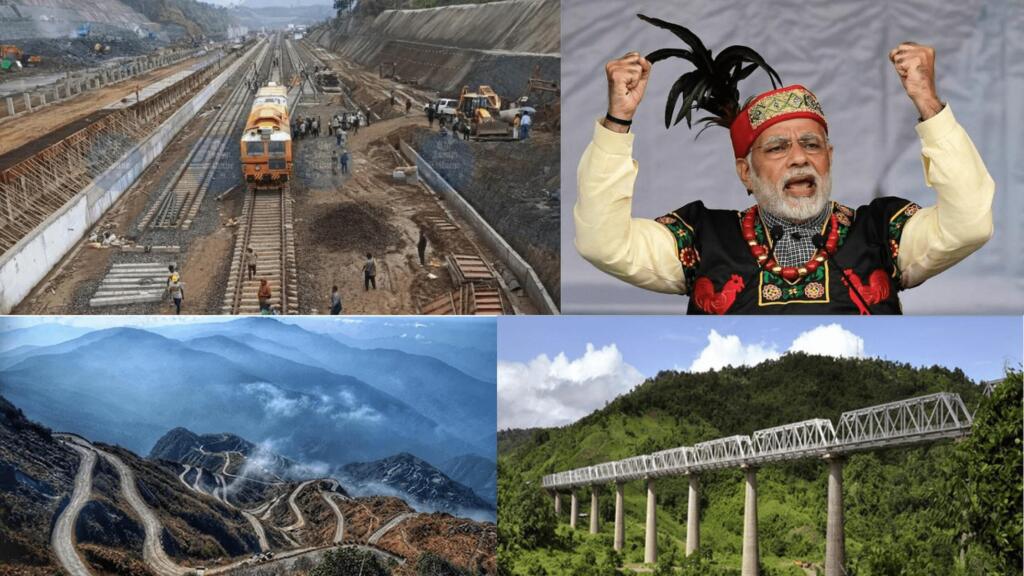
For decades, India’s Northeast was spoken of as a distant frontier rich in culture and natural wealth, but lagging in infrastructure and connectivity. The aspirations of the people of Mizoram, Manipur, Nagaland, Sikkim, Assam, Arunachal Pradesh, Meghalaya, and Tripura remained high, but development was slow to reach the hills, valleys, and border towns of this region. That story has changed decisively in the last eleven years. Under the leadership of Prime Minister Narendra Modi, the Northeast has moved from the margins to the mainstream of India’s growth story. With unprecedented investments in railways, highways, bridges, and digital networks, this region is now writing a new chapter of peace, progress, and prosperity.
Today, Prime Minister Modi is in Mizoram and Manipur, underlining his government’s commitment to carry forward the Act East vision. Speaking in Imphal, in his first visit to the violence-hit state in two years, he declared: “We have to take Manipur forward on the path of peace.” He also reminded the people that “our Imphal is the city of possibilities” and that the 21st century belongs to the Northeast. Development projects worth thousands of crores have been inaugurated and launched across Mizoram, Manipur, and Assam, strengthening infrastructure and creating opportunities for the youth. The Prime Minister’s words reflect how his government has consistently focused on integrating the Northeast with the national mainstream through connectivity and infrastructure-led growth.
Railways: Transforming the Northeast Landscape
Railways have been at the heart of this transformation. Since 2014, the railway budget allocation for the region has increased fivefold, touching ₹62,477 crore, including ₹10,440 crore for the current fiscal year. Projects worth over ₹77,000 crore are underway the highest ever investment in the region’s railway network.
A historic moment has arrived in Mizoram with the inauguration of the Bairabi–Sairang railway line, built at a cost of more than ₹8,000 crore. This 51-kilometre line connects Aizawl to the national railway grid for the first time since independence. With 143 bridges and 45 tunnels carved across some of the most difficult terrain, this project is an engineering marvel. One of its bridges is taller than Delhi’s Qutub Minar. Beyond connecting passengers, the line will improve freight movement, open new markets for Mizoram’s bamboo and horticulture produce, and generate large-scale tourism and employment opportunities.
Prime Minister Modi has also flagged off three new train services Sairang to Delhi (Rajdhani Express), Sairang to Kolkata (Mizoram Express), and Sairang to Guwahati (Aizawl Intercity) firmly putting Mizoram on India’s development map. Alongside, ongoing projects such as the Jiribam–Imphal line in Manipur, the Dimapur–Kohima line in Nagaland, and the Sevoke–Rangpo line in Sikkim are shaping a future of seamless inter-state and strategic connectivity.
The Dimapur–Zubza railway line in Nagaland, costing ₹6,663 crore, is poised to link Kohima to the national network for the first time. Once completed, it will empower thousands of tribal communities by improving access to healthcare, education, and jobs. Similarly, Sikkim’s first-ever railway line the Sevoke–Rangpo project, 44.96 km long with 14 tunnels and 28 bridges is in advanced stages. When completed by 2027, it will not only boost tourism and horticulture but also enhance the Indian Army’s logistics along the Indo-China border. These projects symbolize a historic correction: what remained a dream for decades is becoming reality in just eleven years of determined governance.
Vision and Policy: From Margins To Mainstream
The transformation of the Northeast has been powered by a clear strategic vision. Since 2014, Prime Minister Modi has emphasized “Vikas through connectivity,” making infrastructure the backbone of socio-economic upliftment. This approach has been institutionalized through flagship policies such as the PM Gati Shakti National Master Plan and the North East Special Infrastructure Development Scheme (NESIDS).
The results are visible. Capital outlay for rail projects in the Northeast has increased by over 370% from FY 2014–15 to FY 2023–24. Beyond numbers, the pace of execution has accelerated with cutting-edge engineering, tunnel-building technologies, and a determination to overcome geographic challenges. The Bogibeel Bridge in Assam, connecting to Arunachal Pradesh, stands as a testimony to this resolve.
Together, these efforts ensure that the Northeast is no longer a remote outpost but a central player in India’s growth trajectory. From tourism and trade to agriculture and defence logistics, every sector is being strengthened by these new arteries of development.
Roads, Bridges, and All-Weather Connectivity
Railways alone are not enough to bind a region as geographically diverse as the Northeast. The Ministry of Road Transport and Highways has constructed 16,207 km of National Highways in the region, transforming mobility across the hills and valleys. Projects inaugurated and foundation stones laid today include the 45 km Aizawl Bypass, costing over ₹500 crore under the PM-DevINE scheme, to ease traffic and improve connectivity around the capital city. The Prime Minister has also laid the foundation stone for the Chhimtuipui River Bridge on the Lawngtlai–Siaha Road, which will ensure all-weather connectivity, reduce travel time, and facilitate cross-border trade under the Kaladan Multimodal Transit framework.
In Assam, infrastructure worth over ₹18,530 crore has been inaugurated and launched, while in Manipur, the Prime Minister Modi has laid the foundation stone for projects worth more than ₹7,300 crore at Churachandpur. These include five National Highways, urban road networks, and drainage improvement projects, which will directly improve the ease of living for local communities.
Additionally, under the Pradhan Mantri Gram Sadak Yojana (PMGSY), 17,637 roadworks covering 89,436 km and 2,398 bridges have been sanctioned in the Northeast. Of these, 16,469 roadworks spanning 80,933 km and 2,108 bridges have already been completed. This has brought last-mile connectivity to remote villages, ensuring access to schools, hospitals, and markets.
Each road and bridge in this terrain is not merely an infrastructure project it is a lifeline connecting people to opportunities and the nation to its frontier.
A Northeast Empowered
The Northeast today is on the path of peace, progress, and prosperity. Prime Minister Modi’s visit to Mizoram and Manipur underlines the central government’s commitment not just to announce projects but to implement them on the ground. The inauguration of the Bairabi–Sairang line, the flagging off of new train services, the launch of the Aizawl Bypass, and the foundation stones laid for highways, bridges, and industrial projects are all part of a single narrative integrating the Northeast with the rest of India.
What was once a region marked by insurgency, isolation, and infrastructural neglect is now becoming a symbol of connectivity and confidence. The voices from Mizoram’s bamboo-covered hills, Sikkim’s peaks, Manipur’s valleys, and Nagaland’s villages now speak of opportunity and optimism. As the Prime Minister Modi said in Imphal, the path ahead is one of peace. With railways, highways, and bridges transforming lives, the Northeast is no longer on the margins it is at the heart of India’s Viksit Bharat vision.