
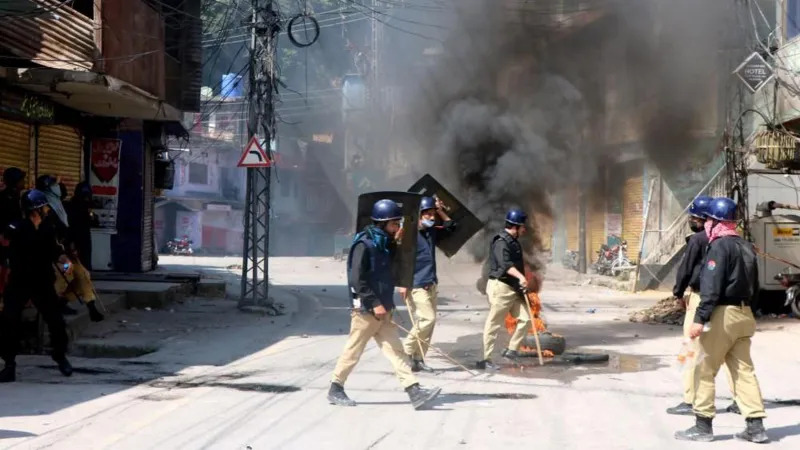
The violent protests that rocked Muzaffarabad in Pakistan-occupied Kashmir (PoK) this week, leaving two dead and 22 injured, are more than just another local agitation. They are a stark reminder of how Pakistan’s decades-long strategy of repression, coupled with its nurturing of Islamic terrorism as a state policy, has boomeranged to destabilize its own backyard. What unfolded in PoK is not an isolated incident but part of a larger pattern of systemic denial of rights, political manipulation, and militarization by Islamabad, all while exporting jihad across borders.
The Protests: A Boiling Point in PoK
The protests led by the Awami Action Committee (AAC) represent years of pent-up frustration. For over seven decades, locals have been denied basic rights, equitable representation, and economic opportunities. The demand to abolish 12 assembly seats reserved for Kashmiri refugees in Pakistan highlights the artificial structures Islamabad has imposed to control PoK’s politics.
Videos circulating online showed armed goons, reportedly backed by the Pakistan Army and the ISI-linked Muslim Conference, firing on unarmed civilians. These visuals underscore the level of state complicity in crushing dissent. In response to peaceful strikes, Islamabad chose to flood the streets with heavily armed troops, impose internet restrictions, and intimidate locals rather than engage with their grievances.
Pakistan’s Strategy of Repression in PoK
PoK has been deliberately kept underdeveloped. While Pakistan projects itself internationally as a champion of Kashmiri self-determination, it systematically denies autonomy to the very people it claims to represent. The absence of industrial investment, suppression of free media, and political engineering through puppet parties expose Islamabad’s double standards.
The protests are symptomatic of a broader reality: Pakistan uses PoK not as a self-governing territory, but as strategic real estate to further its military and ideological goals, especially its proxy wars against India.
Exporting Terror, Importing Instability
The unrest in PoK cannot be divorced from Pakistan’s long history of using terrorism as statecraft. Since the late 1980s, Pakistan’s military-intelligence complex has fostered groups like Lashkar-e-Taiba, Jaish-e-Mohammed, and Hizbul Mujahideen to infiltrate Indian-administered Kashmir and wage jihad. Training camps, radical seminaries, and terror safe havens have operated openly in PoK with tacit—or direct—support from the ISI.
This policy has had two dangerous consequences. First, it has brutalized PoK’s own society. Rather than nurturing civil institutions, Pakistan turned PoK into a launchpad for militants, bringing weapons, radical ideologies, and fear into civilian life. Second, it created a Frankenstein’s monster. Many of these terror outfits, once seen as “strategic assets,” now destabilize Pakistan itself, as seen in the recurring insurgencies and attacks in Khyber Pakhtunkhwa, Balochistan, and even Punjab.
The tragic airstrike last week in Khyber Pakhtunkhwa that killed 30 civilians is another example of Pakistan’s failure to contain militancy it once encouraged. The very militants Islamabad fostered to fight in Afghanistan or Kashmir have turned into domestic enemies, forcing Pakistan’s military into a cycle of violent crackdowns that often kill innocents rather than root causes.
However, on global platforms, no stone is left unturned by Pakistan routinely to slander India of human rights violations in Kashmir. Yet the scenes from Muzaffarabad tell a different story. Armed state-backed thugs firing on peaceful protesters, blanket internet shutdowns, and suppression of dissent are textbook examples of authoritarian repression. Islamabad’s narrative collapses under the weight of its own contradictions.
By denying democratic rights in PoK while crying foul across the border, Pakistan undermines its moral credibility. Worse, its active role in financing and sheltering Islamic terrorism discredits its claims of being a victim of extremism.
The protests in PoK may signal a tipping point. As AAC leader Shaukat Nawaz Mir warned, the agitation has multiple phases and strategies, indicating that people’s patience is running out. Pakistan’s reliance on coercion rather than dialogue risks escalating unrest into an uncontrollable uprising.
For decades, Pakistan has played a dangerous double game—subjugating its own people while exporting jihad abroad. Now, as discontent spreads in PoK and terror blowback intensifies internally, Islamabad faces a crisis of its own making.
The Muzaffarabad protests expose the rot at the heart of Pakistan’s governance model in PoK—denial of rights, militarization, and dependence on Islamist terror proxies. The violence is not merely a local disturbance but a reflection of how Pakistan’s obsession with Kashmir and use of terrorism as state policy have left its own citizens voiceless and vulnerable.
Unless Islamabad abandons its reliance on repression and proxy jihad, PoK will remain a powder keg. And sooner rather than later, the flames Pakistan has stoked abroad may consume its own fragile state structure.