
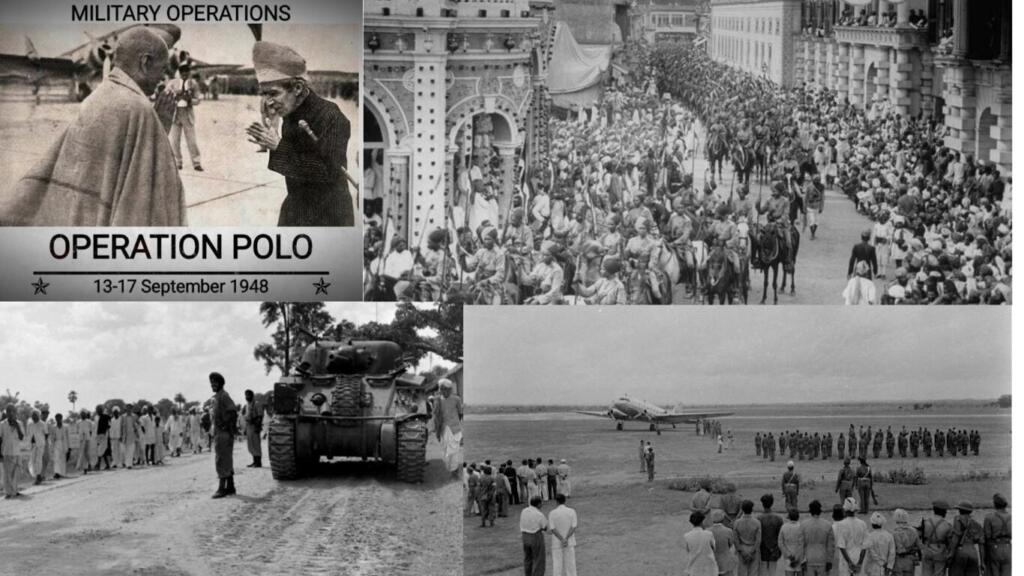
In the tumultuous years following Independence, India’s unity and survival were at stake. While the nation celebrated freedom from colonial rule in 1947, shadows loomed large over its future. The partition had already caused unprecedented bloodshed, and threats of secession from princely states posed a new challenge. At the heart of this crisis was Hyderabad, India’s largest princely state, ruled by the Nizam and terrorized by the Razakars a radical Islamist militia determined to enforce Sharia rule. It was in this moment of crisis that Sardar Vallabhbhai Patel, the Iron Man of India, rose to the occasion with Operation Polo, preventing India from being torn apart by Islamist ambitions.
The Dilemma of Princely States After Independence
When the Indian Independence Act of 1947 came into effect, the princely states were given three options: accede to India, accede to Pakistan, or remain independent. Through skillful diplomacy and negotiations led by Sardar Patel and his secretary V.P. Menon, 562 princely states joined the Union of India in less than a year. Yet three regions Kashmir, Junagadh, and Hyderabad remained unresolved.
Hyderabad was by far the most critical. Larger than the United Kingdom in size, it sat at the heart of the Deccan plateau, with immense resources and a Hindu-majority population. Its ruler, Nizam Mir Osman Ali, however, harbored dreams of carving out an independent Islamic state, completely disconnected from India’s democratic vision. This dangerous ambition, if realized, could have altered the very geography and destiny of South Asia.
The Rise of the Razakars and Islamist Terror
Although the Nizam signed a standstill agreement with India allowing New Delhi to manage Hyderabad’s external affairs and defense real power soon shifted into the hands of Qasim Razvi, a radical lawyer from Maharashtra’s Latur district. Razvi, through his political outfit Majlis-e-Ittehadul Muslimeen (MIM), raised a private army called the Razakars, numbering between 20,000 and 200,000.
The Razakars unleashed a reign of terror. Their rallying cry was “Anal Malik” every Muslim is a ruler. Hindu villages were plundered, women were raped, men were executed, and entire communities were forcibly converted. In Maharashtra alone, around 400 Hindu villages were razed; in Karnataka, hundreds of homes were burnt. Stories of brutality, like that of Nakka Andalamma raped, humiliated, and driven to suicide became seared in the collective memory of the region. The Nizam’s administration, far from restraining them, supported these atrocities with arms and money.
Sardar Patel’s Firm Stand Amid Opposition
While these events unfolded, India’s leadership was divided on how to handle Hyderabad. Lord Mountbatten, India’s last Viceroy, favored dialogue and negotiation. Prime Minister Jawaharlal Nehru too leaned toward a cautious approach, wary of international opinion. But Sardar Vallabhbhai Patel saw the danger with clarity. To him, waiting longer meant legitimizing the Razakars’ terror and risking Hyderabad becoming a second Pakistan in the heart of India.
Patel declared unequivocally that military action was the only option. His foresight was rooted not only in security concerns but in civilizational duty he knew that if Hyderabad fell to Islamist rule, it could trigger another wave of communal violence and even encourage separatist movements elsewhere. The Iron Man’s determination cut through political hesitation and set the stage for Operation Polo.
Operation Polo: India Strikes to Liberate Hyderabad
On 13 September 1948, Indian forces launched Operation Polo, named after Hyderabad’s numerous polo grounds. Commanded by Lt. General Rajendra Sinhji, the Army moved in with speed and surprise. The first clash occurred at Naldurg Fort on the Solapur–Secunderabad highway, where the poorly motivated Hyderabad State forces were quickly overwhelmed.
Indian troops advanced systematically, dismantling Razakar strongholds and securing key towns. By 17 September, just four days after the offensive began, Hyderabad’s defenses collapsed. At 5 p.m. the same day, the Nizam announced a ceasefire and agreed to merge with India. Major General Jayanto Nath Chaudhuri formally accepted the surrender of Hyderabad’s commander, Major General Syed Ahmed El Edroos.
The operation came at a cost 32 Indian soldiers were martyred but it also eliminated over 2,000 Razakars and 800 Hyderabad State troops. The swift and decisive victory sent a message: India would not compromise on its unity and sovereignty.
The Collapse of Islamist Ambitions
Operation Polo not only ended Hyderabad’s ambitions of independence but also crushed Qasim Razvi’s dream of a Sharia-ruled theocracy in India. Razvi was arrested and later exiled to Pakistan, while the Majlis-e-Ittehadul Muslimeen was banned for its extremist activities. The Nizam, stripped of his powers, was made Rajpramukh (Governor) of Hyderabad State for a limited time, his authority reduced to a ceremonial role.
Had Patel not intervened, Hyderabad could have become a base for Islamist forces in India, with catastrophic consequences. A Pakistan-backed Hyderabad in the Deccan would have created a corridor for separatism, threatening India’s integrity from within. Instead, Patel’s firmness ensured that India remained united, stronger, and secure.
The Civilizational Significance of Patel’s Victory
Beyond the military triumph, Operation Polo carried immense civilizational significance. Patel’s actions safeguarded millions of Hindus from systematic persecution and halted the spread of Islamist extremism in southern India. Hyderabad’s integration reinforced the idea that India’s unity was non-negotiable and that appeasement had no place in matters of national survival.
Even today, historians argue that Patel’s bold step prevented a “third Partition.” By securing Hyderabad, Patel ensured that India was not carved up again along communal lines. His leadership proved that firmness, not hesitation, was the key to defending dharma, dignity, and democracy.
Patel’s Legacy as India’s Iron Shield
Operation Polo remains one of the most defining episodes of post-Independence India. In just four days, Sardar Patel and the Indian Army dismantled an Islamist militia, ended the Nizam’s delusions of sovereignty, and brought Hyderabad into the Indian fold.
Patel’s legacy is not just that of a statesman who united 562 princely states, but of a civilizational guardian who refused to bow before terror or appeasement. By crushing the Razakars and saving Hyderabad, he saved India from another Partition and ensured that the nation’s destiny would be written by Indians, not by those who sought to divide it.
Seventy-seven years later, Patel’s vision and courage continue to inspire. His message remains timeless: India’s unity is sacred, its dharmic roots are unshakable, and its survival depends on leaders who dare to act decisively. Operation Polo is not just history it is a reminder that India stands strong today because men like Sardar Patel defended it with iron will and unflinching resolve.