
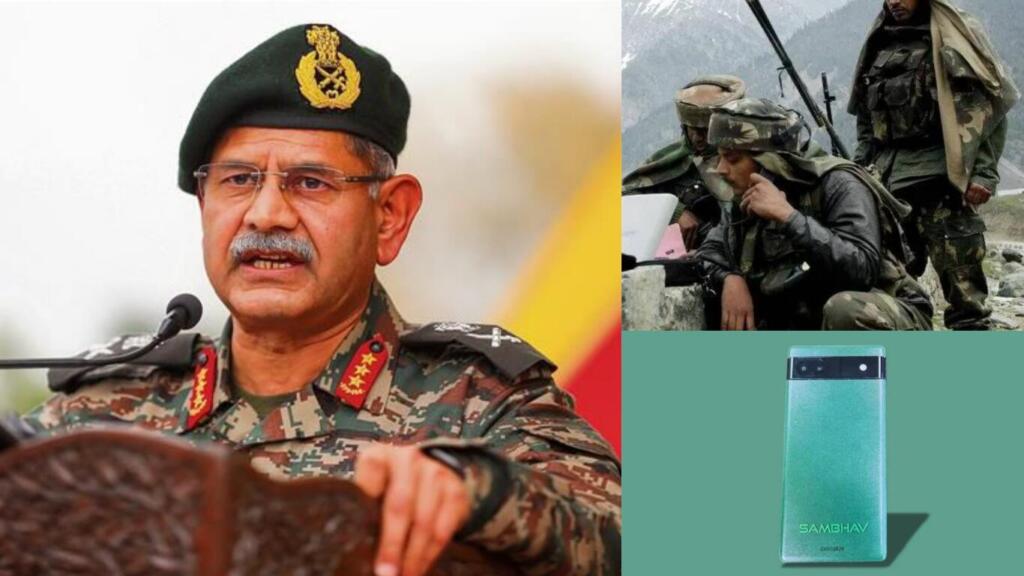
In the era of hybrid warfare, where information is as powerful as firepower, India has taken a decisive step toward technological sovereignty. During the high-profile Operation Sindoor, the Indian Army relied not on foreign apps but on its very own M-Sigma app used from SAMBHAV (Secure Army Mobile Bharat Version) smartphone. Army Chief General Upendra Dwivedi confirmed that this indigenous mobile ecosystem played a critical role in secure communication, ensuring India’s soldiers were not vulnerable to external surveillance. This is Make in India’s defence innovation at its finest where boots march with bots, and national security rests on homegrown technology.
Operation Sindoor: A Turning Point in Secure Warfare
Speaking at the 52nd National Management Convention organised by AIMA, General Dwivedi revealed how SAMBHAV replaced platforms like WhatsApp during Operation Sindoor. “SAMBHAV phones were used for command and communication. We were not using WhatsApp and others. We are now upgrading it to a higher level,” he said.
Operation Sindoor, described by the Army Chief as a “whole-of-nation effort,” demonstrated how coordinated strategy, technological readiness, and military precision together create a strong counter-terrorism shield. Scientists, policymakers, and commanders all worked hand in hand, setting a new benchmark in India’s defence preparedness.
What is SAMBHAV? India’s First Indigenous Secure Mobile System
Launched in 2023, SAMBHAV is India’s first fully indigenous, secure mobile communication ecosystem. Designed for mobility and resilience, it functions independently of network vulnerabilities and supports real-time connectivity through 5G-enabled devices. The system is layered with multi-tier encryption, ensuring that no foreign power or hostile surveillance can intercept critical information.
Its inbuilt application, M-Sigma, acts as an encrypted alternative to WhatsApp, allowing soldiers to exchange images, videos, and files securely. Unlike commercial mobile networks, which are always vulnerable to snooping, SAMBHAV guarantees a network-agnostic, fully encrypted environment. The platform was built in collaboration with Indian academic institutions and domestic tech firms, reflecting the spirit of Aatmanirbhar Bharat.
Deployed on Borders and in Diplomacy
By early 2024, nearly 30,000 SAMBHAV-enabled handsets had been distributed among Indian Army officers. Defence officials confirmed that the system was even used during the last round of military-level talks with China in October, proving that the Army’s commitment to indigenisation extends from the battlefield to the negotiating table.
This is not merely a gadget it is a weapon in the digital domain. It ensures that conversations at the highest levels of command remain immune from hacking, surveillance, or foreign interception. General Dwivedi emphasized that SAMBHAV will undergo continuous upgrades, making it future-proof in the evolving landscape of cyber warfare.
Boots with Bots, India Secures the Future
SAMBHAV is more than a mobile ecosystem it is a declaration of India’s digital sovereignty. By rejecting foreign apps and creating its own encrypted platforms, the Indian Army has ensured that no adversary can compromise its communication lifeline. Operation Sindoor proved that the future of warfare is hybrid, where technology and soldiers must fight side by side. With SAMBHAV, India has fortified its defence ecosystem and sent a powerful message: the era of dependence on foreign platforms is over, and the age of Aatmanirbhar Bharat in national security has begun.